newspapers

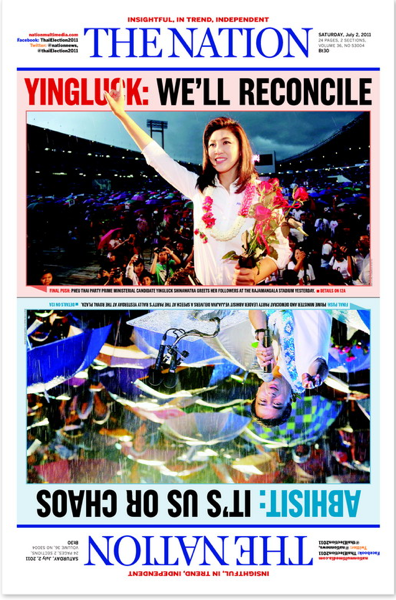
…features a unique design:

2011 07 02 nation

And here it is, rotated 180 degrees:

2011 07 02 nation2

Images via @lekasina on yfrog.

{ 0 comments }

Bangkok Post — in 3D

August 7, 2010

Given my previous dispatches pointing out interesting tidbits from the Bangkok Post, I would be remiss if I failed to note that yesterday’s edition featured 3D images. E&P explains here.1

Yesterday was the Post‘s 64th anniversary, and the paper was delivered with accompanying 3D glasses affixed to a special outer advertising supplement. 3D photos were used in the supplement as well as throughout the paper itself.

Here’s a cell phone pic:

Bangkok Post in 3D

So how did the 3D effect work? It seemed, well, fine to me — though I must say that I have never seen a newspaper in 3D, so I have nothing to which I can compare the experience.

  1. Related (kind of): On the Media‘s excellent episode, from July 16, about the future of newspapers. []

{ 0 comments }

A few non-Thailand links

December 4, 2009

Here are a few non-Thailand related links that I wanted to pass along, just quickly, before the week comes to a close:

That’s it. See you next week.

{ 0 comments }

Some links that have caught my eye of late:

{ 0 comments }

Here’s a round-up of some links that have caught my eye of late:

  • Steve Yelvington on the future of newspapers: Stop the irrational negativity: Newspapers are not dead.” And don’t miss his post about local news sites: “The three primary roles your local website should play.” (Related Newley.com post about newspapers on online journalism here.)
  • The New York Times has a great story about an Italian tourist who recently ventured to Iraq: “Falluja’s Strange Visitor: A Western Tourist.”
  • My pal Austin Bush recently posted a dispatch and some images from the town of Mae Hong Son, in Thailand’s northwest: “Screw Provence.” (More on Mae Hong Son province here.)
  • The Run of Play is my new favorite soccer blog. (It’s written by Brian Phillips, who penned the Slate story about Masal Bugduv, which I mentioned recently.) Related, fun football link: BrazilName: Create your own Brazil football shirt
  • I read a lot of James Wright‘s poetry in college. And I thought of his imagistic work the other day and began consulting The G00g. This poem is one of my favorites: “Having Lost My Sons, I Confront the Wreckage of the Moon: Christmas, 1960.”
  • Atul Gawande in the New Yorker: “Getting There from Here: How should Obama reform health care?
  • The WJS’s Weekend Journal Asia has a round-up of interesting Asia reads: “Asia’s Best Books: Our Top Picks of 2008.”

{ 0 comments }

The newspaper industry in the US is suffering, as we know. But an Indonesian billionaire thinks there’s room for another English-language paper in Jakarta. In November, James Riady launched the Jakarta Globe to compete head-to-head with the well-established Jakarta Post.

Today’s IHT has the story: “Indonesian billionaire takes on the Jakarta Post

That it is probably the worst time in history to start a daily newspaper is not, at least for the moment, on the minds of the people behind The Jakarta Globe.

The Globe, an English-language paper that hit the newsstands in November, is an unusual sight in this era of the shrinking – or disappearing – newspaper: It is a 48-page broadsheet, big enough to cover your desk when unfolded and painted head to toe in color.

The paper is backed by the billionaire James Riady, deputy chairman of the powerful Lippo Group and one of the wealthiest people in Indonesia, with interests including real estate, banking and retail.

Riady is also a budding media mogul. He owns the Indonesian business magazine Globe and is developing a Web portal and a cable television news channel.

“I think they are serious about creating a media empire, becoming the Rupert Murdoch of South East Asia,” said Lin Neumann, The Globe’s chief editor.

This snippet caught my eye, as well:

Neither The Post nor The Globe would discuss advertising revenue or circulation figures. Bayuni said The Globe had not yet cut into The Post’s circulation.

The papers’ editors, however, both pointed to Bangkok as an example of a market that has been able to sustain two English-language broadsheets, although Bangkok is a much bigger market than Jakarta. Both said they would aim at the growing Indonesian middle class – a group that is increasingly learning, working and reading in English. More than half of The Post’s readers are Indonesian, as opposed to expatriate, and The Globe, recognizing this trend, is betting on the local population to increase its market share.

And there’s this, about competition for journalists in Jakarta:

The two papers are fighting over journalists as well as readers. Finding experienced, English-speaking local journalists is not always easy here and the competition for them is high. The papers, however, are taking different approaches.

The Globe has put together a team of about 60 Indonesian reporters, recruiting from wire services like Agence France-Presse and Reuters. One of its deputy editors is Bhimanto Suwastoyo, who worked for AFP for more than 20 years and is widely considered one of the best local journalists.

The Post, on the other hand, has long been a training ground for local reporters looking to get their start in the industry. The paper offers a training program in exchange for service of as long as two years.

Often, Bayuni said, those reporters move on to more prestigious or lucrative positions. Bloomberg News employs six former Post reporters.

{ 0 comments }

It’s no secret that the American newspaper industry is in trouble.

This New Yorker article by James Surowiecki from late December summarizes some of the problems:

  1. Advertising revenue is down. Way down. Department stores and real estate advertisers have been hit hard by the economic downturn. And online ads aren’t as lucrative as print ads.
  2. Fewer people subscribe to newspapers now. Surowiecki notes that “as a percentage of the population, newspapers have about half as many subscribers as they did four decades ago — but the Internet helped turn that slow puncture into a blowout.”
  3. Newspaper companies, critics say, have failed to innovate. Surowiecki says they’ve focused on the product — the newspaper — rather than the consumer.
  4. Ironically, papers like the New York Times are actually more widely-read now than, say, 10 years ago. But revenues are down since most readers are accessing the site online, for free.
  5. For solutions to the profit problem, Surowiecki points to a foundation/nonprofit model, bailouts from rich patrons, or increased online revenues.

Where do newspapers go from here?

Here are some resources for further reading:

{ 0 comments }

Christian Science Paper to End Daily Print Edition. [NYTimes.com]

{ 0 comments }

Journalism in India

Salon.com:

Journalist seeking paycheck? Try India: As U.S. newsrooms shrivel, India’s are booming. And they’re hiring, not firing reporters and editors.

If ever there was a time to take pity on America’s journalists, this would be it.

The U.S. news industry is bleeding jobs. According to the American Society of Newspaper Editors, 2,400 journalists left newspaper newsrooms last year, either through layoffs or buyouts, leaving the industry with its smallest workforce since 1984. Circulation and revenue are falling across the country, as are share prices: Gannett, the country’s largest newspaper publisher, is seeing its stock trade at around one-third its value a year ago; the New York Times Co. is down 45 percent. Classified advertising revenues have dropped 30 percent over the last two years and the last quarter was one of the industry’s worst ever.

Just how bad can it get? The American Journalism Review’s Charles Layton recently concluded that “we may begin seeing, pretty soon, big American cities with no daily newspaper.”

So, what’s an underemployed journalist to do? Some move on to academia or cross over to the dark side of public relations. But a few forward-thinking souls are heading to a land where journalism jobs not only aren’t disappearing, but are more plentiful by the day: India.

(Thanks to A for the link.)

{ 0 comments }