Categories
Newley's Notes

Newley’s Notes 169: India Election Dates — Zuckerberg’s ‘Pivot’ — Elizabeth Warren, Trust Buster? — Ebullient Weiner Dogs

2019 03 10 india mountains

Hi, friends. Welcome to the latest edition of Newley’s Notes.

🚨 Breaking news just out from my WSJ colleague Krishna Pokharel: Indian Election Dates Set for April and May. The big picture:

India announced the rolling dates Sunday for national elections, setting the stage for the world’s biggest democracy to decide this spring whether to leave popular Prime Minister Narendra Modi and his conservative party in power.

And the details: “Elections will happen in seven stages starting on April 11 and ending May 19, with counting of votes to begin on May 23.”

šŸ“° Meanwhile, I had two stories out this week.

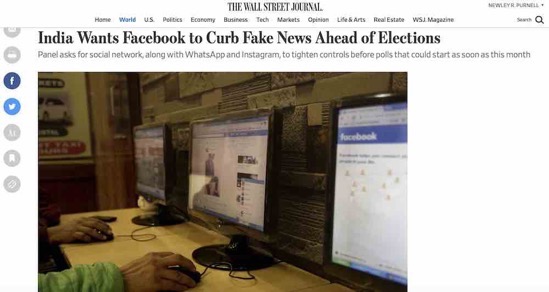
The first: India Wants Facebook to Curb Fake News Ahead of Elections. It begins:

India is pushing Facebook Inc. to do more to combat fake news ahead of coming national elections, underscoring global scrutiny on the social-media titan.

All eyes on are on social media platforms like Facebook.

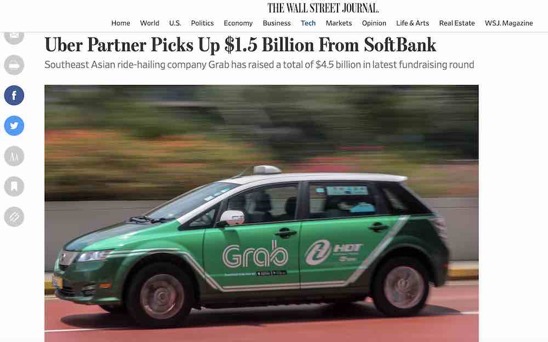
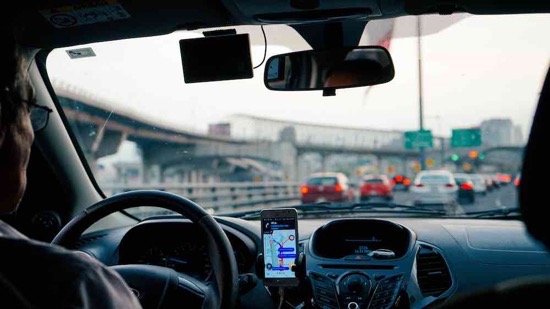
And the second: Uber Partner Picks Up $1.5 Billion From SoftBank. The lede:

Southeast Asian ride-hailing company Grab Holdings Inc. has raised $1.46 billion in fresh funding from Japan’s SoftBank Group Corp., which it will use to fuel its expansion beyond transportation services.

More moolah for Grab. Watch out, Go-Jek.

Here are ten items worth your time this week:

šŸ”® 1) Facebook Plans New Emphasis on Private Communications [WSJ]

Facebook Inc., which became the world’s biggest social network by encouraging people to share photos and messages publicly, said it is now betting on the opposite: that the future of social media lies in private messaging and small-group chats.

Our tech columnist, Chris Mims, writes:

“Nothing in Mr. Zuckerberg’s manifesto or subsequent statements question the fundamental premise of Facebook’s business, which is gathering more data about us in order to reach us with more-targeted and effective advertising.”

(On the “pivot” to private, you may recall what I wrote in NN 144 last year, when I linked to a story about a new messaging app popular with college students: “Who needs Facebook when you have WhatsApp groups?”)

āœ– 2) Elizabeth Warren says she wants to break up Amazon, Google, and Facebook [The Verge]

“The proposal is the most stringent stance taken by a candidate in the presidential campaign so far. Warren, pointing to the antitrust battle over Microsoft in the 1990s, said the companies must be broken up to stimulate competition in a monopolistic market.”

šŸ’Š 3) FDA Approves Esketamine, the First Major Depression Treatment to Reach U.S. Market in Decades [Scientific American]

“The drug is related to ketamine, a common anesthetic that’s sometimes misused recreationally. Many experts have hailed esketamine as a critical option for patients in dire need of new treatments–particularly because it might work faster than existing antidepressants.”

šŸ“ 4) The Geography of Partisan Prejudice [The Atlantic]

ā€œIn general, the most politically intolerant Americans, according to the analysis, tend to be whiter, more highly educated, older, more urban.ā€

šŸ‘“ 5) How badly are we being ripped off on eyewear? Former industry execs tell all [LA Times]

“‘You can get amazingly good frames, with a Warby Parker level of quality, for $4 to $8,’ Butler said. ‘For $15, you can get designer-quality frames, like what you’d get from Prada.’”

šŸ“ 6) The A.I. Diet [NY Times]

“Only recently, with the ability to analyze large data sets using artificial intelligence, have we learned how simplistic and naĆÆve the assumption of a universal diet is…A good diet, it turns out, has to be individualized.

āœ‹ 7) Code hidden in Stone Age art may be the root of human writing [New Scientist]

“The moment she flipped the first one, she knew the trip had been worthwhile. The X and straight lines were symbols she had seen together and separately on various cave walls. Now here they were, with the X sandwiched between two lines to form a compound character. ”

šŸ‘« 8) Couple has eaten at the same Wichita restaurant six nights a week for 15 years [The Wichita Eagle]

"‘It’s just about as cheap as going to the grocery store, buying your groceries, coming home, heating up the kitchen and doing the dishes,’ he said. ’If your time’s worth anything to you, it’s about the same as eating at home but you get a lot better service.’ā€

šŸ“– 9) African American History Books recommended by Imani Perry [5 Books]

“Bringing to light the long hidden suffering of human beings or their agency in earning freedom is a matter of urgency for me. I became a historian because I wanted to flesh all that out.”

🌭 10) What, Never saw a hotdog wiggle so much? [Reddit video] – (Thanks, Anasuya!)

Quote of the week:

šŸ’” ā€œWe are what we pretend to be, so we must be careful about what we pretend to be.ā€
– Kurt Vonnegut, “Mother Night.”

āž” Was this message forwarded to you? Sign up here.

šŸ‘Š Fist bump from New Delhi,
Newley

Categories
India Journalism

India Wants Facebook to Curb Fake News Ahead of Elections

2019 03 08facebook india fake news

That’s the headline of my most recent story, which I wrote with my colleague Rajesh Roy. It begins:

NEW DELHI—India is pushing Facebook Inc. to do more to combat fake news ahead of coming national elections, underscoring global scrutiny on the social-media titan.

A closed Indian parliamentary panel on Wednesday asked Joel Kaplan, the company’s global policy chief, to ensure the social network, its WhatsApp messaging service and its photo-sharing app Instagram wouldn’t be abused as the world’s biggest democracy goes to the polls. India’s election commission is expected to announce soon that the elections will begin in March or April.

ā€œWe discussed the challenges faced with these platforms, especially with regard to data security and citizens’ privacy,ā€ Anurag Thakur, a parliamentarian from the ruling Bharatiya Janata Party who heads the panel on information technology, told The Wall Street Journal.

Click through to read the rest.

Categories
Journalism Tech

Uber Partner Picks Up $1.5 Billion From SoftBank

2019 03 08grab

That’s the headline on a story out Wednesday that I wrote with my colleague Saurabh Chaturvedi. It begins:

SINGAPORE—Southeast Asian ride-hailing company Grab Holdings Inc. has raised $1.46 billion in fresh funding from Japan’s SoftBank Group Corp., which it will use to fuel its expansion beyond transportation services.

That brings the total from Grab’s latest fundraising round, over the past year, to more than $4.5 billion, the company said Wednesday. The SoftBank investment is through the conglomerate’s Vision Fund, which has stakes in some of the world’s most valuable tech companies.

Click through to read the rest.

Categories
Newley's Notes

NN 168: Amazon Grocery Stores; Facebook Moderator Woes; Best Personality Quiz; K9 Kenobi

Hi, friends. Welcome to the latest edition of Newley’s Notes.

"There are decades where nothing happens; and there are weeks where decades happen.ā€ – Vladimir Lenin

šŸ”® That quotation came to mind over the last few days, when we simultaneously saw:

Or, to put things in more modern parlance:

IMG 1452

Here are ten items worth your time this week:

šŸŖ 1) Amazon to Launch New Grocery-Store Business [WSJ]

“The company plans to open its first outlet, in Los Angeles, as early as the end of the year, one person said…Additional talks are under way for Amazon grocery stores in San Francisco, Seattle, Chicago, Washington, D.C., and Philadelphia, the people familiar with the matter said. The new stores would be distinct from the company’s upscale Whole Foods Market chain. ”

šŸ’» 2) The Trauma Floor: The secret lives of Facebook moderators in America [The Verge]

“Collectively, the employees described a workplace that is perpetually teetering on the brink of chaos. It is an environment where workers cope by telling dark jokes about committing suicide, then smoke weed during breaks to numb their emotions.”

šŸš— 3) Lyft’s IPO Could Start a Record Year For New Tech Listings [WSJ]

“Lyft Inc. made its IPO papers public Friday, a move that fires the starting gun on what is expected to be one of the biggest years ever for initial public offerings.”

šŸ“ 4) What’s Next For New Yorker Reporter Jane Mayer? [Elle]

“‘She’s the best investigative reporter in America,’ says Daniel Zalewski, her New Yorker editor. ‘Not the best female investigative reporter.’”

šŸ†’ 5) At Deadspin, can the cool kids of the sports Internet become its moral authority? [Washington Post]

“Deadspin is currently for sale by parent company Univision, but even as it wrestles with the uncertain economics of digital media, there is a more fundamental question for the site. The enfant terrible has grown up: Is the new version righteous or self-righteous?

šŸ”¬ 6) Genetic testing firms share your DNA data more than you think [Axios]

“Genetic testing companies that trace customers’ ancestry are amassing huge databases of DNA information, and some are sharing access with law enforcement, drug makers and app developers.

šŸ‘Ž 7) China bars millions from travel for ā€˜social credit’ offenses [AP]

“Would-be air travelers were blocked from buying tickets 17.5 million times last year for ‘social credit’ offenses including unpaid taxes and fines under a controversial system the ruling Communist Party says will improve public behavior.”

šŸ’ 8) Most Personality Quizzes Are Junk Science. Take One That Isn’t. [FiveThirtyEight]

“Meet the Big Five, the way most psychologists measure and test personality. It’s a system built on decades of research about how people describe one another and themselves. ”

šŸ˜“ 9) The Most Effective Form of Exercise Isn’t ‘Exercise’ At All [Quartz]

“Even brief sessions of 20 seconds of stair-climbing (60 steps) repeated three times a day on three days per week over six weeks can lead to measurable improvements in cardiorespiratory fitness.”

šŸ“· 🐶 10) K9 Can’t Stop Kissing His Partner During Photo Shoot [The Dodo]

“While Knach appears to be trying his best to strike an appropriately stoic and professional pose at first, Kenobi evidently had other ideas.” (Thanks, Anasuya!)

ā¤ If you received this email from a pal, sign up here.

šŸ‘Š Fist bump from New Delhi,
Newley

Categories
Newley's Notes

NN 167: My Newest Page One Story; Non-Secret Google Nest Mic; Oscars Re-Cap; Elizabeth Holmes’s ‘Wolf’

records

Hi, friends. Welcome to the latest edition of Newley’s Notes.

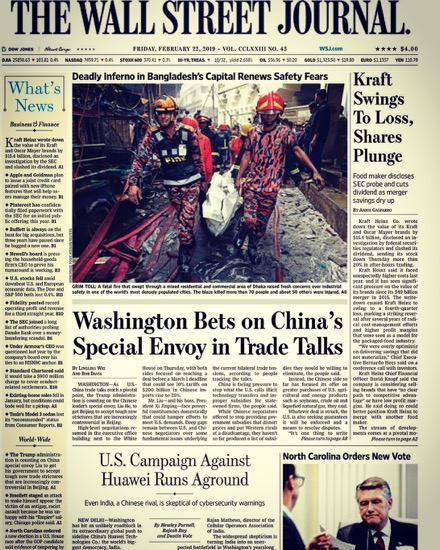
šŸ“° A story I wrote with my colleagues Rajesh Roy and Dustin Volz ran on the front page of Friday’s WSJ.

The hed: U.S. Campaign Against Huawei Runs Aground.

And the lede:

Washington has hit an unlikely roadblock in its extraordinary global push to sideline China’s Huawei Technologies Co.: the world’s biggest democracy, India.

šŸ“¶ Click through to read the rest, including details on the why the American government is trying to thwart Huawei’s expansion, what so-called 5G technologies promise, and why India’s mobile operators say they’re not buying Washington’s warnings.

Here are ten items worth your time this week:

⚠ 1) You Give Apps Sensitive Personal Information. Then They Tell Facebook [WSJ]

“The social-media giant collects intensely personal information from many popular smartphone apps just seconds after users enter it, even if the user has no connection to Facebook, according to testing done by The Wall Street Journal.”

šŸŽ¤ 2) Google claims built-in Nest mic was ā€˜never intended to be a secret’ [The Verge]

“Google has admitted it made an error when it didn’t disclose that its Nest Secure home security system included an on-device microphone.

šŸ† 3) Oscars 2019: ā€˜Green Book,’ Rami Malek and Olivia Colman Are Winners [NY Times]

“‘Green Book,’’ about a white chauffeur and his black client in segregation-era America, won best picture and two other trophies at the 91st Academy Awards, overcoming a series of awards-season setbacks and mixed critical notices.”

🧠 4) China’s CRISPR twins might have had their brains inadvertently enhanced [MIT Technology Review]

“‘The simplest interpretation is that those mutations will probably have an impact on cognitive function in the twins,’ says Silva. He says the exact effect on the girls’ cognition is impossible to predict, and ‘that is why it should not be done.’”

šŸ“‹ 5) How Letterboards Took Over America [Slate]

“Since that fateful day when the photo of Wynn went up, letterboards have transcended baby photos – and Instagram – to become something you see just about everywhere.

šŸ˜” 6) America’s Professional Elite: Wealthy, Successful and Miserable [NY Times Magazine]

“…even in a boom economy, a surprising portion of Americans are professionally miserable right now.

🐺 7) She Never Looks Back: Inside Elizabeth Holmes’s Chilling Final Months at Theranos

“Around this same time, Holmes says that she discovered that Balto – like most huskies – had a tiny trace of wolf origin. Henceforth, she decided that Balto wasn’t really a dog, but rather a wolf. In meetings, at cafĆ©s, whenever anyone stopped to pet the pup and ask his breed, Holmes soberly replied, ‘He’s a wolf.’

šŸ“8) A Detailed Map of Medieval Trade Routes in Europe, Asia, and Africa [Kottke]

“It’s not quite globalization, but many of the world’s peoples were well on their way to connecting with everyone else.”

šŸŒ‹ 9) The Perfect Shot [Twitter: @ABC]

“Yosemite National Park is again wowing visitors and photographers with its annual ”firefall“ – the moment every February when the setting sun illuminates Horsetail Fall to make it glow like a cascade of molten lava.

🌟 10) Watch: Dog Makes Amazing 83-Yard Frisbee Catch at AAF Orlando Apollos Game [SI]

“The new Alliance of American Football league is only in its third week of action and there’s already one play that should be nominated for catch of the year.

šŸ”„ If you received this email from a pal, sign up here.

šŸ‘Š Fist bump from New Delhi,
Newley
Categories
India Journalism Tech

My Latest Page One Story: U.S. Campaign Against Huawei Runs Aground

IMG 1359

That’s the headline on a Page One story I wrote with my colleagues Rajesh Roy and Dustin Volz. It ran online Thursday and in Friday’s paper.

It begins:

Washington has hit an unlikely roadblock in its extraordinary global push to sideline China’s Huawei Technologies Co.: the world’s biggest democracy, India.

Policy makers and telecommunications firms here are so far largely unpersuaded by U.S. warnings that using Huawei’s equipment to upgrade India’s telecom networks presents a major cybersecurity threat, according to more than a dozen government officials and industry executives. Many argue that any such risk is outweighed by Huawei’s cut-rate prices and technological prowess.

Click through to read the rest.

Categories
Book Notes Tech

Book Notes: ‘The Upstarts,’ by Brad Stone

the_upstarts_cover

From time to time I share notes about the books I’ve been reading, or have revisited recently after many years.

These posts are meant to help me remember what I’ve learned, and to point out titles I think are worth consulting. They’re neither formal book reviews nor comprehensive book summaries, but I hope you find them useful.

For previous postings, see my Book Notes category.

The Upstarts: How Uber, Airbnb, and the Killer Companies of the New Silicon Valley Are Changing the World

Published: 2017
ISBN: 0316388394
Amazon link

Brief Summary

A detailed account of how Uber and Airbnb – two startups that launched around the same time and took advantage of similar new technological trends – upended the taxi and hotel industries.

My Notes

  • This is the second book I’ve read by journalist and author Brad Stone. The first was “The Everything Store,” which I loved and wrote about in an earlier Books Notes entry. That book is the definitive account of how Jeff Bezos made Amazon into a global behemoth.

    “The Upstarts” focuses not on one company, but two: Uber and Airbnb. (I began reading this book in preparation for interviewing Uber’s chief executive, Dara Khosrowshahi, last month.)

  • Both Uber and Airbnb benefited from shifting technological trends. As Stone writes, both emerged just as the iPhone and the concept of apps was beginning to take hold; Facebook was growing quickly and encouraging people to “establish their identities online;” Google Maps was emerging and could be integrated by third party apps; and broadband web use was soaring, Stone notes.

  • Both “own little in the way of physical assets.”

  • Founders of both startups lacked lofty ambitions like Google (“organize the world’s information”) or Facebook (“make the world more open and connected”).

    Rather, “Camp, Kalanick and their friends wanted to ride around San Francisco in Style. Chesky and his cohorts were looking for a way to make some extra cash when a conference came to town.”

  • Beyond noting the two startups’ similarities, the book takes a straightforward approach to recounting of how both grew rapidly, encountered challenges, and then overcame them.

    The brash, ambitions, entrepreneurial, math whiz Kalanick was just what Uber needed to grow at a breakneck pace and vanquish rivals. But his personal shortfalls, Stone writes, later got the company into trouble.

    At Airbnb*, Chesky and his co-founders placed an overarching emphasis on the notion of community; they, too, faced some obstacles on their way to success.

    *The original name of the site was Airbedandbreakfast.com, which was later shortened to Airbnb. For some reason I’d always thought the name was “bnb,” for “bed and breakfast,” with an “Air” appended to it.

  • As with “The Everything Store,” which I read to better understand Amazon, I recommend “The Upstarts” if you’d like a better grasp on Uber and Airbnb, and how their early days and culture inform their current activities.

Categories
Journalism Newley's Notes

NN 164: #IndiaTechLash; Super Bowl Roundup; Slack IPO; Golden Retrievers Sledding

2019 02 12 building

Hi, friends. Welcome to the latest edition of Newley’s Notes.

āš ļø Last week I wrote a story about a trend I’ve mentioned before: India’s government pushing back against U.S. tech titans. Maybe I’ll call it #IndiaTechLash. (Got a better phrase? Hit me up.)

The hedline of a story Tues. I wrote with a colleague: Amazon, Facebook and Walmart Need to Watch Their Backs in India.” The lede:

Hoping to match China’s success at protecting and promoting homegrown tech titans, India has plans to continue tightening restrictions on Amazon.com Inc., Walmart Inc., Facebook Inc. and other foreign firms that have come to dominate the country’s budding internet economy.

⚔ And it contained this scoop (scooplet?):

The secretary of India’s Telecommunications Department, Aruna Sundararajan, last week told a gathering of Indian startups in a closed-door meeting in the tech hub of Bangalore that the government will introduce a ā€œnational championā€ policy ā€œvery soonā€ to encourage the rise of Indian companies, according to a person familiar with the matter. She said Indian policy makers had noted the success of China’s internet giants, Alibaba Group Holding Ltd. and Tencent Holdings Ltd. , the person said. She didn’t immediately respond to a request for more details on the program or its timing.

Meanwhile, remember the new e-commerce regulations I’ve written about? Well, they’ve come into effect. The hed on a story by a colleague Fri.: Products Yanked from Amazon in India to Comply With New E-Commerce Rules.

šŸ”® As they say: Watch this space.

Here are ten items worth your time this week:

šŸ’¬ 1) Slack Files to Go Public With Direct Listing [WSJ]

“The workplace-messaging company’s IPO could come as soon as this spring, people familiar with the matter have said. By the time it debuts, Slack could be valued well above $7 billion, the level at which it recently raised money. ”

šŸ” 2) Huawei Sting Offers Rare Glimpse of the U.S. Targeting a Chinese Giant [Bloomberg BusinessWeek]

“Like all inventors, Khan was paranoid about knockoffs. Even so, he was caught by surprise when Huawei, a potential customer, began to behave suspiciously after receiving the meticulously packed sample.”

šŸˆ 3) New England Patriots Win Super Bowl LIII [WSJ]

“Tom Brady did not have a signature game. New England did not light up the scoreboard. But the Patriots, a dynasty of nearly two decades that has revolutionized football as much as they have changed with it, beat the L.A. Rams 13-3 in Super Bowl LIII in a different type of barnburner that, despite a dearth of points, provided a nail-biting finish to the year.”

šŸ“ŗ 4) The Super Bowl ads you will remember [CNN]

“The most memorable spots of the night are ones for brands like Budweiser and Bumble that do not just peddle products, but also sent powerful messages about issues like diversity and women’s empowerment, which are top of mind for many Americans.”

šŸ”» 5) Super Bowl viewership sinks after a solid NFL season [Axios]

“By all accounts, Super Bowl LIII was a snoozer, and its ratings appear to reflect this.”

šŸ‘Ŗ 6) Two Sisters Bought DNA Kits. The Results Blew Apart Their Family. [WSJ]

“Sonny and Brina Hurwitz raised a family in Boston. They both died with secrets.

šŸŽ¤ 7) Fortnite’s Marshmello concert was a bizarre and exciting glimpse of the future [The Verge]

“Even if you’re not a huge fan of electronic music or have never heard of the EDM producer Marshmello, Fortnite’s live in-game concert was still a shockingly stunning sight to behold — it was also an unprecedented moment in gaming.”

āœ’ 8) A Suspense Novelist’s Trail of Deceptions [New Yorker]

“I recently called a senior editor at a New York publishing company to discuss the experience of working with Mallory. ‘My God,’ the editor said, with a laugh. ‘I knew I’d get this call. I didn’t know if it would be you or the F.B.I.‘”

šŸ“² 9) This is the most brilliant iPhone app grouping I’ve ever seen… [Twitter: @arampell]

ā„ 10) Dog video of the week: This should make your day a little happier [Twitter: @MGSniper]

Categories
India Journalism Tech

Amazon, Facebook and Walmart Need to Watch Their Backs in India

2019 02 01 india gate

That’s the headline on a story I wrote Tuesday with my colleague Rajesh Roy. It begins:

Hoping to match China’s success at protecting and promoting homegrown tech titans, India has plans to continue tightening restrictions on Amazon.com Inc., Walmart Inc., Facebook Inc. and other foreign firms that have come to dominate the country’s budding internet economy.

As hundreds of millions of people get online for the first time, and with national elections due in the coming months, Indian policy makers are upping the pressure on American rivals and changing policies to favor domestic players.

The secretary of India’s Telecommunications Department, Aruna Sundararajan, last week told a gathering of Indian startups in a closed-door meeting in the tech hub of Bangalore that the government will introduce a ā€œnational championā€ policy ā€œvery soonā€ to encourage the rise of Indian companies, according to a person familiar with the matter. She said Indian policy makers had noted the success of China’s internet giants, Alibaba Group Holding Ltd. and Tencent Holdings Ltd. , the person said. She didn’t immediately respond to a request for more details on the program or its timing.

Asked about the comments, she said in a WhatsApp message that the idea is to promote Indian companies ā€œto become global champions."

Click through to read the rest.

Categories
Journalism Tech

Uber Wants You to Catch the Bus or Train—if They Can Drive You There

2019 02 01 uber transport

That’s the headline on a story out Wed. that I wrote with my colleague Mike Cherney. It begins:

Uber Technologies Inc., fresh from disrupting the taxi industry and leaping into food delivery, is devising a new business strategy ahead of its anticipated public offering: ferrying passengers to and from mass-transit systems.

Last year, the ride-sharing giant created an internal team with a focus on partnerships with local transit officials, a shift for a company that previously had run-ins with regulators as it expanded around the globe. The move comes as Uber seeks to evolve from being primarily a taxi-like service to a wider transportation platform, offering options like electric bikes and scooters—and eventually public bus and train tickets.

The approach could generate significant revenue for Uber, if the company can convince customers to take more Uber trips to and from bus stops or train stations. Finding new revenue is crucial for the cash-burning giant, which has said it doesn’t expect to be profitable for at least three years and faces increasing competition as it plans for an IPO this year.

Click through to read the rest.