
“A song called revolution is sung.”
Spotted on my morning commute.
“A song called revolution is sung.”
Spotted on my morning commute.
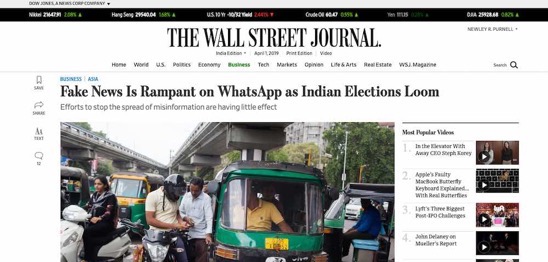
That’s the headline on my newest story, out yesterday. It begins:
NEW DELHI — In India, viral fake news is lighting up Facebook Inc.’s WhatsApp messaging app as the world’s biggest democracy prepares for national elections in the coming weeks.
Efforts by WhatsApp and the government to stop the spread of misinformation are having little effect, according to fact-checking groups and analysts.
That is a challenge for Facebook, as well as policy makers and voters grappling with digital falsehoods in India, a country of 1.3 billion people where mobile internet access has exploded in recent years.
It also provides a unique window on how Facebook Chief Executive Mark Zuckerberg’s surprising strategic shift from public postings to private messaging could play out around the world. Mr. Zuckerberg said in March that Facebook would move to a model favoring encrypted group chats like those on WhatsApp, which is popular in emerging economies including Brazil and Indonesia.
India is WhatsApp’s biggest market. Research firm Counterpoint estimates it has 300 million users, making it bigger here than Facebook. WhatsApp hasn’t released user figures since February 2017, when it said it had 200 million users in India. Since then, plummeting prices for mobile data and inexpensive smartphones have made WhatsApp the default digital town square in a country with deep societal divides.
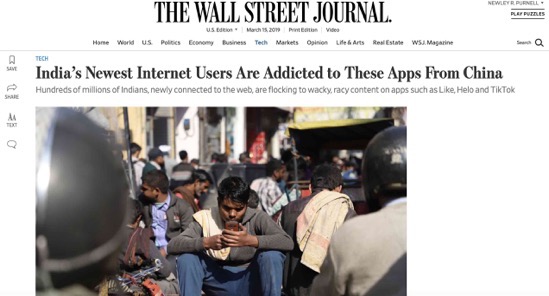
That’s the headline on my latest story, out yesterday. It begins:
NEW DELHI—Some of China’s quirkiest social-media firms are signing up hundreds of millions of consumers in India, tech’s biggest untapped market, looking to capture users who aren’t already locked into Facebook , Twitter or other American apps.
Chinese content-sharing apps such as Bigo Inc.’s Like and Bigo Live, along with Bytedance Ltd.’s Helo and TikTok, are taking off in this country of 1.3 billion, where most people are getting online for the first time using low-cost smartphones and dirt-cheap data plans. These apps, with ad-supported models, feature hours and hours of mostly wacky and often titillating content: brief videos of slapstick gags, girls blowing kisses, patriotic songs, teens twerking to the latest Bollywood hits and more.
Their simple interfaces appeal to users such as Asha Limbu, a 31-year-old from the northeastern state of Manipur who works as a housekeeper in New Delhi. In between doing housework for a middle class family, Ms. Limbu spends three hours a day on Like, scrolling through hundreds of tiny videos in a sitting and connecting with friends and strangers along the way.
“Facebook is boring,” she said. She has heard of Twitter and Instagram but never tried them.
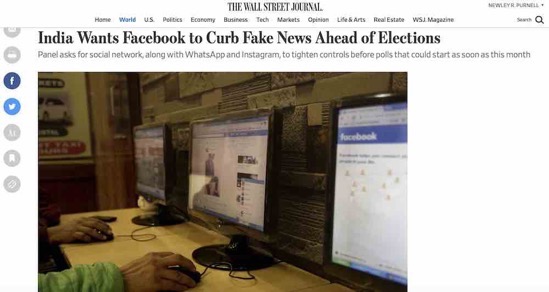
That’s the headline of my most recent story, which I wrote with my colleague Rajesh Roy. It begins:
NEW DELHI—India is pushing Facebook Inc. to do more to combat fake news ahead of coming national elections, underscoring global scrutiny on the social-media titan.
A closed Indian parliamentary panel on Wednesday asked Joel Kaplan, the company’s global policy chief, to ensure the social network, its WhatsApp messaging service and its photo-sharing app Instagram wouldn’t be abused as the world’s biggest democracy goes to the polls. India’s election commission is expected to announce soon that the elections will begin in March or April.
“We discussed the challenges faced with these platforms, especially with regard to data security and citizens’ privacy,” Anurag Thakur, a parliamentarian from the ruling Bharatiya Janata Party who heads the panel on information technology, told The Wall Street Journal.
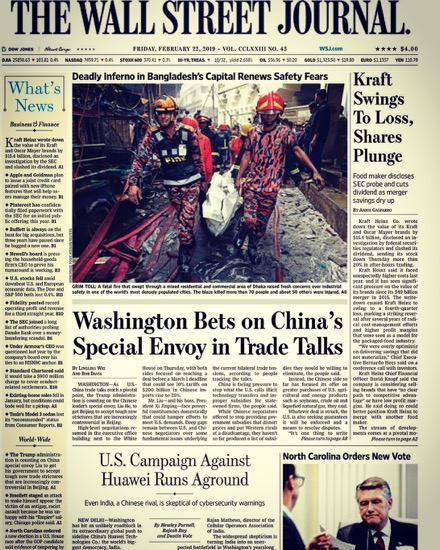
That’s the headline on a Page One story I wrote with my colleagues Rajesh Roy and Dustin Volz. It ran online Thursday and in Friday’s paper.
Washington has hit an unlikely roadblock in its extraordinary global push to sideline China’s Huawei Technologies Co.: the world’s biggest democracy, India.
Policy makers and telecommunications firms here are so far largely unpersuaded by U.S. warnings that using Huawei’s equipment to upgrade India’s telecom networks presents a major cybersecurity threat, according to more than a dozen government officials and industry executives. Many argue that any such risk is outweighed by Huawei’s cut-rate prices and technological prowess.

That’s the headline on a story I wrote Tuesday with my colleague Rajesh Roy. It begins:
Hoping to match China’s success at protecting and promoting homegrown tech titans, India has plans to continue tightening restrictions on Amazon.com Inc., Walmart Inc., Facebook Inc. and other foreign firms that have come to dominate the country’s budding internet economy.
As hundreds of millions of people get online for the first time, and with national elections due in the coming months, Indian policy makers are upping the pressure on American rivals and changing policies to favor domestic players.
The secretary of India’s Telecommunications Department, Aruna Sundararajan, last week told a gathering of Indian startups in a closed-door meeting in the tech hub of Bangalore that the government will introduce a “national champion” policy “very soon” to encourage the rise of Indian companies, according to a person familiar with the matter. She said Indian policy makers had noted the success of China’s internet giants, Alibaba Group Holding Ltd. and Tencent Holdings Ltd. , the person said. She didn’t immediately respond to a request for more details on the program or its timing.
Asked about the comments, she said in a WhatsApp message that the idea is to promote Indian companies “to become global champions."
Click through to read the rest.
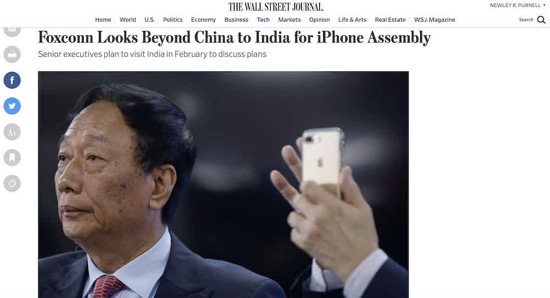
That’s the headline on a story I wrote yesterday with my colleagues Yang Jie, Yoko Kubota, and Rajesh Roy.
Apple Inc.’s largest iPhone assembler, Foxconn Technology Group, is considering producing the devices in India, people familiar with the matter said, a move that could reduce Apple’s dependence on China for manufacturing and potentially for sales.
Executives at Foxconn, a contract manufacturer that assembles a large portion of the world’s iPhones in China, are studying whether to include an India project in budget plans, one of the people said. Senior executives, possibly including Chairman Terry Gou, plan to visit India after next month’s Lunar New Year to discuss plans, the people familiar said.
Foxconn’s look at India comes as sustained friction between Washington and Beijing over trade and technology is pushing many companies to consider diversifying their supply chains away from China, a global center of assembly for smartphones, computers and other electronics.
That’s the headline on my most recent story, out Tuesday and in Wednesday’s print WSJ. It begins:
NEW DELHI— Facebook Inc.’s WhatsApp is facing pressure in India to let authorities trace and read the encrypted messages of its more than 200 million Indian users in a new attempt at constraining global tech giants.
India’s telecommunications regulator has asked for feedback on new rules that—in the name of national security—could force “over the top” services such as WhatsApp, which use mobile operators’ infrastructure, to allow the government access to users’ messages.
At the same time India’s Information Technology Ministry has proposed new intermediary guidelines that would force WhatsApp and others to trace messages and remove objectionable content within 24 hours.
WhatsApp—which has more users in India than in any other country—has “pushed back on government attempts to ban or weaken end-to-end encryption and will continue to do so,” said a person familiar with the company’s thinking.
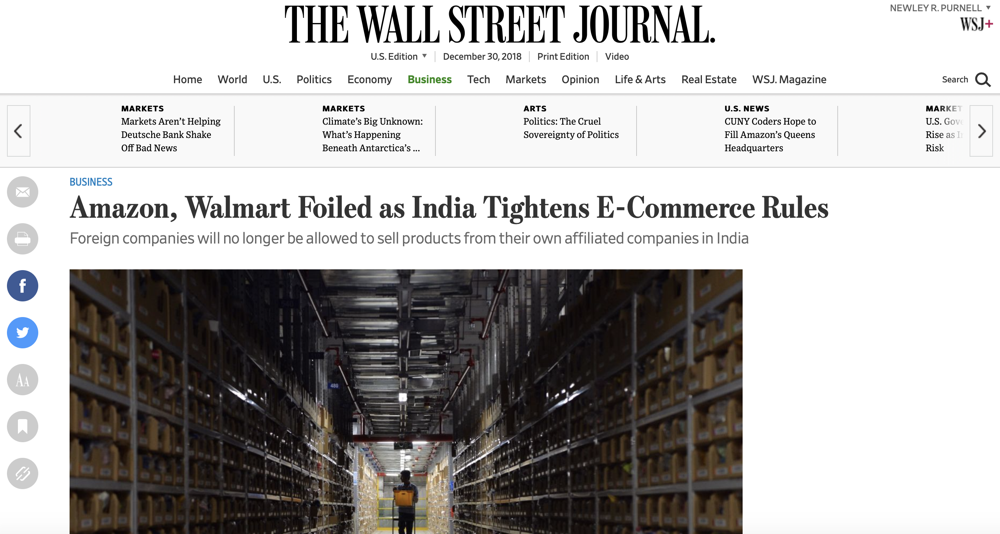
That’s the headline of a story I wrote Thursday with my colleague Corinne Abrams. It begins:
India is tightening restrictions on foreign e-commerce companies operating in the country, in a new challenge to Amazon.com Inc. and Walmart Inc. as they bet billions on the nascent market.
Current rules forbid non-Indian online sellers from holding their own inventory and shipping it out to consumers, as is typically done in other countries. Instead, the foreign sellers have found a work-around, selling online what are effectively their own products but held by their affiliated local companies.
Click through to read the rest.
We wrote more about the issue Friday in another story, which began:
American firms are plowing billions into India’s internet economy in part because, unlike China, India promised a level playing field for foreign firms to compete against local companies. Now that field may be tilting toward domestic startups amid a global backlash against U.S. tech titans, according to analysts and industry officials.
With national elections approaching early next year, India’s government said Wednesday it is tightening restrictions on foreign e-commerce players, the latest move in recent months that restrains their freedom to operate compared with local firms. The new rules present a fresh challenge to Amazon.com Inc. and Walmart Inc. as they aim for growing slices of a market where many of India’s 1.3 billion people are starting to shop online thanks to inexpensive smartphones and data.
Vinay Kesari, a Bangalore-based technology lawyer specializing in regulatory matters who has worked with U.S. tech firms, said such moves to rein in foreign tech companies have been highly unusual and may be a sign of more to come.
“I’ve never seen anything like this happening,” he said. “All bets are off at this point.”
Click through to read the rest.

Here’s the best of what I read in 2018.
As in previous round-ups, some of these titles came out this year, while others were published in years past.
Last year I noted that I’d read just two memorable novels that year. My consumption of fiction this year, sadly, has again been low.
I am always tempted to read nonfiction books related to work – India, tech, business – and I sometimes forget that in tackling both the universal and the particular, novels have a unique power. They build empathy and communicate truths in ways that sometimes nonfiction cannot. For example, take my favorite novel of the year, by Mohsin Hamid…
It succeeds as a page turner, as a thrilling rags to riches tale, as a romance, and also as a realistic look at society, money, power and corruption in South Asia.
(It is set in an unnamed country that appears to be Hamid’s home country, Pakistan, but there are many echoes of India.)
This is the first book my Hamid that I’ve read, and apparently some feel it’s not even his best. You can bet I will be reading his other works. Highly recommended. (Thanks, Michael, for the gift!)
I’d forgotten how vivid the prose is. I highlighted this sentence, about Captain Peleg, which I really loved:
“Though refusing, from conscientious scruples, to bear arms against land invaders, yet himself had illimitably invaded the Atlantic and Pacific; and though a sworn foe to human bloodshed, yet he in his straight-bodied coat, spilled tons upon tons of leviathan gore.”
Tons of leviathan gore!
Previously: