Categories
India Journalism

How Uber’s Racing to Add Drivers Here in India

India 1711211 1280

That’s the subject of my latest story, out Thursday, which begins:

NEW DELHI—How do you train a million new Uber drivers in a country where most people have never driven a car, tapped on a smartphone or even used an online map?

Uber Technologies Inc. faces that daunting task as it tries to avoid its fate in China, where it decided this year to sell its business to homegrown champion Didi Chuxing Technology Co.

The $68 billion San Francisco startup has plenty of cash and cutting-edge technology to bring to its battle in India. Also, the country hasn’t thrown up the kind of regulatory hurdles that have hindered Uber’s growth in other regions. So the company’s ability to find and teach new drivers could decide whether Uber can dominate this fast-growing market.

Click through for a video, narrated by yours truly.

I also wrote a sidebar, “5 Ways Uber Is Tweaking Its Strategy in India.

Categories
India Tech

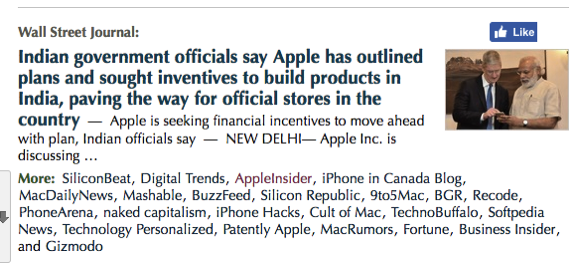
Scoop with a Colleague: Apple Is Discussing Manufacturing in India, Government Officials Say

Apple

The story, which ran Tues., begins:

NEW DELHI— Apple Inc. is discussing with the Indian government the possibility of manufacturing its products in the country, according to two senior government officials, as the company seeks to expand its sales and presence in the South Asian nation.

In a letter to the government last month, the Cupertino, Calif., firm outlined its plans and sought financial incentives to move ahead, the officials told The Wall Street Journal. Senior Trade Ministry authorities in recent weeks met to discuss the matter.

An Apple spokeswoman didn’t respond to requests for comment.

Making goods such as iPhones locally would allow Apple to open its own stores in India, helping build its brand in a country where it has less than a 5% slice of a booming smartphone market.

Our piece was followed by Reuters and picked up by many outlets:

AppleindiaTM

As I wrote on Facebook, subscribe to The WSJ to get such news before anyone else!

Categories
Newley's Notes

This Week’s Newley’s Notes: ‘Demonitization’ Back Story; Your Brain on Running; Striking Images from the Philippines

Newleys notes

Edition 75 of my email newsletter went out to subscribers on Monday. It’s pasted in below.

To get these weekly dispatches delivered to your inbox before I post them here, enter your email address at this link. It’s free, it’s fun, it’s brief — and few people unsubscribe.


Hi friends, thanks for reading Newley’s Notes, a weekly newsletter in which I share links to my stories and various items that catch my eye.

WHAT I WROTE IN THE WSJ

NEW DELHI—Early last month, Prime Minister Narendra Modi summoned his cabinet to a room in India’s capital, told them to leave their cellphones outside and delivered a shocker: He was about to go on national television to declare that almost 90% of the country’s paper money would no longer be legal tender.

The move, prepared in secret by Mr. Modi and his advisers, kicked off a radical experiment in government control and instantly put India at the forefront of a nascent global campaign against cash. The European Central Bank has said it would stop printing the €500 note in 2018. Canada and Singapore have phased out their large-denomination bills. The Philippines, Denmark and others are tweaking regulations to nudge citizens to switch to electronic payments.

But no one has gone as far as Mr. Modi. Aiming to cut back tax dodging, terrorism and government corruption, he made India’s largest bank note and one of its most commonly used ones—the functional equivalents of America’s $100 and $20 bills—unusable overnight.

I also pitched in with a sidebar about some early winners in all of this: mobile payment companies.

“If we continue at this pace, within a month or two we will have made more progress than since our inception” in 2009, the founder of one such firm, MobiKwik, told me.

For more on demonetization, as the government’s move has been labeled, a reminder that a colleague and I did a Facebook Live video not long ago, which you can find online here.

  • Facebook at 30,000 Feet? Not Above India – A story with a colleague on why, despite boasting one of the world’s fastest-growing aviation markets, India is still blocking passengers from using Wi-Fi in flight. It begins:

As more airlines roll out in-flight internet and regulators loosen rules governing wireless devices on planes, one country is a holdout in continuing to prohibit passengers from using Wi-Fi on board: India.

Home to the fastest-growing major air-travel market and a galloping economy, India hasn’t consented to the use of onboard Wi-Fi in its airspace due to security concerns.

Carriers including Emirates Airline, Jet Airways (India) Ltd. and Indian associates of Singapore Airlines and Malaysia’s AirAsia Bhd. say they are eager to offer Wi-Fi if only the government would allow it. Some have been lobbying New Delhi to change the law, according to aviation and tech industry executives.

FIVE ITEMS THAT ARE WORTH YOUR TIME THIS WEEK:

1) A remarkable, highly graphic collection of photos from Duterte’s war on drugs in the Philippines. Simply evastating: Photographer Daniel Berehulak captured for the NYT 57 killings in 35 days. A reminder of the power of visual journalism.

2) Tweetstorm: America’s institutions are screwed, Russia is hitting us hard with disinformation and leaks, but we’ll prevail. That’s the TLDR version of a super-long series of tweets from business analyst Eric Garland that everyone’s talking about on Twitter today.

3) Best Book of 2016, according to a bunch of academics, executives and others Bloomberg polled: “Hillbilly Elegy: A Memoir of a Family and Culture in Crisis,” by J. D. Vance. I haven’t read it yet, but intend to.

4) Why running seems to be good for your brain. In short, aerobic exercise appears to boost the production of cells in the hippocampus, writes Melissa Dahl at NYMag.com:

Not so many years ago, the brightest minds in neuroscience thought that our brains got a set amount of neurons, and that by adulthood, no new neurons would be birthed. But this turned out not to be true. Studies in animal models have shown that new neurons are produced in the brain throughout the lifespan, and, so far, only one activity is known to trigger the birth of those new neurons: vigorous aerobic exercise, said Karen Postal, president of the American Academy of Clinical Neuropsychology. “That’s it,” she said. “That’s the only trigger that we know about.”

5) Coolest market find ever: a piece of amber containing feathers from a dinosaur’s tail. NPR has the details:

In 2015, Lida Xing was visiting a market in northern Myanmar when a salesman brought out a piece of amber about the size of a pink rubber eraser. Inside, he could see a couple of ancient ants and a fuzzy brown tuft that the salesman said was a plant.

As soon as Xing saw it, he knew it wasn’t a plant. It was the delicate, feathered tail of a tiny dinosaur.

“I have studied paleontology for more than 10 years and have been interested in dinosaurs for more than 30 years. But I never expected we could find a dinosaur in amber. This may be the coolest find in my life,” says Xing,

Thanks for reading.

Love,
Newley
Categories
India Journalism

Delhi Snapshot: Think Your TV Job is Tough?


Spare a thought for this local reporter I saw doing a (rather crowded) live shot the other day. I count more than 15 people, not counting the journalist, in the frame. 

That cannot have been been easy, but she seemed totally unflustered. 

Categories
Newley's Notes

In This Week’s Newley’s Notes: Our India ‘Demonetization’ Video; Best Books and Albums of 2016; Chapecoense’s Final Flight

Newleys notes

Edition 74 of my email newsletter went out to subscribers yesterday. It’s pasted in below.

To get these weekly dispatches delivered to your inbox before I post them here, sign up at this link. It’s free, it’s fun, it’s brief — and few people unsubscribe.


Hi friends, thanks for reading Newley’s Notes, a weekly newsletter where I share my stories and links to items that catch my eye.

WHAT I WROTE IN THE WSJ

Morgan Stanley Fund Cuts Valuation of Its Holding in India’s Flipkart. The story begins:

A Morgan Stanley investment fund has reduced the valuation of its holding in Flipkart Internet Pvt. by 38%, as India’s leading e-commerce firm faces increased competition from U.S. rival Amazon.com Inc. and others.

In a U.S. regulatory filing this week, the Morgan Stanley Select Dimensions Investment Series fund said for the quarter ended Sept. 30, it held 1,969 Flipkart shares, which it valued at $102,644, or $52.13 a share.

Meanwhile, on a separate topic, a colleague and I recorded a Facebook Live video on India’s “demonetization,” the government’s move to eliminate its biggest-denomination bills. Watch it on the WSJ Facebook page here; the video has been viewed more than 65,000 times.

WHAT I WROTE AT NEWLEY.COM

Top Lesser-Known (but Good) Sci-Fi Movies of 2016

On the Importance of Reading Books to Understand the World

Why We Gain Weight Over the Holidays

FIVE ITEMS THAT ARE WORTH YOUR TIME THIS WEEK:

1) Can a lowly reporter become an Instagram star? Bloomberg’s Max Chafkin embarked on a humorous quest to become an “influencer,” commanding cash for his posts:

The plan, which I worked out with my editor and a slightly confused Bloomberg Businessweek lawyer, was this: With Saynt’s company advising me, I would go undercover for a month, attempting to turn my schlubby @mchafkin profile into that of a full-fledged influencer. I would do everything possible within legal bounds to amass as many followers as I could. My niche would be men’s fashion, a fast-growing category in which I clearly had no experience. The ultimate goal: to persuade someone, somewhere, to pay me cash money for my influence.

2) People are really into boring video games in which they drive tractors and trucks. A look at why people play games with titles like “Farming Simulator 17” and “American Truck Simulator.”

3) Meta-list: Best Books of 2016. Jason Kottke has a round-up of the year’s top releases.

4) The 100 best albums of 2016. A list compiled by music writer Ted Gioia.

5) The story behind Chapecoense’s tragic final flight. This heartbreaking WSJ story explains how the Brazilian championship contenders came to be flying on the charter plane headed to Colombia, and why it went down.

Thanks for reading.

Love,
Newley

P.S. If someone forwarded you this email, you can subscribe here.

Categories
Movies

Top Lesser-Known (but Good) Sci-Fi Movies of 2016

Gizmodo has a list of good sci-fi films you might have missed this year.

The only one I’ve seen here is “Midnight Special,” which I thought was solid but not earth-shattering.

I must say I was surprised to see “Swiss Army Man,” which I mentioned back in April, listed here. I just couldn’t get past the trailer. But maybe it’s worth a watch?

Categories
India Tech

By Me and a Colleague Yesterday: Morgan Stanley Fund Cuts Valuation of its Flipkart Holding

The story begins:

MUMBAI—A Morgan Stanley investment fund has reduced the valuation of its holding in Flipkart Internet Pvt. by 38%, as India’s leading e-commerce firm faces increased competition from U.S. rival Amazon.com Inc. and others.

In a U.S. regulatory filing this week, the Morgan Stanley Select Dimensions Investment Series fund said for the quarter ended Sept. 30, it held 1,969 Flipkart shares, which it valued at $102,644, or $52.13 a share.

For the preceding quarter, the fund—part of Morgan Stanley Investment Management, the company’s asset management division—reported the same number of shares in the startup, but valued them at $165,967, or $84.29 a share

In a statement, a Flipkart spokeswoman said the Morgan Stanley fund’s markdown was a “purely theoretical exercise” that is “not based on any real transactions.”

Related posts/stories:

By Me on Friday: How Amazon Has Taken India by Storm

Video: Me on Facebook Live Talking about Our Recent Amazon Story

Categories
Economics India

Facebook Live Video: A Colleague and I Discuss Demonetization in India

Embedded above and on The WSJ Facebook page here: A colleague and I earlier this week discussed India’s demonetization — the government’s sudden decision to eliminate its biggest bills.

Categories
Books

On the Importance of Reading Books to Understand the World

Will Schwalbe, in a WSJ Saturday essay called “The Need to Read”:

We need to read and to be readers now more than ever.

And:

Books are uniquely suited to helping us change our relationship to the rhythms and habits of daily life in this world of endless connectivity. We can’t interrupt books; we can only interrupt ourselves while reading them. They are the expression of an individual or a group of individuals, not of a hive mind or collective consciousness. They speak to us, thoughtfully, one at a time. They demand our attention. And they demand that we briefly put aside our own beliefs and prejudices and listen to someone else’s. You can rant against a book, scribble in the margin or even chuck it out the window. Still, you won’t change the words on the page.

The technology of a book is genius: The order of the words is fixed, whether on the page or on the screen, but the speed at which you read them is entirely up to you. Sure, this allows you to skip ahead and jump around. But it also allows you to slow down, savor and ponder.

And a passage that especially resounded with me:

So I’m on a search—and have been, I now realize, all my life—to find books to help me make sense of the world, to help me become a better person, to help me get my head around the big questions that I have and answer some of the small ones while I’m at it.

I know I’m not alone in my hunger for books to help me find the right questions to ask, and find answers to the ones that I have. I am now in my mid-50s, a classic time for introspection. But any age is a good age for examining your life. Readers from their teens to their 90s have shared with me their desire for a list of books to help guide them.

In a word: yes.

The essay is excerpted from Schwalbe’s new work, “Books for Living,” which comes out next month.

Categories
Life

Why We Gain Weight Over the Holidays

Stephan Guyenet, an obesity researcher whose work I’ve linked to in the past, on why we tend to get fat over Thanksgiving and Christmas:

Thanksgiving is a special time in the United States when we gather our loved ones and celebrate the abundance of fall with a rich palette of traditional foods. Yet a new study suggests that the 6-week holiday period that spans Thanksgiving, Christmas, and New Year’s Eve accounts for most of our country’s weight problem (1). Understanding this fact, and why it happens, gives us powerful insights into why we gain weight, and what to do about it.

The human brain is the product of millions of years of survival in the face of scarcity, and it has a number of hard-wired tricks up its sleeve that helped us stay alive in the world of our distant ancestors. One of these is an important function called reward, which mostly whirrs away below our conscious awareness. In a nutshell, every human brain is wired with specific motivations that help us seek the things that are good for us, including physical comfort, sex, social interaction, water, and of course, food (3). But not just any kind of food: the brain isn’t wired to make us crazy about celery sticks and lentils, but rather to seek concentrated sources of fat, starch, sugar, and protein that would have met the rigorous demands of ancient life (4, 5, 6). In everyday experience, we feel cravings as we smell turkey roasting in the oven, or see a slice of pumpkin pie obscured by a generous dollop of whipped cream. This craving, along with the enjoyment we feel as we eat delicious foods, is the conscious manifestation of reward.

Click through for more info, and steps to help curb holiday weight gain.