Categories
Thai politics Thailand

WSJ: “Thaksin Seeks Probe of Thai Street Protests”

WSJ:

Former Thai leader Thaksin Shinawatra’s lawyers Monday said they have filed a petition to the International Criminal Court in the Netherlands to investigate the way Thailand’s security forces suppressed massive street protests in the Thai capital last year. The move could embarrass the country’s army-backed government and further fray nerves in a country still coming to terms with the extent of last May’s violence, in which 91 people were killed and hundreds more injured.

It’s unclear whether the court will accept the petition; Thailand isn’t one of the 144 members of the International Criminal Court at the Hague. Some analysts portrayed the petition as a way to seek to invigorate a fresh round of antigovernment protests in Bangkok or otherwise generate publicity for Mr. Thaksin, a former prime minister deposed in a 2006 coup.

Categories
Thai politics Thailand

One year ago today

— AFP today: “Thai government, army deny coup claims.”

Bangkok Post today: “Suthep brushes aside coup claim.

The Nation today: “Isoc denies coup plot

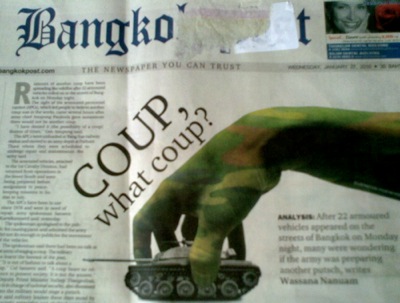
One year ago today — Jan. 27, 2010 — this was the Bangkok Post‘s front page:

bkk_post_coup_rumors.jpg

No larger point to mention at the moment — political uncertainties obviously remain here in Thailand — but just wanted to note this, for the record.

Categories
Thai politics Thailand

Economist on yellow shirt protests

preah_vihear.jpg

From The Economist:

Thailand’s nationalist protesters: Yellow badge of courage:

YELLOW polo shirts? Check. Plastic hand clappers? Check. Nationalist banners? Check. And so the supporters of the right-wing People’s Alliance for Democracy (PAD) once again took to the streets of Bangkok on Tuesday, ready to stand up to a treacherous government. In the past, the PAD staged marathon protests against the former prime minister, Thaksin Shinawatra, and his allies. They claim credit for toppling two elected governments in 2006 and 2008, though on both occasions the army or the courts delivered the coup de grâce.

This time their fire is directed at the current prime minister, Abhisit Vejjajiva, who is accused of betraying the nation along its border with Cambodia…

(Image: Economist, via Wikimedia Commons.)

Categories
Bangkok Thailand

Tilt-shift Thailand video

Here’s a cool Thailand video (embedded below) by Joerg Daiber. The tilt-shift technique gives the various scenes an interesting, miniature-like quality.

Toy Thailand from joerg on Vimeo.

(Via CNNGo.)

Categories
Thai politics Thailand

Social media and Thailand’s red shirt protests

Note: This post contains a story I wrote for the fall, 2010 issue of Dateline, the magazine of the Foreign Correspondents’ Club of Thailand. I am reproducing the article here with the club’s permission. I have added images and links to various Web sites, but the text remains the same.

Social media and Thailand’s red shirt protests
By Newley Purnell

While covering Bangkok’s anti-government red shirt protests during April and May, Associated Press journalist Thanyarat Doksone read a report on Twitter from a Thai radio station saying that the demonstrations had spread to the Asoke area of the Thai capital. 

twitter.png

She was in a different part of town, so the Lampang native typed a message to her own “followers” on the microblogging service to see if any of them could confirm the development. But it turned out not to be true. One of her followers was in the area, noted that all was quiet — and even posted an image to prove that there was no unrest of note.  

The episode underlines a changing communications ecosystem: As in other countries where news is breaking, tech-savvy residents in Thailand used a variety of outlets to stay abreast of the rapidly developing events during the red shirt demonstrations.  

As in years past, people who wanted to follow the unrest could read newspaper reports, watch the events on TV, listen to the radio, and speak with friends and family. But this spring, unlike during previous bouts of political instability, Thailand residents increasingly took advantage of social media outlets like Twitter and Facebook to share and collect information about what was happening around them. 

Twitter’s world-wide rise has been rapid. When ousted Prime Minister Thaksin Shinawatra was overthrown in a military coup in 2006, Twitter’s three founders in the U.S. had just launched the service. Now, four years later, the company says the site receives 190 million visitors per month, and an astounding 65 million Twitter messages, or tweets, are sent out every day.

2011-01-21_abhisit_twitter.tiff

Prominent figures in Thailand who have Twitter accounts include Prime Minister Abhisit Vejjajiva (112,000 followers), Finance Minister Korn Chatikavanij (41,000 followers), and Nation editor Sutichai Yoon (83,000 followers). And of course, much to the government’s chagrin, former Prime Minister Thaksin (114,000 followers) — or one of his aides — posts frequent snippets during his many travels.

Around the world, critics dismiss the service’s 140-character-or-less bursts as shallow and irrelevant. After all, goes the saying, do we really care what you had for breakfast? But Twitter, increasingly, has political implications. 

In June 2009, the service was used inside and outside Iran to share information about events on the ground following President Mahmoud Ahmadinejad’s controversial election. Amid media censorship inside Iran, the U.S. State Department even asked Twitter to continue operating rather than shut down briefly for scheduled maintenance.

Here in Thailand, Mark MacKinnon, East Asia correspondent for Canada’s The Globe and Mail newspaper, says that Twitter helped him in reporting the red shirt protests by allowing him to gather information from a wide variety of outlets. He used the service to take the temperature in various parts of town, and found that his postings allowed him to preserve — and publish — bits of local color throughout the day that might otherwise have been confined to his notebook. His newspaper even ran collections of his running tweets, providing a compelling narrative for global readers as events developed here. 

Twitter would also play a more serious role during MacKinnon’s time in Bangkok. He was caught in the city’s Wat Pathum temple while reporting the military crackdown on May 19. MacKinnon was with Andrew Buncombe, a journalist for London’s Independent newspaper, when Buncombe was shot and injured after the temple came under fire. Neither Buncombe nor the other wounded civilians trapped inside were able to exit.

After calling embassies and hospitals, MacKinnon used Twitter to ask for help in urging authorities to stop the gunfire so that the injured could be evacuated. “People around me are dying because they can’t get to hospital across the road because of fighting,” he tweeted, along with a photo of some of the injured. 

The message was relayed, in turn, by his followers, and the dispatches were even posted on the Web site of London’s Guardian newspaper. Twitter “helped raise the volume,” he says, and “deserves some of the credit” in bringing about a resolution. 

Jon Russell, a Saraburi-based freelance journalist who publishes a popular blog about social media in Asia, notes that people had used Twitter in Thailand in years past, but that the service grew in popularity during the red shirt protests. Journalists and news outlets began using Twitter, embracing the “real time potential of the service in a way that had never been done before in Thailand.” 

2011-01-24_fb.png

Russell notes that Facebook, too, has grown rapidly in the Kingdom, and that Thailand is among the top five fastest-growing Facebook markets globally. He says that while Twitter users tend to be open to debate, due to its closed nature, Facebook interactions can be more one-sided.

Eric Seldin, a veteran cameraman who runs Bangkok’s Thaicam Production Services, posted his observations and images to Twitter throughout the red shirt protests. His followers grew from approximately 400 to 800 within just a week, he says, as people increasingly craved information about the events unfolding in Bangkok. Seldin even used the service to guide a German camera crew with whom he was working. He could monitor events throughout the city, using Twitter as “original raw sourcing, and then double and triple confirming,” he says. “I could use Twitter as a clearinghouse.” 

He adds that the transparent nature of the service allowed users to quickly verify who was trustworthy and who wasn’t. Media might report one version of events, but individuals could quickly post images, videos, or text accounts — in real time — that refuted or supported these descriptions. “When there was misinformation” from the media or individuals, “people called them on it,” he says.

Richard Barrow, a prolific blogger who lives in Samut Prakarn and runs a network of Thailand-related Web sites, shared numerous images and accounts during the protests with his more than 5,000 followers. During the unrest, “Twitter provided us with a much faster and efficient source of breaking news,” he said in an email. “Literally. What is better than a someone on the scene taking pictures and uploading them onto Twitter and Facebook?” He adds that Thailand’s newspapers may have political biases, whereas so-called “citizen journalists” often do not.

After noticing that local papers weren’t keeping up with the rapidly developing events in Bangkok, Barrow even created a Google Map he labeled “Bangkok Dangerous.” He plotted on it, in English, locations where protests and clashes were taking place. He updated it frequently, and the guide ultimately filled a void: It has been viewed some 2.7 million times to date, he says.

2011-01-24_map.jpg

To be sure, Twitter and Facebook have their drawbacks. Reliability is one issue. Few people would use such services for their sole sources of information, and most regard them as a supplement to products of traditional journalism. Still, it’s clear to those who use Twitter, especially, that — just as in every other facet of life — some people inspire trust, while others do not. Readers — and those doing the tweeting — must proceed with caution.

Another risk is political polarization and the temptation to be more rude online than one would be in public. MacKinnon notes that social media tends to allow people to act differently toward others than the might otherwise. During the protests, he noticed exchanges on Twitter that included “things people wouldn’t say if they saw each other in the street.” he says. “People were being hateful.”

In addition, in a world of shorter attention spans and ever-proliferating media, there is another challenge to journalists: Twitter is yet another information stream to be monitored. And this leads, quite simply, to more work. 

Thanyarat says that Twitter can be quite helpful, “but it also adds the burden of fact checking.” she says. “You have to get through the noise to get at what’s really useful. And in a way it adds to your tasks.”

Categories
Thai politics Thailand

NYT/IHT: “Thai Inquiry Into Violence Falters”

Powerful story in the NYT/IHT today:

Thai Inquiry Into Violence Falters

BANGKOK — A zookeeper was shot and killed as he was leaving work. An antigovernment demonstrator who sought shelter in a Buddhist temple was shot five times but lived, possibly because a coin in his satchel deflected a bullet. A soldier who rushed to help a fallen comrade after an explosion suffered severe brain damage from a second blast.

The tales of the dead and wounded from the political violence last year in Bangkok could fill volumes. But they are not filling case dockets in the Thai courts.

Eight months after troops swept through Bangkok and dislodged protesters from their barricaded encampment, investigations into who was responsible for about 90 deaths and nearly 2,000 wounds have faltered.

Don’t miss the accompanying photos, “Portraits of the Wounded.”

Categories
Thailand

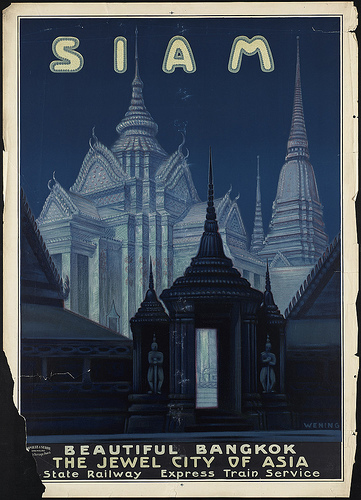
Vintage Thailand travel poster

UPDATE — April 7, 2011: Here’s a polished version of the poster.

2011-01-18_siam_travel.jpg

Here’s a very cool, vintage Thailand travel poster from the Boston Public Library. Caption: “Siam. Beautiful Bangkok, the Jewel city of Asia.” “Date issued: 1910-1959 (approximate).”

From the library’s Travel Posters collection, which contains some real gems.

(Via @babyfishie.)

Image: Boston Public Library, on Flickr.

Categories
Sports Thailand

Could ASEAN bid for the World Cup? (cross posted to Siam Voices)

Note: This post originally appeared on Siam Voices, a collaborative Thailand blog at Asian Correspondent. I have added an update.

2011-01-18_asean-2030.jpg

Yesterday’s Bangkok Post:

Asean kicks around plan to host World Cup

Asean foreign ministers have agreed to propose to the grouping’s leadership that the region host the World Cup in 2030 as a group, diplomatic sources say.

The foreign ministers, who are meeting in Lombok, Indonesia, would submit a formal and detailed plan for approval by the Asean leaders when they meet in Jakarta on May 7 and 8.

The idea of the region jointly hosting the World Cup in 2030 was first proposed by Malaysia at the annual foreign ministers’ meeting in Hanoi in July last year.

Yesterdays’s Jakarta Post:

2030 World Cup in ASEAN? Why not?

In an attempt to boost integration among its people, ASEAN will propose to FIFA that the 10 member countries jointly host the 2030 soccer World Cup.

Foreign ministers of the ASEAN countries — Indonesia, Malaysia, Thailand, the Philippines, Singapore, Brunei, Cambodia, Vietnam, Laos and Myanmar — gathered here Sunday for a retreat meeting agreed to table their candidacy this year to jointly host the world’s biggest sporting event.

As we know, the 2014 World Cup will be in Brazil. Then it’s Russia for 2018 and Qatar in 2022.

A few thoughts:

1. Southeast Asia is geographically large, and — as touched upon in the Jakarta Post item — travel between countries as far-flung as Indonesia, Brunei, and the Philippines presents logistical challenges.

2. If a bid were to materialize, would the FIFA Executive Committee be put off by political instability here in Thailand — a country at the heart of the region, and perhaps ASEAN’s biggest tourist draw? Or perhaps tensions will have eased by then? What about Myanmar, as a member of ASEAN? Would Myanmar host matches?

3. Infrastructure in Southeast Asia is lacking. The Bangkok Post story says: “By the time the international football association, Fifa, decides on the 2030 World Cup host, all Asean capitals are expected to have built international standard sports and football stadiums, said one of the sources.”

I would be interested to hear more about these plans.

4. Speaking of FIFA’s executive committee, what about the fuss over Thailand’s Worawi Makudi and England’s failed World Cup bid? Would England support an ASEAN bid, given Thailand’s failure to deliver for the Three Lions?

5. This is not the first time the idea has been floated, as the Bangkok Post piece notes. The Post ran this shot Oct., 2009 item: “Asean eyeing to host World Cup.”

6. Interestingly, there is already an ASEAN 2030 Facebook group that has been “liked” by 478 people. It contains this interesting passage, which seems to encapsulate the “why not?” spirit that would presumably need to be part of any potential bid:

The astounding decision last week by FIFA, the world’s football federation, to award Russia and Qatar to host the World Cup in 2018 and 2022 respectively gives hope that ASEAN should seriously aspire, as a Community, to host this quadrennial sporting event, with the largest worldwide audience, in 2030.

Image: ASEAN 2030 Facebook page.

UPDATE: January 18 — The Bangkok Post has a new story today: “Worawi: Joint Asean World Cup unlikely.” There’s also this piece, “A kicking idea: using sport to forge an Asean identity.”

Categories
Bangkok Thailand

Thailand street fashion blog: Siam Stylista

2011-01-13_ss.jpg

Those who enjoy street fashion blogs like The Sartorialist may be interested in a new-to-me blog called Siam Stylista.

(Image: Siam Stylista on Flickr.)

Categories
Bangkok Thai politics Thailand

Two takes (one satirical) on the ongoing red shirt protests at Rajaprasong

In the wake of Sunday’s rally, two different takes — one a news account, the other a sendup — on the ongoing red shirt protests at the Rajaprasong intersection.

First, from today’s Bangkok Post:

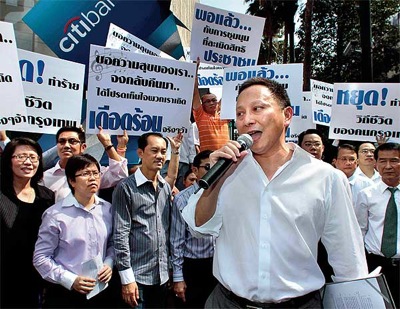
Red shirt rallies are making us broke, say angry retailers

2011-01-12_bkk_post_raj.jpg

Business operators, vendors and residents at the Ratchaprasong intersection have urged the government to regulate political gatherings, complaining that the shopping malls and other businesses in the area were being badly hit by the red shirt rallies.

About 2,000 business operators, vendors and employees yesterday gathered in front of Gaysorn Plaza shopping centre at 11.30am to oppose the use of Ratchaprasong intersection as a protest venue.

Putting aside the irony of protesting in Rajaprasong against protests in Rajaprasong, the UDD gatherings in the vicinity are a very real concern, and not just for a government that may feel jittery about continued displays of red shirt unity. I’ve spoken with people who work in the area, and the last several red shirt gatherings, while peaceful, have been quite disruptive. And certainly those residing in the nearby areas are feeling nervous, as well.

(Side note: I’ve heard speculation that the government intends to deal with the threat of red shirts blockading parts of the city again by simply not allowing them to mass in the way they did last year: That is, they would nip future Phan Fah bridge or Rajaprasong rallies in the bud, before demonstrators can seal off the areas. But couldn’t one of these Rajaprasong protests, some might wonder, quite easily turn permanent? What would the authorities do if the red shirts refused to leave?)

Then there’s an item today at Not the Nation, an Onion-like Web site that satirizes Bangkok’s English language daily The Nation:

Rajaprasong Vendors Demand Reds Buy More Handbags

2011-01-12_ntn_raja.jpg

Retailers urge penniless protestors to step up consumption of luxuries

After suffering another weekend of lost sales due to large-scale UDD protests, the vendors of Bangkok’s Rajprasong shopping district have assembled for their own protest, demanding that future gatherings of red-shirts promise to buy more handbags, accessories, and high-end fashion items.

Calling themselves the Patriot’s Rajprasong Anti-Demonstration Association, or PRADA, the vendors asked for a “fair balance” between the political rights of the UDD and the mercantile rights of luxury retailers.

“We proudly serve this nation’s richest and most influential people and their need to pay 300% markups on ostentatious designer brands,” said Suksana Meechaiprap, the PRADA spokesperson and co-owner of Zenith watch shop in Gaysorn Plaza. “Our way of life, which is a cornerstone of traditional Thai culture, is under threat.”

On a more serious note, the next Rajaprasong rally is reportedly planned for Jan. 23.