Categories
Thai politics Thailand

Notes from Thai PM Abhisit’s FCCT speech

2011 03 22 abhisit

As promised, here are some quotes from Thai Prime Minister Abhisit Vejjajiva’s annual Foreign Correspondents’ Club of Thailand speech last night.

But first, a few general observations. This has been been noted many times before, but I just want to reiterate: Abhisit is quite a skillful politician. He is a highly articulate English speaker, making him well-equipped to deal with the foreign media; he stays on message; he remains calm and is not easily provoked; and he is gifted at using humor to take the sting out of difficult questions and engender sympathy with his audience.

In his speech, Abhisit seemed to focus on pocketbook issues: The country’s economy is improving, he said. His administration wants to focus on stability. And the “silent majority” of Thais feel their voices have been drowned out by noisy red shirt demonstrators.

The crowd — journalists, diplomats, members of the business community, etc. — seemed fairly receptive of the speech, and the few times he received serious needling from reporters, the crowd seemed mostly on the PM’s side.

In roughly the order that he touched on these subjects in his speech and in the subsequent Q&A, here are some snippets:

On his future:

“Maybe you’ll be wondering if I’ll be here next year. I’m wondering, too.”

On his tenure:

“The point I’d like to make tonight is that it’s time for Thailand to move forward. We’ve improved so much over the last two years during my tenure, and a few years before that we were in turbulence and (had) political challenges. But at least over the last couple of years, there has been a government focused on moving the country forward.”

On the economy:

“It’s not just about the macroeconomic numbers that you see today,” such as a move from a contraction in the economy to growth. Tourists and export numbers are improving, and “we have been able to keep fiscal and monetary stability despite the scale of the financial crisis that hit the global economy.” The debt to GDP ratio is good, and unemployment is low.

But “the Thai people still deserve more, and despite the fact that we’ve moved on from the economic crisis, Thai people face new challenges like rising prices, and the cost of living is going up.”

“We recognize that the number one problem now is to help people fight high prices.”

On education:

The government is focusing on “free basic education for 15 years, so that families are now comfortable about having their kids in school.”

Questions for voters and the timing of new election (June or July):

“Do you want to move forward with the policies that we have initiated and will build on, or do they want to stay in this cycle of conflict and violence? Do they want a government that will continue to put their interests first, or do they want people who are still tied to one person’s interests and wouldn’t allow the country and the Thai people to move beyond (it)? That’s the choice that will be facing the Thai electorate in the end of June or at the latest the end of July.”

Elections “will be an opportunity for the silent majority to be heard…for the majority of Thais, a lot of them feel their voices have been ignored” while demonstrators have been noisy.

“I hope that by the time next year’s FCCT dinner arrives, I shall be here to report further progress on delivering the people’s policies…”

On his legacy:

“I hope that these last two years…the government (will be seen as having) steered the economy through crisis, allowed the political institutions to work again since they were in paralysis…and most significantly…to create greater security and welfare for the Thai people.”

On the strengthening baht:

“We don’t have a baht problem, we have a dollar problem.” “All regional currencies have appreciated,” as well.

On his citizenship — and football:

“It was never a secret” that he is a British citizen. “I was born in Newcastle,” he said, and he is a Newcastle football supporter. He’s never had “divided loyalties” between the UK and Thailand. “The people who are questioning my nationality are not doing so because they are suspicious of my (citizenship or loyalties), they just want to take me to the ICC.”

“In fact,” he said, “I recall that the former British ambassador was very disappointed to learn that during the World Cup I supported Argentina.”

He also discussed Thailand-Myanmar relations, the Rohingya issue, and tourism in Phuket. But these passages stand out, for me, as being the most memorable.

Categories
Thai politics Thailand

Thai PM Abhisit’s FCCT dinner tonight

Tonight is the annual prime minister’s dinner with the Foreign Correspondents’ Club of Thailand (FCCT). Details on the event are here.

Just as I did last year and the year before, I’ll be sharing some thoughts on the evening. Stay tuned…

Categories
Sports Thailand

Thais beats Palestinians in historic soccer match

An AP story from yesterday:

Palestinian Pride On Display At Home Soccer Match

The Palestinian national soccer team lost to Thailand in a penalty shootout on Wednesday in an Olympic qualifying match deep in symbolism: it’s the first time the Palestinians have hosted a competitive match at the international level, and for excited fans in this conflict-ridden area, it marks an important step in their struggle for independence.

Trailing 1-0 from the first leg in Bangkok, the Palestinian team scored the only goal through Abdul Hamid Abuhabib just before halftime but lost 6-5 in the shootout.

However, the game meant much more to Palestinians than the final result.

“The world now will see Palestine in different eyes, in sports eyes,” said Jibril Rajoub, a former West Bank strongman who now heads the Palestinian soccer union. “This is a new launch for the Palestinian people toward freedom and independence.”

(Emphais mine.)

Click through to the story to see some images. There’s more from the Asian Football Confederation, the Washington Post, and the BBC.

Categories
Thai politics Thailand

Bangkok Post : “Snap election ‘just weeks away'”

Today’s Bangkok Post:

Snap election ‘just weeks away’

Prime Minister Abhisit Vejjajiva has indicated an early House dissolution is likely to be called later this month or early next month to clear the way for the general election, a highly-placed coalition source said.

The premier’s move came as pressure continued to mount against the government, particularly regarding the rising cost of living, falling rice prices and a hike in fuel prices.

A government source said Mr Abhisit had told key figures of the coalition parties that an early House dissolution will probably be called later this month or early next month.

(Emphasis mine.)

Categories
Sports Thailand

Thailand soccer chief: Brazil coming to Thailand for Oct. 7 friendly

brazil

According to a story in today’s Bangkok Post, Football Association of Thailand head Worawi Makudi says Brazil will travel here to play the Thai national team on Oct. 7:

Worawi Makudi, president of the Football Association of Thailand, said his Brazilian counterpart Ricardo Teixeira had promised to send the country’s top players to the Kingdom for the October 7 match.

Worawi, who is a Fifa executive member, discussed the matter with Teixeira in Zurich where they are attending Fifa’s annual meeting.

“Teixeira promised that he will send Brazil’s strongest team to Thailand for the friendly,” said Worawi.

“This is good news for Thai fans. It will also be a good opportunity for Thai players to play against world-class players.

Also, the Brazilian Football Confederation will send its national futsal (five-a-side) to compete in a special event in Thailand in June, Worawi said.

(Emphasis mine.)

You’ll recall that Thailand was due to host England in June. But that game is off. Backstory is here and here.

(Image: Bangkok Post.)

Categories
Thailand

Reuters on wages and inflation in Thailand

A Reuters story from yesterday: Analysis: Thailand risks growing old before it gets rich:

Earning $6 a day from her food stall outside her home next to a railway track, Lumyai Rungruang is sceptical of news that Thailand’s wages are rising. The 54-year-old is too busy contending with spiralling inflation.

Coconut juice has doubled in price. Egg prices are up 50 percent at 90 baht ($2.95) a dozen. Doubtful her income can keep pace, she bristles when pressed about her future.

“I expect to work the rest of my life,” the mother of five said from her makeshift stall with its corrugated iron roof and bamboo stools, where she sells rice porridge and noodles.

For the past decade, Thailand’s minimum wage has trailed inflation, creating one of the widest gaps between rich and poor in Asia according to the World Bank, and fuelling working-class frustrations that erupted into violent street protests last year.

But Thai wages are creeping up, supported by an average 6.4 percent minimum-wage increase this year, rising agricultural prices that have helped farmers, a shortage of skilled workers and a planned increase in civil-servant salaries from April.

While higher incomes could boost Prime Minister Abhisit Vejjajiva’s chances at polls this year and prod consumer spending, they raise questions over whether Thailand’s economy, Southeast Asia’s second biggest, can keep its cost advantage over Asian rivals — from China to Malaysia and India.

They also highlight another troubling question facing the Thai government and millions of workers like Lumyai: will Thailand grow old before it grows rich, as its population of 67 million people ages at one of the fastest rates in Asia?

(Emphasis mine.)

Categories
Journalism Thai politics Thailand

BBC: “New finding on cameraman’s death during Thai protests”

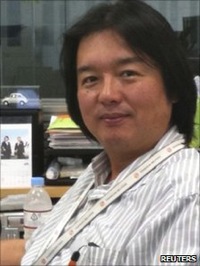
2011 02 28 hiro

The BBC has this story today:

New finding on cameraman’s death during Thai protests

Investigators in Thailand have reversed an earlier finding into the killing of a Reuters cameraman during red-shirt anti government protests last April.

Officials from the Department of Special Investigations (DSI) now say Hiro Muramoto was shot by an AK47, a gun not used by Thai soldiers.

An earlier leaked report blamed the military for shooting the cameraman.

Critics say the investigations into how 89 people died in last year’s protests have been hurt by interference.

Hiro Muramoto, a Japanese cameraman working for Reuters, was killed on 10 April last year.

Thai soldiers were trying to clear many thousands of anti-government protesters, known as red-shirts, from the streets of Bangkok.

They failed – five soldiers died in the attempt and 20 civilians.

Mr Muramoto died from a bullet through his chest.

An earlier finding by the DSI had concluded this was fired by an M16 from an army-held position that night. Witnesses from the scene agreed.

The military was unhappy with that finding and army sources have told reporters that a military officer was assigned to help the DSI’s investigation.

(Emphasis mine.)

Photo: Reuters via BBC.

Categories
Thai politics Thailand

Red shirts to hold anniversary rally on March 12

AP has this story today:

Thailand’s ‘Red Shirts’ urge release of colleagues

Seven recently freed leaders of Thailand’s anti-government “Red Shirt” movement called Sunday for the release of more than 180 of their colleagues who remain jailed since a violent military crackdown last year.

The seven gathered for a ceremony at Bangkok’s Wat Pathuwanaram temple, where six people were fatally shot last year as the army swept demonstrators from the streets to end weeks of mass protests that shook the city and left nearly 90 people dead.

And:

The Red Shirts have nevertheless vowed to stage another large rally on March 12 – the anniversary of the start of last year’s mass protests, which shut down swathes of the city including major shopping malls and hotels, and ended with more around 1,400 people injured.

(Emphasis mine.)

Categories
Thai politics Thailand

Reuters: “Thai PM says has the edge in close election”

A Reuters story from yesterday: Exclusive: Thai PM says has the edge in close election:

Thailand’s prime minister said on Wednesday his Democrat Party would have the edge in a mid-year election but he would probably need to form a coalition to govern, signaling a close and potentially volatile poll.

In an interview with Reuters, 46-year-old, Oxford University-educated Abhisit Vejjajiva said he expected the election to bring stability to the troubled country, regardless of who wins, and an alliance with smaller parties would probably pave the way for him to form a government.

“We are looking at some time around the first half of this year,” Abhisit said of the election, his firmest indication yet of the timing for a poll. “It is a close election like last time, except that we are slightly ahead. The latest polls show we are ahead in all polls except the northeast.”

Categories
Thai politics Thailand

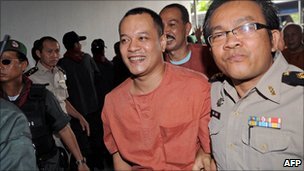
7 Red Shirt leaders out on bail

2011 02 22 reds

AP:

Thailand Court Grants Bail for Red Shirt Leaders

A Thai court has granted bail for seven leaders of the antigovernment “Red Shirt” movement detained after mass protests and riots ended in May.

BBC:

Thailand’s red-shirt leaders freed on bail

Seven leaders of Thailand’s “red-shirt” protest movement have been freed on bail after nine months in jail on terrorism charges.

Separately another red-shirt, Surachai Damwattananusorn, has been arrested on charges of insulting the monarchy.

The government has meanwhile extended implementation of the Internal Security Act for another month.

It is trying to contain continuing protests by both the red-shirts and the nationalist “yellow-shirt” protesters.

The decision to release all seven red-shirt leaders and a protest guard was a surprise. At most, two leaders were expected to be freed.

There are also stories from Reuters and Bloomberg.

(Image: BBC.)