Categories
India Journalism Tech

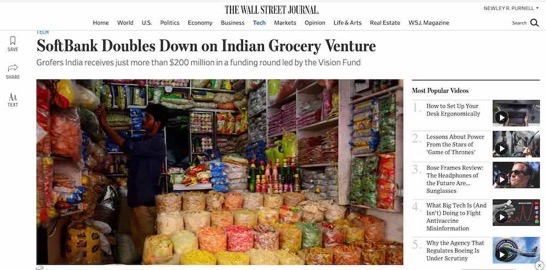
SoftBank Doubles Down on Indian Grocery Venture

softbank_grofers

That’s the headline on my newest story, an exclusive out yesterday. It begins:

NEW DELHI–SoftBank Group Corp. is doubling down on its bet on an Indian grocery-delivery startup, in the global investor’s latest foray in the world’s largest untapped tech market.

Grofers India Pvt. said Wednesday that it received just over $200 million in a funding round led by the Vision Fund, which SoftBank Chief Executive Masayoshi Son is using to invest in cutting-edge technologies. Tiger Global Management and Sequoia Capital, two other prominent tech investors, also participated in the round, said Grofers, which is based in Gurgaon, India.

Click through to read the rest.

Categories
Journalism Tech

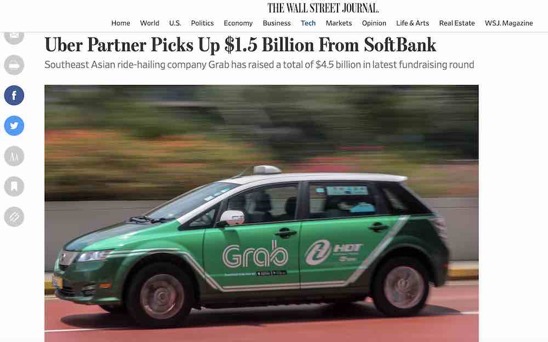
Uber Partner Picks Up $1.5 Billion From SoftBank

2019 03 08grab

That’s the headline on a story out Wednesday that I wrote with my colleague Saurabh Chaturvedi. It begins:

SINGAPORE—Southeast Asian ride-hailing company Grab Holdings Inc. has raised $1.46 billion in fresh funding from Japan’s SoftBank Group Corp., which it will use to fuel its expansion beyond transportation services.

That brings the total from Grab’s latest fundraising round, over the past year, to more than $4.5 billion, the company said Wednesday. The SoftBank investment is through the conglomerate’s Vision Fund, which has stakes in some of the world’s most valuable tech companies.

Click through to read the rest.
Categories
India Journalism Tech

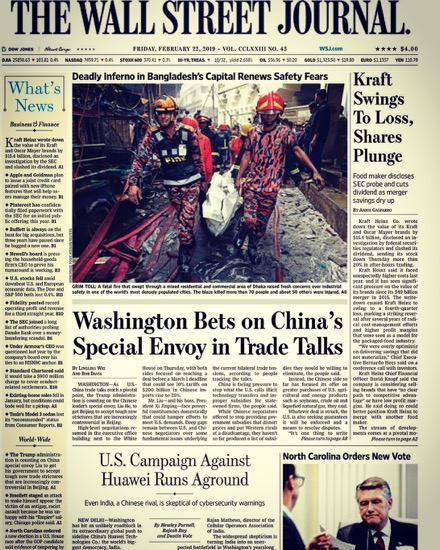
My Latest Page One Story: U.S. Campaign Against Huawei Runs Aground

IMG 1359

That’s the headline on a Page One story I wrote with my colleagues Rajesh Roy and Dustin Volz. It ran online Thursday and in Friday’s paper.

It begins:

Washington has hit an unlikely roadblock in its extraordinary global push to sideline China’s Huawei Technologies Co.: the world’s biggest democracy, India.

Policy makers and telecommunications firms here are so far largely unpersuaded by U.S. warnings that using Huawei’s equipment to upgrade India’s telecom networks presents a major cybersecurity threat, according to more than a dozen government officials and industry executives. Many argue that any such risk is outweighed by Huawei’s cut-rate prices and technological prowess.

Click through to read the rest.
Categories
Book Notes Tech

Book Notes: ‘The Upstarts,’ by Brad Stone

the_upstarts_cover

From time to time I share notes about the books I’ve been reading, or have revisited recently after many years.

These posts are meant to help me remember what I’ve learned, and to point out titles I think are worth consulting. They’re neither formal book reviews nor comprehensive book summaries, but I hope you find them useful.

For previous postings, see my Book Notes category.

The Upstarts: How Uber, Airbnb, and the Killer Companies of the New Silicon Valley Are Changing the World

Published: 2017
ISBN: 0316388394
Amazon link

Brief Summary

A detailed account of how Uber and Airbnb – two startups that launched around the same time and took advantage of similar new technological trends – upended the taxi and hotel industries.

My Notes

  • This is the second book I’ve read by journalist and author Brad Stone. The first was “The Everything Store,” which I loved and wrote about in an earlier Books Notes entry. That book is the definitive account of how Jeff Bezos made Amazon into a global behemoth.

    “The Upstarts” focuses not on one company, but two: Uber and Airbnb. (I began reading this book in preparation for interviewing Uber’s chief executive, Dara Khosrowshahi, last month.)

  • Both Uber and Airbnb benefited from shifting technological trends. As Stone writes, both emerged just as the iPhone and the concept of apps was beginning to take hold; Facebook was growing quickly and encouraging people to “establish their identities online;” Google Maps was emerging and could be integrated by third party apps; and broadband web use was soaring, Stone notes.

  • Both “own little in the way of physical assets.”

  • Founders of both startups lacked lofty ambitions like Google (“organize the world’s information”) or Facebook (“make the world more open and connected”).

    Rather, “Camp, Kalanick and their friends wanted to ride around San Francisco in Style. Chesky and his cohorts were looking for a way to make some extra cash when a conference came to town.”

  • Beyond noting the two startups’ similarities, the book takes a straightforward approach to recounting of how both grew rapidly, encountered challenges, and then overcame them.

    The brash, ambitions, entrepreneurial, math whiz Kalanick was just what Uber needed to grow at a breakneck pace and vanquish rivals. But his personal shortfalls, Stone writes, later got the company into trouble.

    At Airbnb*, Chesky and his co-founders placed an overarching emphasis on the notion of community; they, too, faced some obstacles on their way to success.

    *The original name of the site was Airbedandbreakfast.com, which was later shortened to Airbnb. For some reason I’d always thought the name was “bnb,” for “bed and breakfast,” with an “Air” appended to it.

  • As with “The Everything Store,” which I read to better understand Amazon, I recommend “The Upstarts” if you’d like a better grasp on Uber and Airbnb, and how their early days and culture inform their current activities.

Categories
India Journalism Tech

Amazon, Facebook and Walmart Need to Watch Their Backs in India

2019 02 01 india gate

That’s the headline on a story I wrote Tuesday with my colleague Rajesh Roy. It begins:

Hoping to match China’s success at protecting and promoting homegrown tech titans, India has plans to continue tightening restrictions on Amazon.com Inc., Walmart Inc., Facebook Inc. and other foreign firms that have come to dominate the country’s budding internet economy.

As hundreds of millions of people get online for the first time, and with national elections due in the coming months, Indian policy makers are upping the pressure on American rivals and changing policies to favor domestic players.

The secretary of India’s Telecommunications Department, Aruna Sundararajan, last week told a gathering of Indian startups in a closed-door meeting in the tech hub of Bangalore that the government will introduce a “national champion” policy “very soon” to encourage the rise of Indian companies, according to a person familiar with the matter. She said Indian policy makers had noted the success of China’s internet giants, Alibaba Group Holding Ltd. and Tencent Holdings Ltd. , the person said. She didn’t immediately respond to a request for more details on the program or its timing.

Asked about the comments, she said in a WhatsApp message that the idea is to promote Indian companies “to become global champions."

Click through to read the rest.
Categories
Journalism Tech

Uber Wants You to Catch the Bus or Train—if They Can Drive You There

2019 02 01 uber transport

That’s the headline on a story out Wed. that I wrote with my colleague Mike Cherney. It begins:

Uber Technologies Inc., fresh from disrupting the taxi industry and leaping into food delivery, is devising a new business strategy ahead of its anticipated public offering: ferrying passengers to and from mass-transit systems.

Last year, the ride-sharing giant created an internal team with a focus on partnerships with local transit officials, a shift for a company that previously had run-ins with regulators as it expanded around the globe. The move comes as Uber seeks to evolve from being primarily a taxi-like service to a wider transportation platform, offering options like electric bikes and scooters—and eventually public bus and train tickets.

The approach could generate significant revenue for Uber, if the company can convince customers to take more Uber trips to and from bus stops or train stations. Finding new revenue is crucial for the cash-burning giant, which has said it doesn’t expect to be profitable for at least three years and faces increasing competition as it plans for an IPO this year.

Click through to read the rest.

Categories
India Journalism Tech

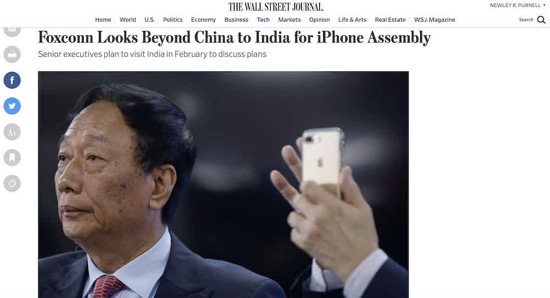
Foxconn Looks Beyond China to India for iPhone Assembly

2019 01 23foxconn

That’s the headline on a story I wrote yesterday with my colleagues Yang Jie, Yoko Kubota, and Rajesh Roy.

It begins:

Apple Inc.’s largest iPhone assembler, Foxconn Technology Group, is considering producing the devices in India, people familiar with the matter said, a move that could reduce Apple’s dependence on China for manufacturing and potentially for sales.

Executives at Foxconn, a contract manufacturer that assembles a large portion of the world’s iPhones in China, are studying whether to include an India project in budget plans, one of the people said. Senior executives, possibly including Chairman Terry Gou, plan to visit India after next month’s Lunar New Year to discuss plans, the people familiar said.

Foxconn’s look at India comes as sustained friction between Washington and Beijing over trade and technology is pushing many companies to consider diversifying their supply chains away from China, a global center of assembly for smartphones, computers and other electronics.

Click through to read the rest.

Categories
Journalism Tech

Facebook’s WhatsApp Limits Users’ Ability to Forward Messages

2019 01 22whatsapp

That’s the headline on my most recent story, out yesterday, with my colleague James Hookway. It begins:

Facebook Inc.’s WhatsApp messaging service is limiting users’ ability to forward content, seeking to curtail ways the popular platform allows the spread of misinformation and sometimes has led to violence.

The move, which follows months of criticism over the company’s response to such incidents, is one of the bigger changes Facebook has made to one of its core services in response to political pressure.

The company said Monday that WhatsApp’s more than one billion global users can now only forward material to five individual users or groups at once, down from 20.

Categories
Journalism Tech

Uber CEO Says Market Turmoil Won’t Derail IPO Plans

2019 01 14uberceo

That’s the headline on my latest story, out Tuesday and in Wednesdsay’s print WSJ. It begins:

Uber Technologies Inc. Chief Executive Dara Khosrowshahi said market turbulence in the U.S. would be unlikely to affect the ride-hailing titan’s plans for a public listing.

“Any company that’s going public would like to do it in a positive, stable market,” Mr. Khosrowshahi said in an interview Tuesday in Singapore. But the startup is large and flexible enough to go public in almost any market, he said. “We’ll do it when we’re ready, and, hopefully, the markets will be in a good state."

Mr. Khosrowshahi said Uber was internally on track to list this year, having previously said he expected to seek a debut in the second half of 2019 in what would be one of the biggest public offerings planned for the year. The company is also keeping an eye out for a possible debut by rival U.S. firm Lyft Inc., which has indicated it plans to seek an IPO this year and filed confidentially with the SEC the same day Uber did.

“The good news is that we’ve got a strong balance sheet so we don’t need to go public this year,” he said. “It’s a desire,” he said, but “if it doesn’t happen it doesn’t happen. “I’d be disappointed and I think our shareholders would be disappointed but the company would be just fine."

Click through to read the rest.

Categories
Journalism Tech

Popular Weather App Collects Too Much User Data, Security Experts Say

2019 01 03weather app

That’s the headline on my latest story, out Wednesday. It begins:

NEW DELHI—A popular weather app built by a Chinese tech conglomerate has been collecting an unusual amount of data from smartphones around the world and attempting to subscribe some users to paid services without permission, according to a London-based security firm’s research.

The free app, one of the world’s most-downloaded weather apps in Google’s Play store, is from TCL Communication Technology Holdings Ltd., of Shenzhen, China. TCL makes Alcatel- and BlackBerry -branded phones, while a sister company makes televisions.

The app, called “Weather Forecast—World Weather Accurate Radar,” collects data including smartphone users’ geographic locations, email addresses and unique 15-digit International Mobile Equipment Identity (IMEI) numbers on TCL servers in China, according to Upstream Systems, the mobile commerce and security firm that found the activity. Until last month, the app was known as “Weather—Simple weather forecast.”

A TCL spokesman didn’t address queries about the amount of data the app collects.

The weather app also has attempted to surreptitiously subscribe more than 100,000 users of its low-cost Alcatel smartphones in countries such as Brazil, Malaysia and Nigeria to paid virtual-reality services, according to Upstream Systems. The security firm, which discovered the activity as part of its work for mobile operators, said users would have been billed more than $1.5 million had it not blocked the attempts.

Click through to read the rest.