Categories
Tech

My 10 Favorite Email Newsletters

Adapted from an edition of my newsletter, Newley’s Notes, sent October 25, 2020. Image via Onlineprinters on Unsplash.

Email newsletters, as I’ve mentioned before, are a fantastic tool for keeping track of fast-breaking news — and man, has there been a lot of that recently — and being exposed to big ideas.

Here are ten of my favorites.

I like that most of these provide an individual’s voice, an interesting perspective, and highlight material I wouldn’t otherwise see:

📱 1) Benedict Evansweekly newsletter is a must-read if you care about tech. A longtime VC at famed Silicon Valley firm Andreessen Horowitz, he has deep knowledge of the history of tech and business; I appreciate his macro-level views especially.

🗯 2) Another excellent tech-focused newsletter is Azeem Azhar’s Exponential View. Tagline: a “weekly guide to the future.”

💻 3) On Tech, by the New York Times’s Shira Ovide, is a daily dispatch on technology happenings, ranging from tech’s collision with business and politics to cultural issues. A bonus: she concludes each email an item labeled “hugs to this” – a link to something special, often related to animal hi-jinx.

📕 4) One of my favorite websites all of time is Five Books. Academics, authors, and other experts in their fields recommend the five best books on particular topics. Brilliant, simple, and hugely useful. Their newsletter provides their most recent posts.

📖 5) Anne Trubek, author and founder of Cleveland-based independent publisher Belt Publishing, writes a newsletter called Notes from a Small Press. It’s full of details on the history of publishing and what it’s like to be a book publisher in 2020. (Longtime readers may recall that my first job out of college was working as an editorial assistant at Random House, and I remain interested in book publishing.)

✏️ 6) Longform.org’s newsletter provides a summation of all the best long-form writing from the past week.

🗞 7) Matt Thomas’s Sunday New York Times Digest is just that: links to must-reads from each edition of the traditionally massive Sunday paper.

☔ 8) Lee Lefever, a digital business guru, is documenting in his newsletter Ready for Rain his move from Seattle to Orcas Island, where he and his wife are building a house. It’s full of meditations on lifestyle, tech, and, of course, homebuilding.

🥼 9) Peter Attia is a physician who focuses on topics such as longevity, nutrition, and athletic performance. His newsletter contains his most recent blog posts and alerts when a new episode of his (excellent) podcast is out.

🎨 10) …and last but not least, I got the idea for this week’s Newley’s Notes from artist and writer Austin Kleon, who did the same in this week’s edition of his newsletter, which is all about art, literature, music, and creativity. Since he wrote a popular book called “Steal Like an Artist,” I figured it was fitting to draw inspiration from him. 🙂

What did I miss? What are some of your favorites? Leave a comment or share this post on Twitter; I’m @Newley.
Categories
India Journalism Tech

Facebook, Under Pressure in India, Bans Politician for Hate Speech

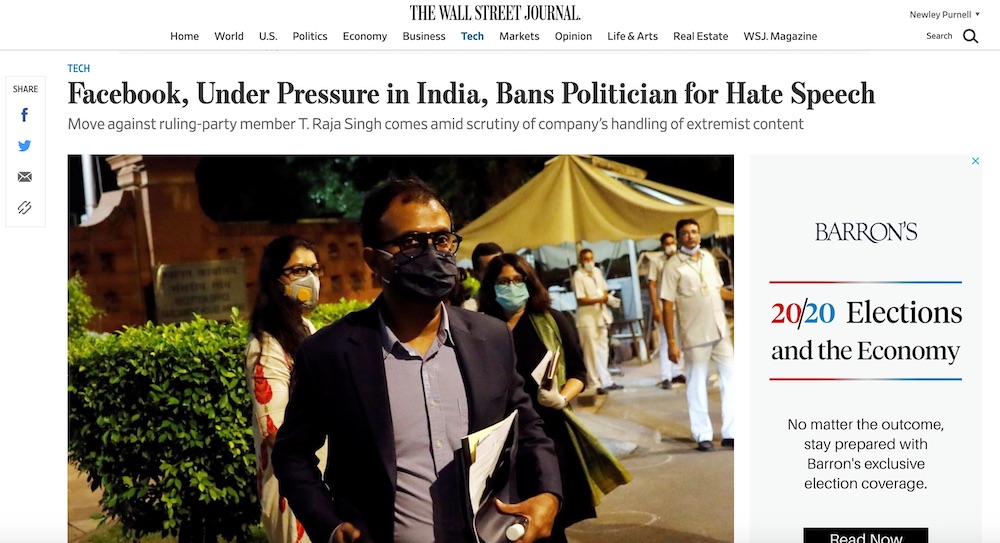
That’s the headline on our newest story, out Thursday. It begins:

Facebook Inc. banned a member of India’s ruling party for violating its policies against hate speech, amid a growing political storm over its handling of extremist content on its platform.

The removal of the politician, T. Raja Singh, is an about-face for the company and one that will be politically tricky in India, its biggest market by number of users.

The Wall Street Journal reported last month that Facebook’s head of public policy in the country, Ankhi Das, had opposed banning Mr. Singh under Facebook’s “dangerous individual” prohibitions. In communications to Facebook staffers, she said punishing violations by politicians from Prime Minister Narendra Modi’s party could hurt the company’s business interests in the country.

Click through to read the rest.

Categories
Hong Kong Journalism Newley's Notes Tech

NN226: Scoop — WhatsApp, Tech Giants Stand Firm in Hong Kong

Sent as an email newsletter (sign up here) Thurs., July 9.

👋 Hi, friends. Welcome to the latest edition of Newley’s Notes, a weekly newsletter containing my recent Wall Street Journal stories, must-read links on tech and life, and funny dog videos.

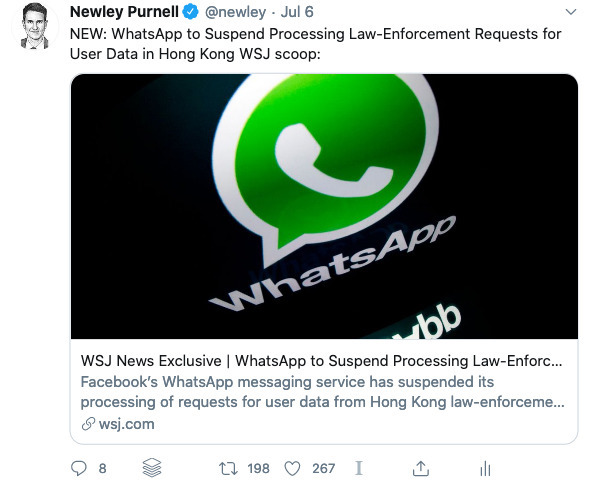
This week’s NN is late. I’d meant to send it Monday evening, but then this happened. See image above.

🚨 I got the exclusive that WhatsApp – quickly followed by Facebook, then Twitter and Google – was suspending its processing of requests for user data from Hong Kong.

WhatsApp and its tech peers were prompted to do so by China’s imposition here in the city of a wide-ranging new national security law.

I’m proud to say we had the news for our subscribers before anyone else, and it was followed by outlets around the world.

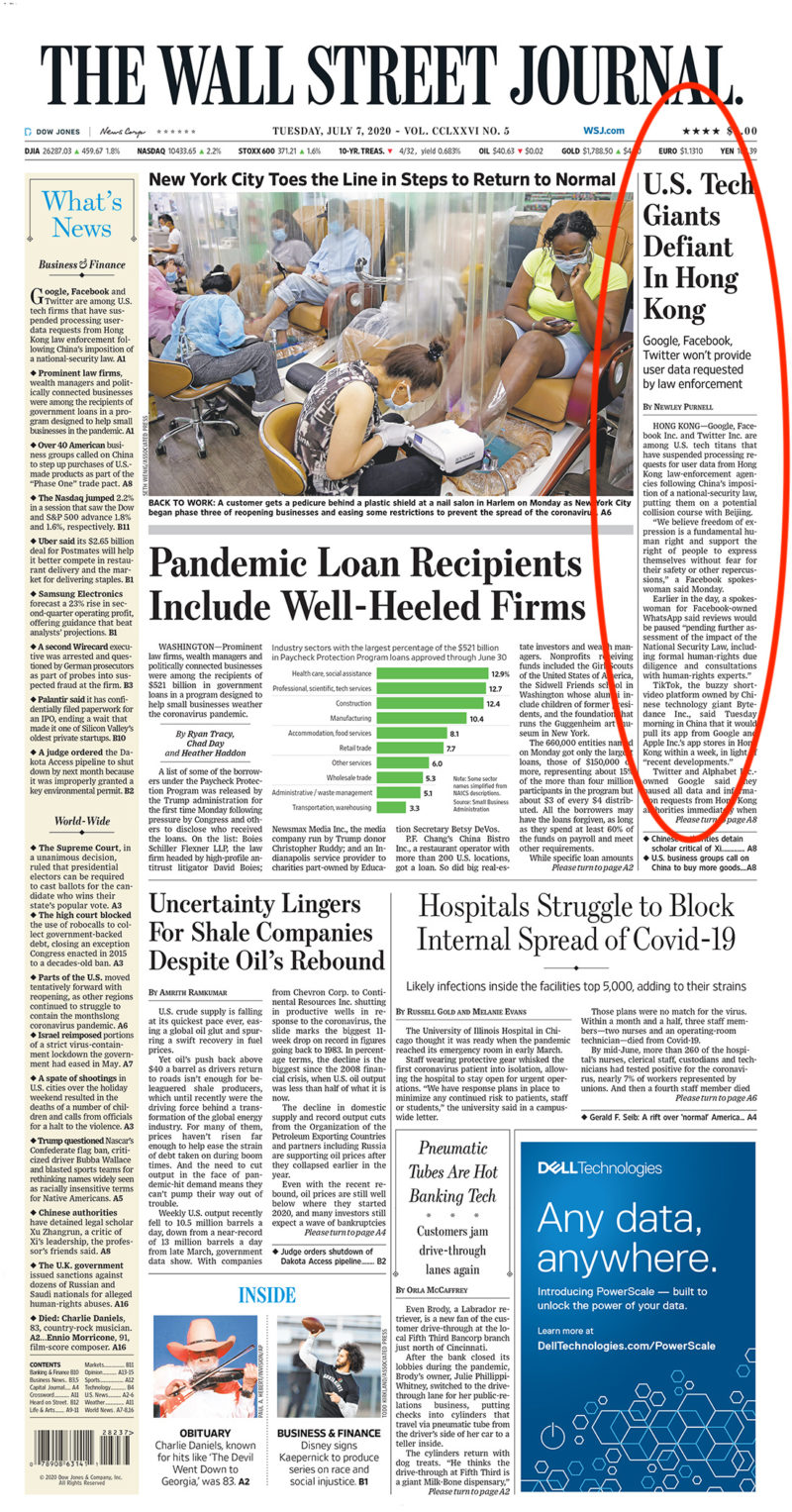
🗞 The story also ran on the front page of Tuesday’s WSJ:

🎧 I was on our The Journal podcast to talk about the story (listen here), and I was also on our Tech News Briefing show (listen here).

The Journal podcast

For more on China, Hong Kong, and the new law, read on…

Here are ten items worth your time this week:

🇨🇳 1) What’s Hong Kong’s new national security law all about? “Experts say its provisions fundamentally alter the legal landscape in Hong Kong, carving out space within the city’s Western-style rule-of-law system for mainland Chinese methods of enforcing Communist Party control,” my colleague Chun Han Wong reports.

⏲️ 2) Things are happening fast here in HK, my colleague Dan Strumpf wrote in a story out Wednesday about the inauguration of a new home for China’s security agents:

“First the construction signs went up, then a flagpole appeared and police officers started to swarm the streets. Within hours, a skyscraper hotel in a cozy neighborhood of bars, apartments and boutiques was transformed into something new: the headquarters of Beijing’s powerful new security agency for the city.”

🧙‍♂️ 3) And in non-China/Hong Kong news: “How J. K. Rowling Became Voldemort”:

“Younger Millennials – those born around 1990, the same time as Harry Potter’s lead actors Daniel Radcliffe and Emma Watson – feel just as strongly about transgender rights. To many of them, it is the social-justice cause, their generation’s revolutionary idea.”

✍️ 4) “In an era that fetishizes form,” Joyce Carol Oates “has become America’s preëminent fiction writer by doing everything you’re not supposed to do.”

🚷 5) A Japanese city has passed a draft ordinance aimed at stopping people from using their smartphones while walking.

💬 6) Social media first brought about “context collapse” (people talk to everyone all at once, rather than distinct people or groups), and now, writes Nicolas Carr, it has created something more serious: “content collapse.” “A presidential candidate’s policy announcement is given equal weight to a snapshot of your niece’s hamster and a video of the latest Kardashian contouring,” he says.

⏳ 7) Shot: “Back to the Future” was released 35 years ago last week. Here are 30 facts about the great film, one of which – you’re telling me they started filming with Eric Stoltz instead of Michael J. Fox as Marty McFly?! – I find mind-blowing.

🎹 8) Chaser: The Nostalgia Machine is a website where you enter a year, click a button, and jam to some sweet tunes from yesteryear.

✏️ 9) Gary Larson, creator of “The Far Side,” has started cartooning again (this time on a tablet).

🐶 10) Dog-related video of the week: You rang? (Thanks, Anasuya!)

•••

💡 Quote of the week:

“If your choices are beautiful, so too will you be.” – Epictetus

•••

🤗 What’s new with you? Hit reply to send me tips, queries, random comments, and videos of adorably attentive pups.

👊 Fist bump from Hong Kong,

Newley

Categories
Hong Kong Journalism Tech

Facebook, Twitter, Google Face Free-Speech Test in Hong Kong

That’s the headline on my newest story, with my colleague Eva Xiao, out Friday. It begins:

U.S. technology titans face a looming test of their free-speech credentials in Hong Kong as China’s new national-security law for the city demands local authorities take measures to supervise and regulate its uncensored internet.

Facebook Inc. and its Instagram service, Twitter Inc. and YouTube, a unit of Alphabet Inc.’s Google, operate freely in the city even as they have been shut out or opted out of the mainland’s tightly controlled internet, which uses the “Great Firewall” to censor information.

In Hong Kong many citizens have grown accustomed to freely using their accounts to speak out on political matters, voice support for antigovernment protests, and register their anger at China’s increasing sway over the city.

Now the U.S. tech companies face a high-wire act, analysts say, if authorities here ask them to delete user accounts or their content. Refusal could invite Beijing’s scrutiny and potentially put them at risk of legal action under the new national-security law. Complying would alienate longtime users in the city, some of whom continue to speak out on their platforms, and leave the companies open to criticism from politicians in the U.S. or U.K.

Click through to read the rest.

Categories
Journalism Tech

India Ban Disrupts TikTok Users and China’s Digital Ambitions

That’s the headline on my newest story, our Tuesday, with my colleague Liza Lin. It begins:

India’s decision to ban dozens of Chinese apps is a big setback for China’s top tech firms trying to replicate their remarkable domestic success globally, as they are now stymied in what many consider the world’s last great untapped digital market.

India would block new downloads and prevent or disrupt access for existing Indian users of 59 Chinese apps in a matter of days, a government official who is familiar with the matter said Tuesday. “We have already asked Google and Apple to take note of the government’s latest decision and remove the apps,” the official said, “They are in the process of executing the ban.”

The official, who declined to be named, also said authorities are working with internet service providers to block access for existing app users.

Among the apps are Bytedance Ltd.’s wildly popular TikTok—which has been downloaded 660 million times in India, the company’s largest market by users outside China—along with Alibaba Group Holding Ltd.’s UC Browser and Tencent Holdings Ltd.’s WeChat messaging platform. Some TikTok users in India have started to receive error messages and are unable to access the video app, according to checks by The Wall Street Journal.

Click through to read the rest.

Categories
India Journalism Tech

Facebook Takes $5.7 Billion Stake in India’s Jio Platforms

That’s the headline on my most recent story, out Wednesday with my colleague Jeff Horwitz. It begins:

Facebook Inc. said it would pay $5.7 billion for just under 10% of Indian telecom operator Jio Platforms Ltd., a massive expansion of the social media giant’s commitment to a promising market where it has faced difficulties.

The deal, unveiled late Tuesday, is Facebook’s largest overseas investment and gives it the opportunity to bring its WhatsApp messaging service—which has more than 400 million users in India—into closer partnership with the mobile operator that upended India’s telecommunications industry with cut-rate data plans.

Jio Platforms Ltd. and its subsidiary, mobile operator Reliance Jio Infocomm Ltd., are part of Indian conglomerate Reliance Industries Ltd. Jio Infocomm provides services to about 388 million customers.

The deal shows how Facebook, like other tech giants, is pushing ahead and taking advantage of its relative strength during a pandemic that is causing most other industries to retreat.

In a subsequent story, I looked a little closer at the who gets what out of the deal. The lede:

Facebook Inc.’s $5.7 billion tie-up with an Indian mobile leader could create a new kind of animal in the world’s biggest untapped digital market: a social media behemoth wedded to a mobile infrastructure titan—both coveting e-commerce.

Now the two companies are expected to square off against some formidable online shopping rivals: Amazon.com Inc. and Walmart Inc., which have each invested billions in the South Asian market.

Categories
Journalism Tech

Facebook’s WhatsApp Battles Coronavirus Misinformation

whatsapp forwarding

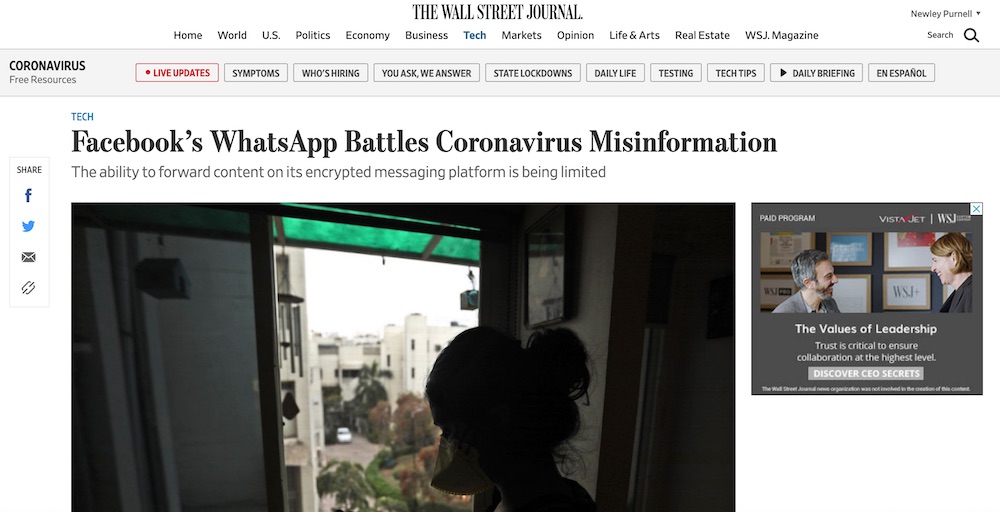
That’s the headline on my newest story, out Tuesday. It begins:

Facebook Inc.’s WhatsApp is limiting users’ ability to forward content on its encrypted messaging platform, as misinformation about the coronavirus pandemic proliferates on the service in its biggest market, India.

In one of the biggest changes WhatsApp has made to a core feature, the company said Tuesday that its more than two billion users globally can now send along frequently forwarded messages they receive to only one person or group at a time, down from five.

In recent weeks the company has “seen a significant increase in the amount of forwarding which users have told us can feel overwhelming and can contribute to the spread of misinformation,” the company said.

WhatsApp is also testing a new feature that enables users to click an icon next to frequently forwarded messages—those forwarded at least five times—to search the web for their contents and verify them before sending the message to others, a WhatsApp spokeswoman said.

Click through to read the rest.

Categories
Journalism Tech

Hotel Giant Oyo Looks to Rewrite Contracts That Fueled Its Rise

That’s the headline on my most recent story, written with my colleague Phred Dvorak, out Thursday. It begins:

Oyo Hotels and Homes, which built itself into the world’s second-biggest hotel chain by total number of rooms, is phasing out an important tool that fueled its rise.

The India-based company and a key investment by SoftBank Group Corp.’s $100 billion tech fund grew quickly in part by offering independent hotel owners the unusual perk of guaranteed revenues if their hotels joined Oyo’s chain. Many hotels signed up, attracted by the guarantees—sometimes at more than 100% of the previous year’s revenue, according to former Oyo employees. However, some hotels didn’t produce sufficient bookings, leaving Oyo on the hook to meet those revenue levels and resulting in disputes with some hotel owners.

Now, Oyo is ending the practice of awarding those guarantees around the world and instead is rolling out new contracts for its hoteliers without them, Chief Executive Ritesh Agarwal told The Wall Street Journal. The new contracts also raise fees charged to the hotels, according to some hotels and former Oyo employees.

Mr. Agarwal said the company is taking the step largely because the guarantees have served their purpose of convincing hotels that Oyo could boost their occupancy and revenue. But he said Oyo had some problems with the guarantees, particularly in its biggest market of China, and that around 15% of Oyo’s rooms still had them as of the beginning of the year.

“In reflection, we are able to see that minimum guarantees work, but only when they are handled with great care,” he said. Oyo’s share of the money guests pay for their rooms is on average more than 15%, after any losses on the guarantees are subtracted, he said.

Click through to read the rest.

Categories
India Journalism Tech

Amazon’s Bezos Pledges New $1 Billion India Investment Amid Pushback

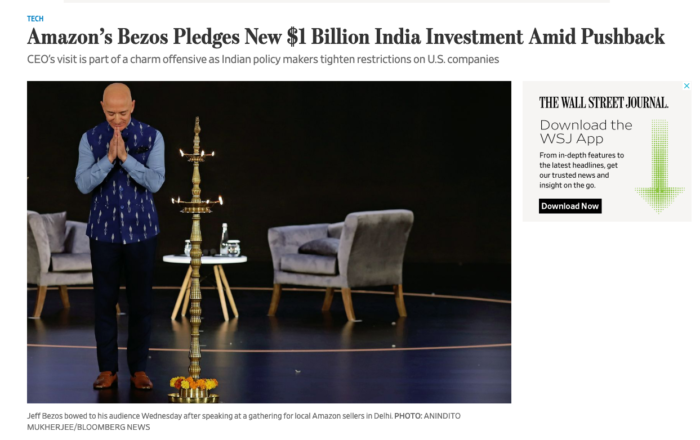
That’s the headline on my newest story, with my colleague Krishna Pokharel, out Wednesday. It begins:

NEW DELHI— Amazon.com Inc. Chief Executive Jeff Bezos pledged to invest an additional $1 billion in the company’s Indian operations, part of a charm offensive in a promising but challenging market.

Mr. Bezos told a gathering of local Amazon sellers that the intent is to help more small businesses start selling on the company’s marketplace. The new funds will supplement the $5 billion that Amazon has said it is spending to build out its Indian business, a spokeswoman said.

Click through to read the rest.

Categories
India Journalism Tech

India Orders WhatsApp, Google to Save Data on Mob Attack

That’s the headline on my newest story, with my colleague Krishna Pokharel, out Tuesday. It begins:

NEW DELHI — An Indian court ordered Facebook Inc.’s WhatsApp and Alphabet Inc.’s Google to preserve data connected to an attack on a university campus earlier this month in the latest attempt by authorities in the country to wrangle more control over the messaging and search giants.

According to an attorney involved in the case, the Delhi High Court said Tuesday that the companies, local police and university authorities must try to save messages, photos and videos connected to the Jan. 5 attack, when several dozen people stormed the campus of New Delhi’s Jawaharlal Nehru University, injuring 32 students and two faculty members.

Click through to read the rest.