Categories
Journalism Tech

Meta’s Threads Isn’t Labeling Propaganda Accounts From Russia, China State Media

WSJ Meta Threads propaganda

That’s the headline on a story I had out Wednesday. It began:

State-backed news outlets from Russia and other authoritarian governments have rushed to join Meta Platforms’ new Threads microblogging service, posting propaganda such as a fake video purporting to show President Biden in a store perusing books on dementia.

Unlike on Facebook and Instagram, their verified accounts on Threads aren’t labeled as state-controlled media, raising questions over how the Facebook parent intends to police content on its Twitter rival that launched this month. Twitter, now being rebranded as X, in 2020 began applying labels to state-run news organizations; under Elon Musk, it removed them in April.

Meta also in 2020 began applying such labels to state-run media accounts on Facebook and Instagram. That came after independent studies found Russian influence campaigns ahead of the 2016 election used such services to suppress voter turnout and boost Donald Trump’s presidential bid.

Meta launched Threads before the service was fully built out to capitalize on Twitter’s struggles under Musk, The Wall Street Journal has reported. That means Threads lacks basic moderation features including the labels.

Russia’s RT and Sputnik News, China’s CGTN and Xinhua News, and Fars News—run by Iran’s Islamic Revolutionary Guard—have attracted more than 270,000 followers on Threads since the service launched this month, according to a tally by the Journal. That is far fewer than the hundreds of thousands or even millions of followers they have built over the years on Twitter.

Sputnik News, a Russian outlet that analysts describe as publishing propaganda, posted last week a manipulated video purporting to show Biden perusing books next to a sign saying “Brain exercises for dementia.”

Fact-checking groups debunked the video in 2020, saying that it took real footage of Biden looking at books in a store and superimposed a sign nearby that said “Brain exercises for dementia.” Sputnik News didn’t post the video to its Instagram account, where it is labeled as a state-affiliated organization.

After the Journal asked a Meta spokeswoman about the video of Biden on Threads, the post began showing a label describing it as “False information,” saying “independent fact-checkers say this information has no basis in fact.”
Click through to read the rest.

Categories
Journalism Tech

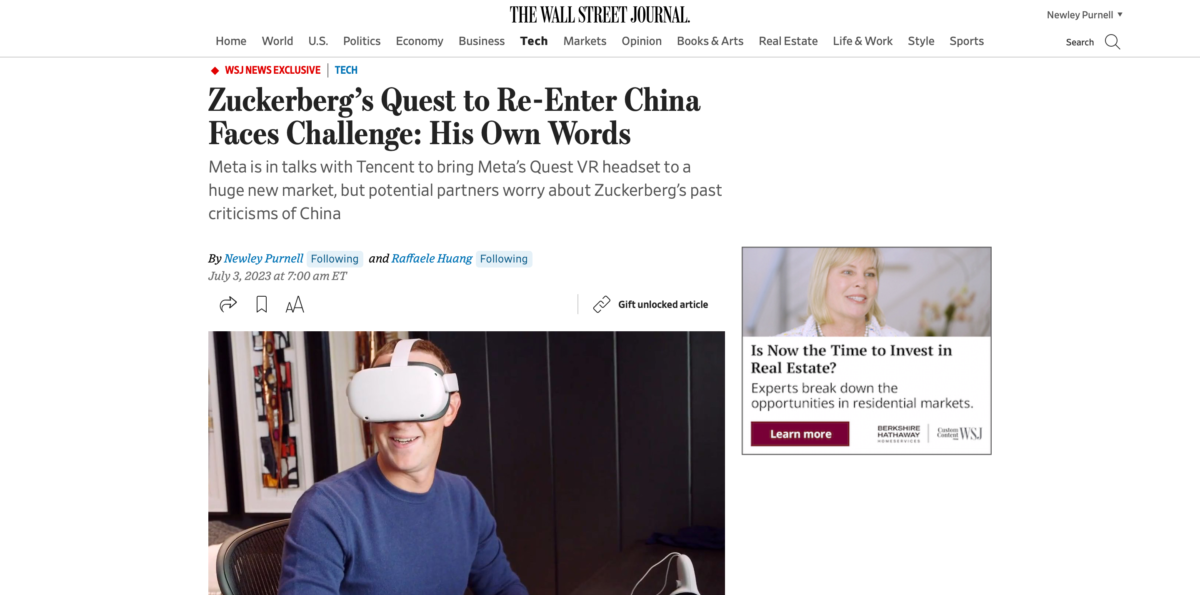
Zuckerberg’s Quest to Re-Enter China Faces Challenge: His Own Words

That’s the headline on my newest story, out Monday with my colleague Raffaele Huang. It begins:

HONG KONG — Mark Zuckerberg in late 2021 had a question for those working on Meta Platforms’ strategy for its virtual-reality headset: If Apple can sell iPhones in China, and Tesla can sell cars, why can’t we sell our devices there?

The question, posed on a video call, led to a push by Meta to restart its China business by selling its Quest headsets in the country, according to a person familiar with the matter, more than a decade after Facebook was blocked there.

The company held discussions with several Chinese tech companies and has made progress with videogame powerhouse Tencent Holdings, people familiar with the matter said. But the effort faces challenges, in part because Chinese executives worry that Zuckerberg isn’t seen as friendly to China, according to people familiar with the matter.

In recent years the Meta founder has accused China of stealing technology and taken aim at ByteDance, the Chinese owner of video-sharing platform TikTok. That has undermined a charm offensive Zuckerberg undertook in Beijing in 2016 and bolstered negative views of the entrepreneur in Beijing, the people said.

Officials’ perceptions of Zuckerberg could add uncertainty should Meta and its partner seek licenses and approvals for their products and services in China, some of the people said.

Click through to read the rest.

Categories
Hong Kong Journalism Tech

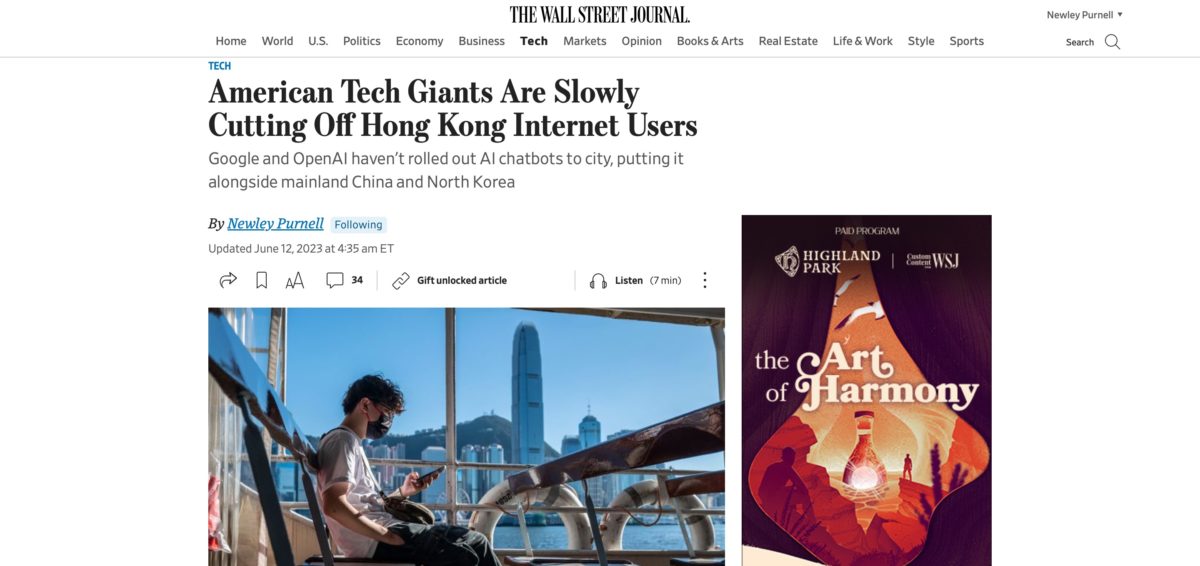
American Tech Giants Are Slowly Cutting Off Hong Kong Internet Users

That’s the headline on a story I had out at the beginning of last week.

It began:

HONG KONG—Bit by bit, American tech giants are shutting out users in Hong Kong, where moves by authorities to thwart online dissent are shifting the target from individuals to platforms such as Google’s YouTube.

Alphabet-owned Google, San Francisco-based OpenAI and Microsoft have limited access to their artificial-intelligence chatbots in recent months in the global finance and business hub. In OpenAI’s case, the restriction puts Hong Kong and mainland China alongside North Korea, Syria and Iran.

While none of the companies have given reasons, observers say they could be exposed to risk if the chatbots spew out content that violates a national-security law imposed by China nearly three years ago. The law criminalizes many types of criticism of the government and Beijing.

Google, OpenAI and Microsoft declined to comment on why they restricted use in Hong Kong, but said they are working to bring their services to new locations in the future.

Last week, Hong Kong’s Department of Justice sought a court order to block online dissemination of a popular pro-democracy anthem, “Glory to Hong Kong.” The order cited 32 videos on YouTube of the song, which has lyrics that the government says contain a slogan that amounts to advocating secession. It is the first major legal challenge to American tech companies over politically sensitive Hong Kong content.

At a hearing on the request on Monday, national security judge Wilson Chan said the court would resume deliberation on July 21.

The moves add to a slow creep of tech giants treating Hong Kong more like a city in mainland China. Apple has joined with China’s Tencent to filter suspicious websites, with users complaining it temporarily blocked access to legitimate sites such as Twitter rival Mastodon. Disney has declined to offer on its streaming service two episodes of “The Simpsons” that it worried could run afoul of the national-security law, according to a person familiar with the matter.

Some fear that Hong Kong’s largely unfettered internet is being nudged closer to China’s, which is strictly censored by a system known as the Great Firewall and has had no access to foreign social-media services such as Twitter and Facebook since 2009.

“We don’t have the Great Firewall yet, but companies aren’t offering their services,” said Heatherm Huang, co-founder of Hong Kong-based tech company Measurable AI, which analyzes online shopping data for financial firms. “Overall, it’s a sad story,” he said.

Click through to read the rest.

Categories
Hong Kong Journalism Tech

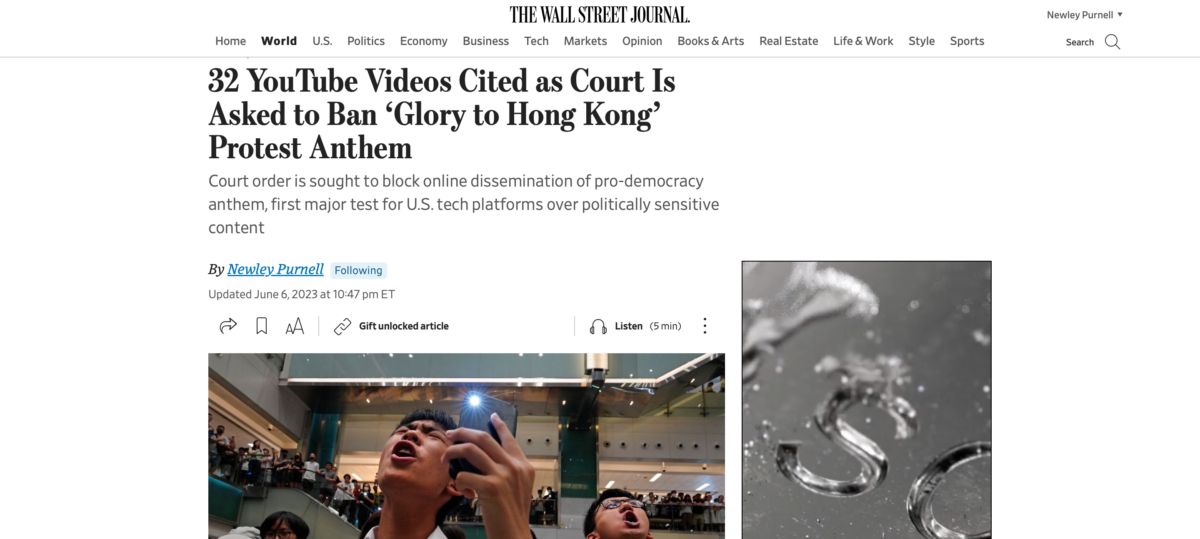
32 YouTube Videos Cited as Court Is Asked to Ban ‘Glory to Hong Kong’ Protest Anthem

That was the headline on a story that ran earlier this month. (I’m late in posting it here.)

It began:

HONG KONG—Government officials in the financial center are seeking a court order to block the dissemination online of a popular pro-democracy song, the first major legal challenge to U.S. tech companies such as Google over politically sensitive content on their platforms.

The Department of Justice applied to the city’s High Court for an injunction banning the broadcasting or distribution—including on the internet and any media accessible online—of the song “Glory to Hong Kong,” the government said Tuesday. The date for a court hearing hasn’t been set.

While the legal action doesn’t name any specific companies, Google has been swept up in a controversy over the song as authorities move to stifle dissent using a national security law imposed by China in the city almost three years ago. The government’s application for the court order includes links to 32 videos on Google’s YouTube related to the song.

Categories
India Journalism Tech

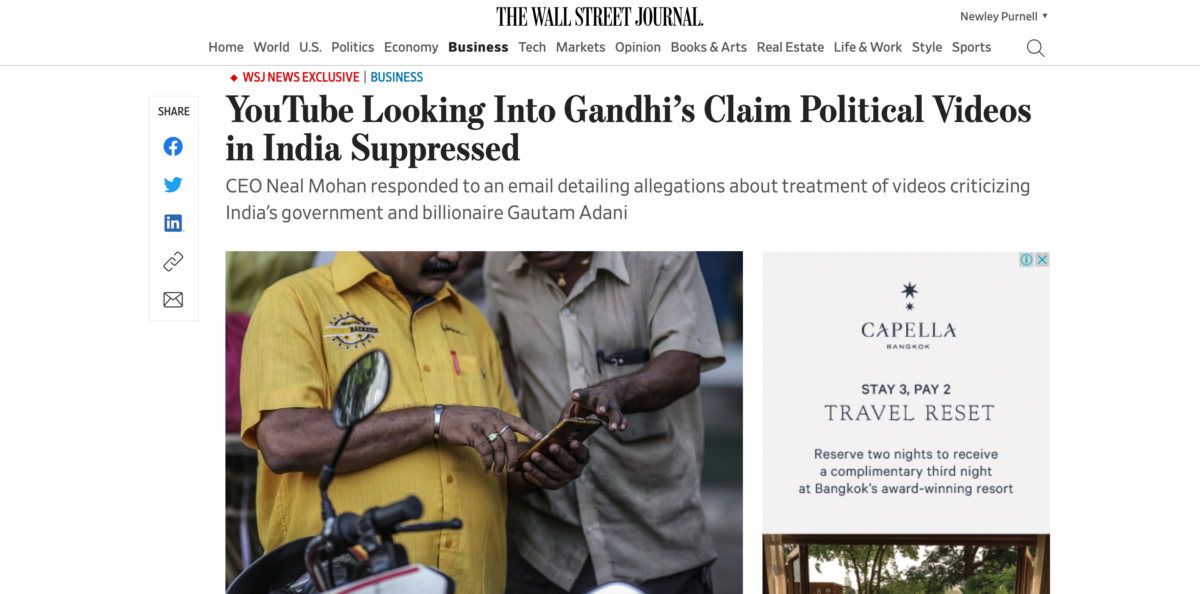
YouTube Looking Into Gandhi’s Claim Political Videos in India Suppressed

That’s the headline on my latest story, an exclusive out Wednesday.

It begins:

YouTube’s chief executive said in an email that the company is looking into a claim by Indian opposition leader Rahul Gandhi that the Alphabet Inc. unit is suppressing his videos criticizing India’s ruling party and a billionaire who controls a conglomerate accused of wide-ranging fraud.

The March 25 email from YouTube’s Neal Mohan, which was reviewed by The Wall Street Journal, came in response to a letter sent two weeks earlier from the leader of a group of overseas Indians who support Mr. Gandhi’s Congress party.

The letter, which was reviewed by the Journal, included data from Mr. Gandhi’s social-media team making the case that his videos related to “the issue of cronyism of the ruling government with one industrialist, Mr. Gautam Adani,” are receiving views that are significantly lower than YouTube analytics suggest they should be, and are being “suppressed, perhaps unwittingly and algorithmically.”

The data, which was reviewed by the Journal, showed that based on interactions such as likes on two videos alleging Prime Minister Narendra Modi has given special treatment to the company headed by Mr. Adani, the Adani Group, the videos should have received about 2.8 million views combined, but instead got less than a third of that.

The data also suggested Mr. Gandhi’s videos are receiving fewer views because they are now recommended less frequently to users via YouTube’s home page, the letter said.

“Thanks,” Mr. Mohan wrote in reply. “Team is taking a look,” he wrote, without elaborating.

Representatives for Alphabet Inc.’s Google and YouTube didn’t respond to requests for comment.

Representatives for the Prime Minister’s Office, Mr. Modi’s ruling Bharatiya Janata Party and the Adani Group didn’t immediately respond to requests for comment.

Click through to read the rest.

Categories
Journalism Tech

Google Halts Download of Chinese App Pinduoduo Over Security Concerns

That’s the headline on my latest story, out yesterday with my colleague Clarence Leong.

It begins:

Alphabet Inc.’s Google blocked downloads of e-commerce app Pinduoduo after versions of it not carried in its app store were found to contain malware, adding to security concerns about Chinese-developed apps.

The Pinduoduo app, which is owned by PDD Holdings Inc., has been suspended from Google Play over security concerns while it conducts an investigation, a Google spokesperson said Tuesday.

Google Play isn’t available to users in China, which is the biggest market for Pinduoduo, a popular e-commerce platform best known for offering deals for goods by banding consumers together. Android users in China can download apps from app stores operated by Chinese tech companies, such as Tencent Holdings Ltd. and Baidu Inc. Pinduoduo had around 750 million monthly active users during the first quarter of last year—the most recent figure released by the company.

Temu, a popular shopping app in the U.S., also run by PDD, hasn’t been affected and is still available to download, according to Google.

Click through to read the rest.

Categories
Journalism Tech

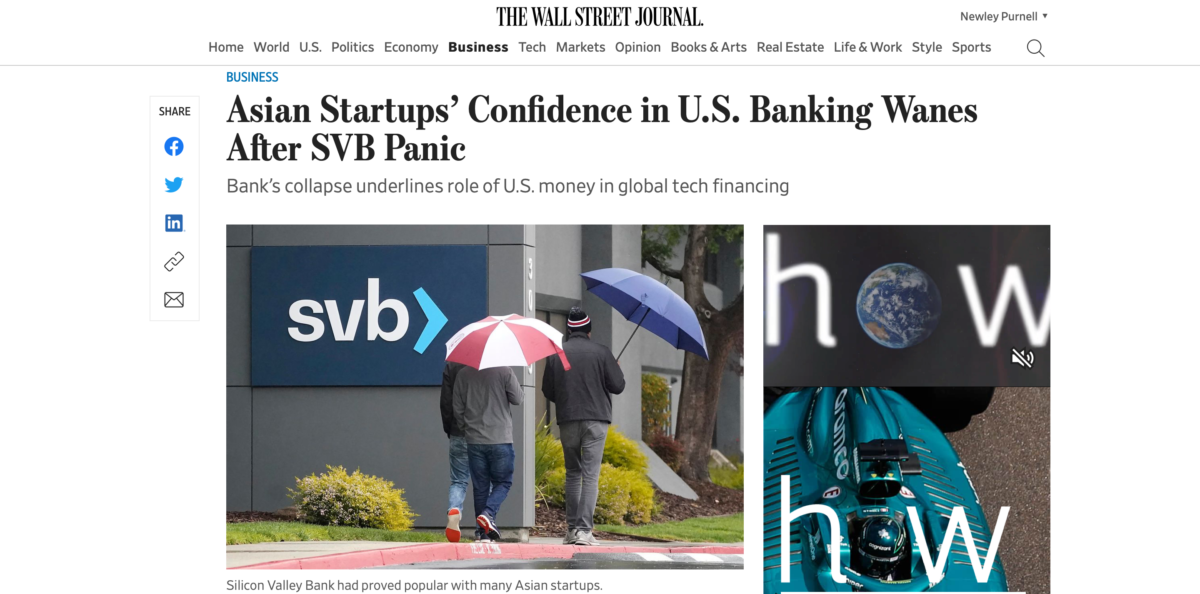
Asian Startups’ Confidence in U.S. Banking Wanes After SVB Panic

That was the headline on a story I wrote last week with my colleagues Raffaele Huang and Clarence Leong.

It began:

SINGAPORE—The failure of Silicon Valley Bank reverberated through startups and venture-capital firms from China to Singapore and India during a roller coaster few days that shook confidence in Asia over reliance on U.S. tech financing.

After frantic efforts trying to secure their money, some startup executives said the incident served as a warning despite U.S. authorities stepping in Sunday to shore up the bank’s customers.

“The SVB problem is an episode that reminds us to review our reliance on investment from the U.S.,” said Wang Guanyan, an executive of a Guangzhou, China-based startup that develops virtual-reality games.

Click through to read the rest.

Categories
Journalism Tech

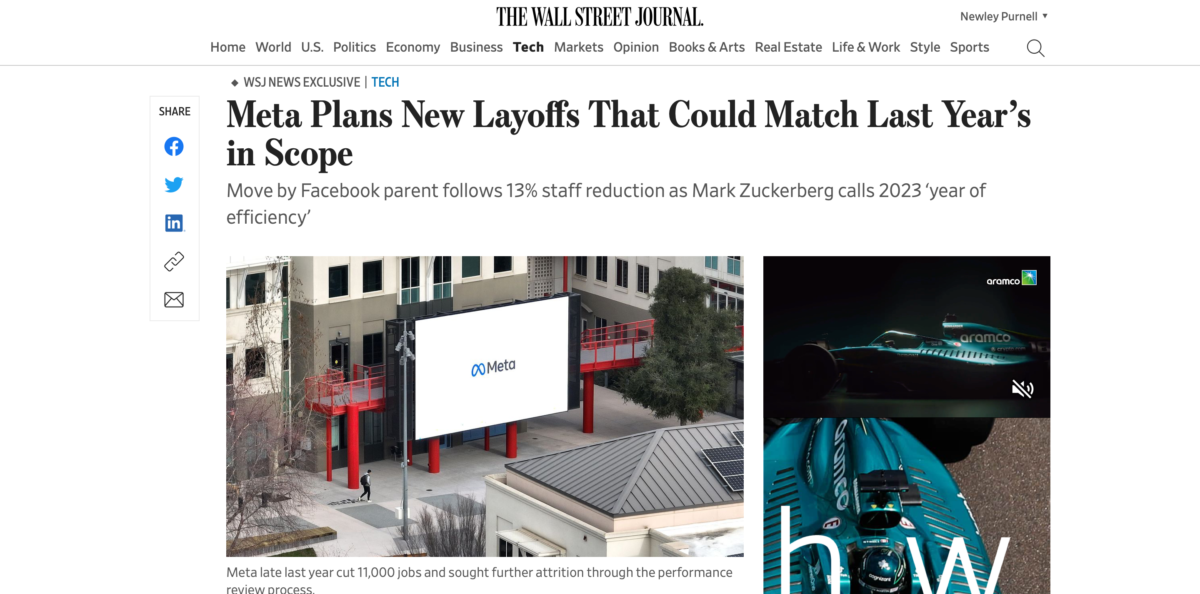
Meta Plans New Layoffs That Could Match Last Year’s in Scope

That was the headline on a March 10 scoop I wrote with my colleagues Jeff Horwitz, Salvador Rodriguez, and Sam Schechner.

(Mark Zuckerberg announced the cuts a few days later.)

The story began:

Facebook parent Meta Platforms Inc. is planning additional layoffs to be announced in multiple rounds over the coming months that in total would be roughly the same magnitude as the 13% cut to its workforce last year, according to people familiar with the matter.

The new cuts, the first wave of which is expected to be announced next week, are likely to hit non-engineering roles especially hard, the people said. The company is also expected to shut down some projects and teams in conjunction with these cuts.

Click through to read the rest.

Categories
India Journalism Tech

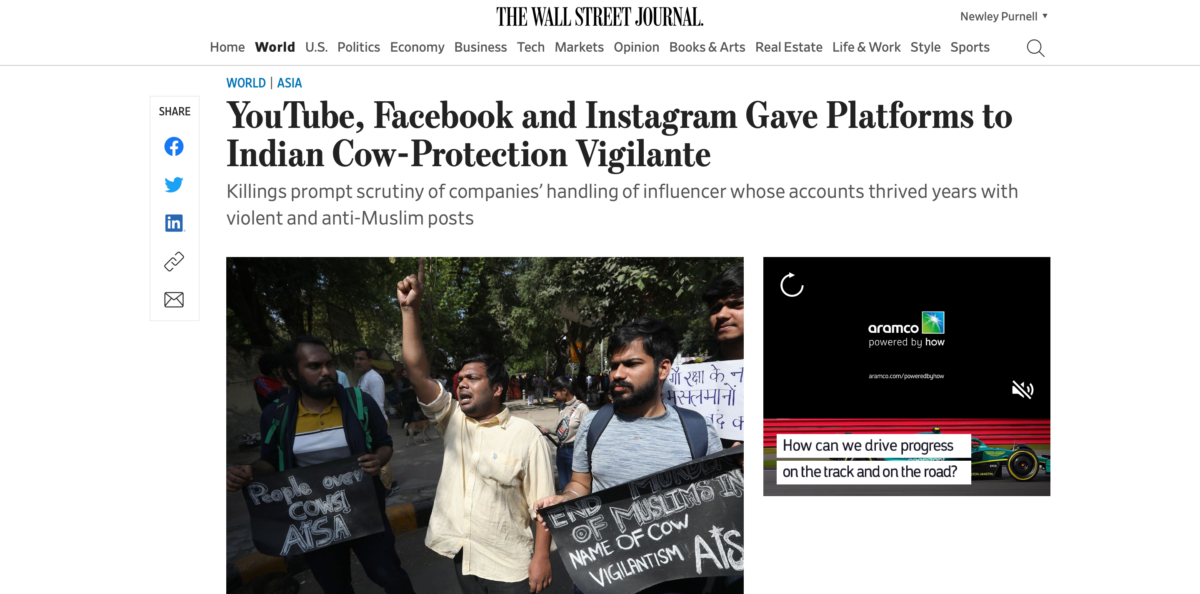
YouTube, Facebook and Instagram Gave Platforms to Indian Cow-Protection Vigilante

That was the headline on March 6 story I wrote with my colleague Jeff Horwitz. It began:

Monu Manesar, the alias of an Indian cow-protection influencer, has spent the past six years documenting his personal war against cattle smugglers on YouTube, Facebook and Instagram.

In openly violent posts that often clashed with the platforms’ stated content policies, his accounts livestreamed car chases of men suspected to be transporting beef or cows—an animal deeply revered in Hinduism. He and fellow vigilantes filmed themselves ramming vehicles, shooting out truck tires and trading gunfire with alleged smugglers. The posts included anti-Muslim slurs and trophy photos of captives bleeding from the head.

Human-rights organizations warned YouTube, a unit of Alphabet Inc.’s Google, and Meta Platforms Inc., parent of Facebook and Instagram, that the exploits posed a threat to human life and encouraged violence against Muslims. The Monu Manesar accounts stayed online and continued to rack up followers, however: 210,000 subscribers on YouTube and nearly 150,000 across Meta’s Facebook and Instagram.

Now police in India are investigating Monu Manesar—whose real name is Mohit Yadav, according to police—and his associates in the deaths of two alleged cow smugglers whose charred bodies were found on Feb. 16 in their burned-out vehicle. The episode has sparked new debate over such vigilantism in India and what role social-media platforms play in fomenting religious violence.

Click through to read the rest.

Categories
Journalism Tech

Meta in Talks to Reboot China Business With VR Headsets

That’s the headline on my latest story, out last Tuesday with my colleague Raffaele Huang. It begins:

Tencent Holdings Ltd. is in talks to sell Facebook parent Meta Platforms Inc.’s popular virtual-reality headset in China, home to the world’s biggest pool of internet users.

Tencent, China’s biggest videogame company, has proposed to Meta that it become the exclusive seller of Meta’s Quest 2 headsets in China, people familiar with the discussion said. Tencent has also sought to publish Chinese versions of existing videogames for the device, they said.

The discussions, which began in recent months, are still at an early stage and a deal might not be reached, some of the people said.

Among issues that would need to be addressed are how user data would be handled, whether global macroeconomic conditions would be right for a partnership, and whether any deal between two of the biggest tech companies in the U.S. and China could draw scrutiny from Washington and Beijing, the people said. The two companies would also face China’s tight regulations on videogames.

Currently, the headset and its apps aren’t officially available in China. People there can buy devices from parallel importers on e-commerce platforms such as Alibaba Group Holding Ltd.’s Taobao and JD.com Inc., and set up the headsets and download apps with a virtual private network to bypass China’s internet firewall.

Click through to read the rest.