Categories
HOWTO Journalism Tech

3 Digital Tools I Used to Write my Master’s Thesis

In April, after more than six months of work, I submitted the thesis I wrote for my master’s in business and economics journalism.

At more than 11,000 words and 41 pages long, it was the longest story I’d ever written.

I interviewed dozens of people, analyzed hundreds of pages of court documents, submitted and tracked multiple Freedom of Information Act requests, read several books on my topic, and composed perhaps twenty drafts of what became the final piece.

I’ll tell you more about the story itself in the weeks and months ahead, I’m sure. For now, though, I wanted to share the top three digital tools I used to organize my writing and research.

1. For writing: Scrivener
2013 04 24 scrivener

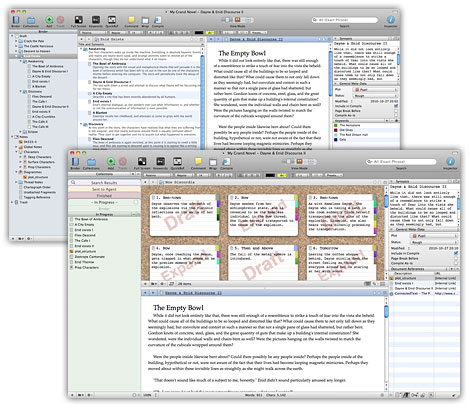
I’ve been using the Writing app Scrivener since 2007. It’s less a word processor than a tool for organizing all sorts of digital materials and creating an environment where you can more easily produce text.

I made ample use, for example, of the folders shown on the top left corner of the image above. These folders allowed me to organize various snippets of text; keep running lists of items to investigate; maintain outlines and timelines; and more. I could always keep my main draft open and navigate, with just a click, to another item — as opposed to having to open several Word files and toggle between them.

When conducting interviews, I also relied on Scrivener’s split screen function. I kept my questions in the top pane and typed my sources’ answers in the bottom pane as we chatted. Scrivener also has an excellent full screen mode, which is helpful when you simply want to focus on the text.

The Mac version of Scrivener is $45. For more information on the app, here’s a detailed review of the app’s many features. And here’s a post about using Scrivener for dissertation writing.

2. For organizing data: Excel

2013 07 27 excel mac

Excel? You better believe it. I used spreadsheets to keep track of:

  • Court materials — I listed dates of various documents, their titles, a description of contents, URLs if they were online, and even the files’ location on my hard drive.
  • Sources — I kept track of names, job titles, contact information, and more.
  • Timeline — My story spans several years, so I used a simple timeline to keep track of the chronology of events. This was helpful when it came time to construct my narrative.

Excel is part of Office for Mac. Microsoft’s home and student version is $139.99.

For more, see this overview of Excel for journalists.

3. For bookmarking: Pinboard
2013 07 28 pinboard

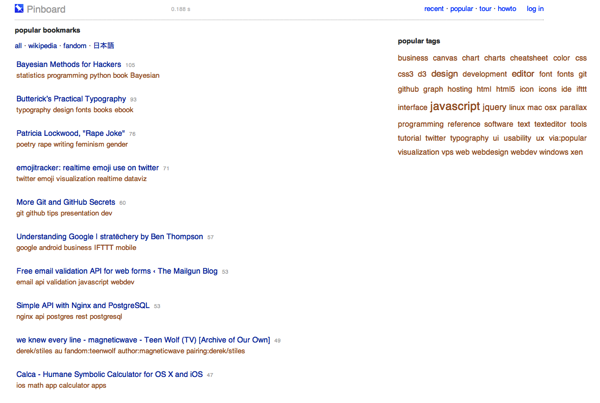
I bookmarked hundreds of items online while researching my story, and Pinboard was a huge help. The Web-based bookmarking site is a kind of “antisocial social bookmarking” service.

That is, Pinboard offers all the benefits of social bookmarking, like the ability to access your saved sites from any browser or computer. But unlike many such services, Pinboard allows you to keep your bookmarks private.

You can also assign your bookmarks tags, so they’re easily sorted by keyword, and use a browser bookmarklet to quickly save a site and apply a label like “read later.” So as I came across various news accounts, books, interviews, and other materials online, I simply added a bookmark in Pinboard and could later go back and filter the sites by keyword.

Pinboard is bare-bones, fast, and easy to use. It was approximately $9 when I signed up last year, I seem to recall, and now costs $10.16. This is a one-time fee that rises as more people join the site.

So those were my top three digital tools: Scrivener, Excel, and Pinboard.

What about you? Have some favorite apps for writing or data organization? Let me know on Twitter or leave a comment below.

Categories
Links

7 Links

2013 07 21 armstrong

  1. Cambodia’s Sam Rainsy Returns to Cheers Before Vote — Bloomberg
  2. Thailand riveted by tale of jet-setting, millionaire monk accused of rape and fraud — AP
  3. Bangkok construction boom faces resistance — Al Jazeera
  4. Fan Runs Arsenal to Video Hit in VietnamWall Street Journal/Southeast Asia Real Time
  5. How Clothes Should Fit — HowClothesShouldFit.com
  6. J.K. Rowling and the Chamber of Literary Fame — Bloomberg
  7. Photo above, via Michael Beschloss on Twitter: “Here is Neil Armstrong back in lunar module after his moonwalk this day 1969…”

(Previous link round-ups are available via the links tag.)

Categories
Misc.

It Is Hot and Humid Here in NYC

2013 07 18 nyc hot

That is all.

Categories
Misc.

What Domesticating Siberian Foxes May Tell Us About Dogs

I recently watched a fascinating segment of the 2009 BBC show “The Secret Life of the Dog”. I’d never seen it, and wanted to share it here. It’s about domesticating foxes in Siberia.

The gist: Over the course of more than 40 years, scientists took normal foxes, which were aggressive toward humans, and looked for the tamest ones.

Then they bred them.

In just a few generations, the foxes — animals that would typically attack humans when threatened — had become completely tame creatures that snuggled the scientists rather than biting their hands.

What’s more, over time, the foxes started to look like…dogs.

Cute dogs.

The tame foxes even developed floppy ears, the color of their coats lightened, and their tails curled.

One theory is that the least aggressive foxes were less fierce because they had retained their juvenile traits into adulthood. And so dogs — domesticated wolves, that is — similarly display the traits of juvenile wolves.

For more, here’s an American Scientist article from 1999 on the experiment. And there’s a Wikipedia page, as well.

I also came across some domesticated fox footage on Youtube taken by someone who appears to own a couple of the creatures. The video becomes extra-remarkable at 1:14:

And finally, in case you’re wondering: It appears that you can purchase your own domesticated Russian fox. (The Cost: $8,900.)

(UPDATE: This post originally contained a link to and embedded clip of the show on YouTube. It’s no longer available there, so I’ve removed them.)

Categories
Sports

My Favorite Moment from the Confederations Cup Final: Brazil Sings the National Anthem

Brazil beat world and European champions Spain 3-0 to win the Confederations Cup last night.

But really, the game was decided before the teams even kicked off.

It was hard to imagine Brazil losing, at home in Rio de Janeiro’s Maracanã stadium, after seeing this (video embedded below and online here):


HIMNO BRASIL by dm_505f34141e1f6

That, my friends, is not a team that is willing to lose on its home turf.

It wasn’t the prettiest game, to be sure, but the Seleção won through sheer determination. And, as the video demonstrates, incredible passion.

Categories
Tech

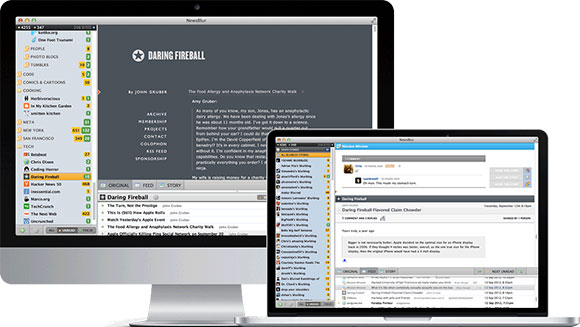
Google Reader Dies Tomorrow. My Replacement: NewsBlur

2013 06 30 newsblur

We’ve known since March that Google Reader, the hugely popular RSS reader, is dying July 1.

That’s tomorrow! (Or maybe even today, depending on where you are.)

I’ve relied on RSS readers to keep track of various blogs and news sites since 2005, and have been trying out several Google Reader replacements in recent weeks.

I wasn’t crazy about Feedly‘s interface, though it’s free.

Feed Wrangler, which is $20 per year, is a hit among the tech elite and seems quite workable. But I didn’t like the folder-less, “smart streams” approach. (Unlike some folks, I’m not looking for RSS innovation. I just want a service that works well, in a Google Reader-esque manner, and looks decent.)

So, with just one day left to until Google Reader officially goes kaput, I settled on NewsBlur, pictured above. I like it a lot so far. The free version has limited functionality, so I sprung for the $24 annual subscription. Here’s a detailed review of NewsBlur.

Other resources: Here’s more on exporting your Google Reader data. And here’s a round-up of several other Google Reader alternatives.

Happy feed reading.

Categories
Misc.

Snippet of the day, fast food edition

2013 06 30 donut sandwich

A snippet from a New York Times story yesterday:

The new menu items added by fast-food chains this year indicate as much: a brownie-batter-filled doughnut (Dunkin’ Donuts), a bacon habanero ranch Quarter Pounder (McDonald’s), bacon-filled tater tots (Burger King), a six-slices-of-bacon-and-cheese burger (Carl’s Jr. and Hardee’s), a choco-covered pretzel and choco chunk vanilla Blizzard (Dairy Queen), and a chocolate molten lava cake (Arby’s).

Then there’s the Glazed Donut Breakfast Sandwich from Dunkin’ Donuts that Mr. Moran tried. It was rolled out nationally this month after a Massachusetts test that was a ‘viral hit,’ the company’s executive chef told The Boston Globe earlier this month. ‘Within days of the test, people were sending pictures, tweeting ‘look what I got!’ or ‘this is so wrong!’ and it was just incredible.’

If unhealthy food is wrong, restaurant visitors apparently don’t want to be right.

Related: See my 2012 post — especially points two and three — about my favorite nutrition book, “Why Calories Count: From Science to Politics.”

(Image: Dunkin’ Donuts.)

Categories
Misc.

AP: ‘Myanmar telecom deal with Qatar firm sparks ire’

The AP reports:

Religious tensions engulfing Myanmar spread Friday to the world of big business: Monks and others in the Buddhist-dominated country demanded to know why a lucrative license for a new national mobile phone network had gone to a company from a Muslim nation.

There’s more on the deal itself from Bloomberg:

Norway’s Telenor ASA (TEL) and Ooredoo QSC (QTEL) of Qatar won licenses to expand telecommunications in Myanmar, one of the world’s last remaining untapped markets where only about one in 10 people has a mobile phone.

The two carriers beat nine other bidders including Singapore Telecommunications Ltd. (ST), billionaire George Soros and Bharti Airtel Ltd. (BHARTI) in the auction. A France Telecom SA-Marubeni Corp. group was named as a backup in case one of the winners doesn’t fulfill final requirements.

The decision ends a six-month race that drew 91 expressions of interest to operate in the country of 64 million people. The licenses are among the biggest prizes for foreign companies since President Thein Sein moved to allow greater political and economic freedom after taking power in 2011. They’ll be awarded according to a telecommunications law that parliament expects to adopt soon, according to a statement yesterday.

(All emphasis mine.)

Categories
Misc.

‘The New Myanmar’: All 6 episodes of Anasuya’s new show

Last month I mentioned that the first two episodes of “The New Myanmar,” hosted by Anasuya Sanyal — also known as my amazing wife — were available online.

The show’s final four episodes have now aired on Channel NewsAsia, as well, and I wanted to embed them here.

Again, here are the first two shows:

Episode one, “Artistic Freedom,” about music and the arts in the country:

Episode two, about Yangon’s architectural heritage:

And now for the newer shows:

Episode three, on business development in Myanmar:

Episode four, on media in the country:

Episode five, about resolving the country’s ethnic conflicts:

And, finally, episode six, on what lies ahead for Myanmar:

Categories
Journalism

Patrick Winn Kicks off Reddit AMA on Myanmar

A quick note: Patrick Winn, a journalist who’s done a lot of reporting on Myanmar for Globalpost, is currently holding a Reddit AMA — (Ask Me Anything) on the country. Worth a look.