The New York Times has the story.
Tag: thaksin
Bloomberg interviewed Thailand’s former prime minister Thaksin Shinawatra and has run two stories that are worth a look.
The pieces are here:
Former Thai Premier Thaksin Shinawatra said his sister’s government will avoid conflicts like those that led to his ouster in a 2006 coup, even as it presses ahead with efforts to curb the power of the courts.
…and here:
Any changes to a Thai law that protects Thai King Bhumibol Adulyadej and other royal family members from insults should come from his advisers, former Prime Minister Thaksin Shinawatra said.
Here’s a reminder — as if any were needed — of how influential (and controversial) Thaksin Shinawatra remains here in Thailand.
Apparently national police chief Priewpan Damapong recently paid a visit to the exiled former prime minister in Hong Kong. Priewpan was reportedly on holiday and wanted to visit Thaksin — his ex-brother-in-law — on the ousted PM’s birthday.
Priewpan is now taking heat for the one-day trip, with Thaksin critics saying the visit was unethical — and that Priewpan should have arrested Thaksin.
The Bangkok Post reports today:
National police chief Priewpan Damapong has come under fire after leaving the country to meet fugitive former prime minister Thaksin Shinawatra in Hong Kong.
Anti-Thaksin critics said Pol Gen Priewpan either breached the law or seriously violated professional ethics in failing to arrest the former leader.
As national police chief, Pol Gen Priewpan had to arrest Thaksin when he met him, they claimed.
Thaksin is in self-imposed exile to escape a two-year prison term for helping his wife purchase a plot of state land in Bangkok during his stint as premier.
Deputy Prime Minister Chalerm Yubamrung Wednesday responded to the criticism saying he did not think Pol Gen Priewpan violated any law by meeting his former brother-in-law, who is celebrating his 63rd birthday in Hong Kong today.
“Why was it inappropriate?” Mr Chalerm shot back when asked to comment by reporters.
He said Pol Gen Priewpan had taken leave to travel to Hong Kong, and could not be considered to have failed to perform his duty because the national police chief had no duties to perform overseas.
“Our laws do not apply in Hong Kong,” Mr Chalerm said.
There’s more from The Nation.
Categories
Economist on Thaksin and Hun Sen
Following my recent post on Thaksin’s Songkran rally next door in Cambodia, I wanted to point out a related Economist piece.
The story examines the exiled former Thai prime minister’s relationship with Cambodia’s PM, Hun Sen:
As much as the rally was a testament to Mr Thaksin’s popularity, it was perhaps even more a reflection of the unusual friendship that has burgeoned between him and Mr Hun Sen over the past few years. At a cost that the Cambodian government has refused to disclose, thousands of its security officers were deployed along with hundreds of support staff including street sweepers, electrical engineers, health workers and many more besides. While much of Cambodia had been shut down over the weekend to celebrate the Khmer New Year, which took place Friday, the authorities in Siem Reap went into overdrive.
Read the whole thing.
Will former prime minister Thaksin Shinawatra end his self-imposed exile and return to Thailand?
The AP reports that Thaksin, on a visit to Cambodia, said his homecoming isn’t far off:
Exiled former Prime Minister Thaksin Shinawatra celebrated Thailand’s most important holiday in neighbouring Cambodia this weekend, telling thousands of fervent supporters who crossed the border to meet him that he intends to return home soon on his own terms.
Thaksin, ousted by a 2006 military coup after being accused of abuse of power and disrespect for the monarchy, led a song-filled rally to mark Songkran, the Thai New Year. Between appearances on stage, he worked the crowd in a manner recalling his past political campaigning.
Thaksin, 62, has been living overseas since jumping bail in 2008 to avoid a two-year jail term on a corruption conviction he says was politically motivated. Saturday’s event, just a few hours’ drive from northeastern Thailand, raises the question: Will he be celebrating the next Songkran at home?
Thaksin – by far Thailand’s most divisive politician – has said in the past few days that his return will be “in the next three to four months”, “not so long” and when “everything is stable”.
He sang several popular songs during his appearance on Saturday, with lyrics changed to stress his homesickness or urge his supporters to support his younger sister Yingluck, the current prime minister. He added an off-key rendition of My Way, which segued oddly into Let It Be.
(On the subject of Thaksin’s singing: Yes, embedded above and on YouTube is footage of him singing “My Way” and “Let it Be.”)
The WSJ, meanwhile, has this analysis of Thaksin’s statements:
Six years after the military coup that ousted him from power, Mr. Thaksin shows he has lost little of his potential to rub his opponents the wrong way. He remains a deeply polarizing force in Thailand at a time when this pivotal Southeast Asian economy is trying to reassure investors after last year’s floods swamped large parts of the country’s industrial belt. The rally in Cambodia also coincided with his younger sister Yingluck Shinawatra’s push to change the country’s post-coup constitution and introduce a possible amnesty for Mr. Thaksin after she became prime minister last year following a landslide election victory—a move that could set the stage for a fresh round of turmoil in the country.
Mr. Thaksin’s foes already view the new government’s plans to change the constitution as a thinly-disguised attempt to enable the former leader to return to Thailand a free man instead of serving a two-year prison sentence on a corruption conviction he says was politically motivated. It is unclear what form the new charter might take, but analysts say the government could be looking at removing constitutional protections for the army officers who planned the 2006 coup.
At the same time, the government is also considering ways to introduce a potential amnesty for people caught up in Thailand’s political violence since 2006. A parliamentary House Committee on National Reconciliation—headed by coup leader turned politician Sonthi Boonyaratglin—has proposed a broad reprieve for key players in the country’s political conflicts, and also has suggested dropping all charges brought by the army’s now-defunct Assets Examination Committee—including the corruption case against Mr. Thaksin.
Elsewhere, on the topic of political reconciliation, The Economist says:
Almost six years after Thaksin Shinawatra…was ousted as prime minister in a coup by royalist generals, it might seem like time to move on. Not a bit of it, Thailand’s politicians seem to think. Legislators have spent the past few weeks arguing obsessively and bitterly about the rights and wrongs of the coup and its long aftermath—all, apparently, in the name of “national reconciliation”. The result, not unexpectedly, is not so much reconciliation as even more recrimination.
Read the whole thing.
And finally, for more analysis of what might happen if the controversial ex-PM were to return, see this New Mandala post: “When Thaksin Comes Home”
(All emphasis mine.)
The video is here.
UPDATE: There’s also a Bloomberg text story to go along with the interview. It says:
Thaksin Shinawatra, deposed as Thai premier in a 2006 coup, said his sister’s seven-month-old government will avoid the same fate due to her good ties with the army and expressed hope he’d return from exile this year.
“As long as there is no issue related to the monarchy, as long as there is no issue about internal security, the military will stay in the barracks,” Thaksin, whose sister Yingluck Shinawatra became prime minister in August, said in an interview yesterday in Seoul. “My sister works hard for the people, she respects the monarchy very much and she can work with the military without conflict.”
Yingluck’s push to rewrite the constitution risks sparking violence like in 2008 when a similar effort by Thaksin’s allies led to protests by his yellow-shirted opponents who shut down parts of Bangkok and seized its airports. Yingluck, a political novice before standing in July elections, is seeking to reassure foreign investors after floods last year swamped thousands of factories and caused the economy to shrink for the first time since 2009.
Categories
Thaksin to Get Thai Passport Back?
Reuters reports today:
Thailand’s self-exiled, fugitive former Prime Minister Thaksin Shinawatra could be reissued his Thai passport within weeks as a “New Year present” from the government, the country’s foreign minister said on Friday.
Thaksin, who lives in Dubai to avoid jail in Thailand, should be granted a regular Thai passport because no court order was issued to revoke it when he fled in 2008, Surapong Towijakchaikul said.
“We are considering returning the passport to former prime minister Thaksin and we expect to be able to do so within weeks,” Surapong told reporters.
“To be fair we are reviewing the laws and we found that the action is possible … it could be a New Year’s present.”
Thaksin, a twice-elected telecoms billionaire who once owned English Premier League soccer club Manchester City, is one of the world’s most well-known fugitives and travels on passports issued by Nicaragua and Montenegro.
(All emphasis mine.)
The Bangkok Post has more.
The death toll from Thailand’s record flooding has risen above 600, the government says.
But both the Bangkok Post and The Nation newspapers are leading with non-flooding news this Monday morning.
The government had reportedly been attempting to arrange a royal pardon for controversial former prime minister Thaksin.
But the headlines today tell us that won’t be happening.
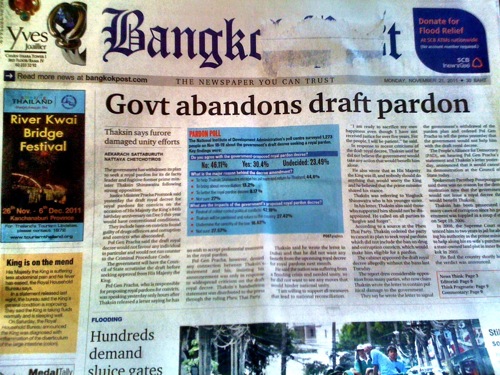
Here’s a cell phone pic of today’s Bangkok Post front page:
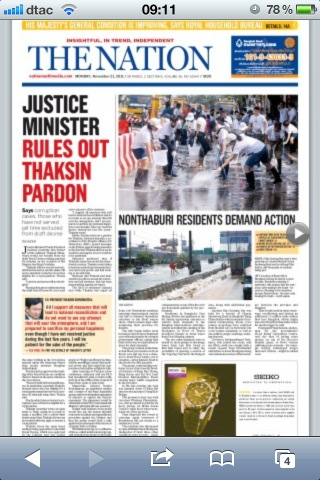
And here, via @tukky_nt, is a screen capture of The Nation‘s leading story.
In its story, the Post says:
The government has withdrawn its plan to seek a royal pardon for its de facto leader and fugitive former prime minister Thaksin Shinawatra following strong opposition.
Justice Minister Pracha Promnok said Sunday the draft royal decree for royal pardons for convicts on the occasion of His Majesty the King’s 84th birthday anniversary on Dec 5 this year would have conventional conditions.
They include bans on convicts found guilty of drugs offences and corruption and convicts who absconded.
And The Nation reports:
Justice Minister Pracha Promnok insisted yesterday that former prime minister Thaksin Shina-watra would not benefit from the draft Royal Decree seeking pardons for inmates on the occasion of His Majesty the King’s birthday.
“Thaksin will not receive any benefit from the decree, and his name will not be included on the list of convicts eligible for a royal pardon,” Pracha said.
“Convicts on the run will not be eligible.”
Pracha told a press conference that the draft Royal Decree for 2012 used the same wording as the 2011 decree enacted under the Democrat Party’s then justice minister Piraphan Saliratwipak.
(All emphasis mine.)
More to come on the ongoing flooding. But I wanted to note that news coverage among Bangkok’s English language papers had temporarily shifted away from the floods.
Perhaps it shows that interest in the floods may be waning — and that underlying political issues (namely, Thaksin’s future) remain pressing.
Today’s WSJ reports on what exiled former prime minister Thaksin Shinawatra has been up to of late.
The story touches on Thaksin’s recent travels, Yingluck, and the administration’s relationship with the military:
BANGKOK—Former Thai leader Thaksin Shinawatra is taking a more visible role in Thailand and across Asia, stirring renewed tensions between the country’s powerful military and a new government led by the populist tycoon’s sister.
During the run-up to July’s national elections, Mr. Thaksin, 64 years old, repeatedly said he would avoid intervening in political decisions if his sister, Yingluck Shinawatra, were elected prime minister. At most, he said, he would help guide Ms. Yingluck—who took office last month—on economic policy.
Political analysts said that was a carefully scripted strategy to tamp down tension between the Shinawatra clan’s populist supporters and Thailand’s powerful armed forces, which ousted Mr. Thaksin in a bloodless coup five years ago and still retain considerable power.
Mr. Thaksin recently has taken heavily publicized trips from his base in Dubai to Japan and Cambodia while his supporters push for a new amnesty law that would enable him to return to Thailand a free man. He has been living overseas to avoid imprisonment on a 2008 corruption conviction.
(Emphasis mine.)
Today’s Bangkok Post says:
Former prime minister Thaksin Shinawatra will begin a visit to Cambodia on Sept 16 to attend the Asian Economic Forum Conference, Cambodian Prime Minister Hun Sen said on Monday, Xinhua news agency reported on its website.
Hun Sen said Thaksin’s visit was scheduled before the official visit of Prime Minister Yingluck Shinawatra, who will make an official one-day visit to Phnom Penh on Thursday.
(Emphasis mine.)