The Thai new year, Songkran, kicks off here in Bangkok and around the country today.
It’s the nation’s biggest holiday, with many businesses shutting down through early next week. The period is known for its water fights, outdoor parties, and general craziness.
I probably won’t be posting much here for the next few days, but you can catch me on Twitter in the meantime.
To get a sense of the what the holiday’s all about, here’s a WSJ Southeast Asia Real Time slide show with some images of the revelry. And CNNGo has a Songkran overview.
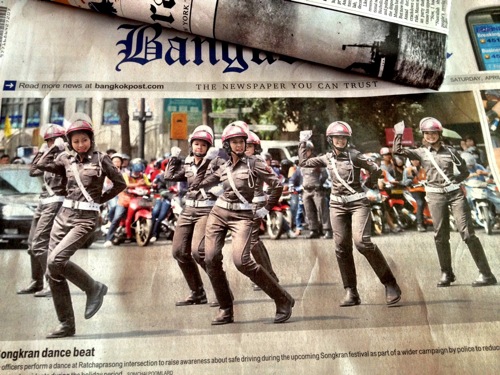
The front page of yesterday’s Bangkok Post was adorned with the photo above. The caption said this group of Thai policewomen was dancing…
…to raise awareness about safe driving during the upcoming Songkran festival as part of a wider campaign by police to reduce fatalities and injuries from road accidents during the holiday period.
Video of what appears to be the performance, along with other footage, is embedded above and available on YouTube here.
According to Thailand News, the song is called “สงกรานต์ขับไม่ดื่ม Songkran-Kub-Mai-Duem (Drink don’t drive in Songkran).”
Drunk driving is an ongoing problem during Songkran, which marks the Thai new year. Non-stop parties and raucous water fights are common throughout the country during this time.
Songkran runs from roughly April 13-16.
Update — April 13: Fixed the title of this post to correct the spelling of Songkran.
Thailand’s film censors have banned an adaptation of Shakespeare’s “Macbeth,” saying it could inflame political passions in the country where it is taboo to criticize the monarchy.
The Thai-language film “Shakespeare Must Die” tells the story of a theater group in a fictional country resembling Thailand that is staging a production of “Macbeth,” in which an ambitious general murders his way to the Scottish throne.
One of the film’s main characters is a dictator named “Dear Leader,” who resembles former Thai Prime Minister Thaksin Shinawatra, whose ouster in a 2006 coup sparked years of political turmoil between his supporters and critics.
Censors at the Culture Ministry issued a brief memo Tuesday saying that the film could not be distributed in Thailand because it “has content that causes divisiveness among the people of the nation.” The memo did not specify which scenes were deemed offensive.
But, Ing K., the film’s director, said the censorship committee objected to anti-monarchy overtones in the film as well as politically charged content, including a scene based on an iconic photo from Bangkok’s 1976 student uprising showing a demonstrator being lynched.
“The committee questioned why we wanted to bring back violent pain from the past to make people angry,” Ing K. said in an interview Wednesday. The censors also disliked the attire of a murderer in the film, who wore a bright red hooded cloak – the same color worn by the pro-Thaksin demonstrators known as the “Red Shirts.”
The director called the ruling “absurd” and a reflection of the fear in Thai society.
Censors in Thailand have banned a film based on William Shakespeare’s tragedy ‘Macbeth’, saying it could cause divisions in the country where an uneasy truce persists after several years of sometimes bloody upheaval and political polarization.
A trailer for the film, directed by Ing Kanjanavanit, shows scenes from Thailand’s recent past, including a 1973 crackdown on student protesters and street clashes in 2010 between the military and anti-government demonstrators in which 91 died.
“The film ‘Shakespeare Must Die’ has content that causes divisiveness among the people of the nation,” the Film Censorship Board said in a statement late on Tuesday. “The film is grouped under films that are not allowed to be distributed in the Kingdom.”
“Shakespeare Must Die,” a new Thai film that bills itself as a Shakespearean horror movie, tells the story of a dictator who suppresses a local staging of “Macbeth.”
But in a case of life imitating art, the Thai government — which partially funded the movie — has banned it, saying its content “causes divisiveness among the people of the nation.”
Directed by Ing K, or Samanrat Kanjanavanit, and produced by “Pink Man” artist Manit Sriwanichpoom, “Shakespeare Must Die” is based on the Scottish Play, with “some cinematic and Thai cultural adaptations,” according to a director’s statement.
And:
Shakespeare “is barely heard of in Thailand,” its website says, “a country that is actually living through Shakespearean times.”
The film’s official trailer, embedded above, is on YouTube here.
As Myanmar tallies the last votes from Sunday’s critical parliamentary by-elections, many business leaders are pondering the implications of the country’s recent run of political reforms. For many Southeast Asia-based companies, the big issue is whether migrant workers from the country also known as Burma decide to return home, resulting in a tighter labor market – especially in Thailand.
Give it a read and please consider sharing it on Facebook or Twitter, if you’re so inclined.
A quick follow up on my post yesterday highlighting the BBC video report on Dejchat Phuangket, a Bangkok motorcycle taxi driver and social media maven.
Thanks to Byron at Coconuts Bangkok for getting in touch to say that his site has also run items on Khun Dejchat.
The first post provides an overview of Dejchat’s work following the Valentine’s Day explosions.
The second is a longer interview with Dejchat. One interesting tidbit on offer here: The story points out that he created an interesting Web site about his hometown in Sisaket province. (Warning: The site employs auto-loading luk thung music!)
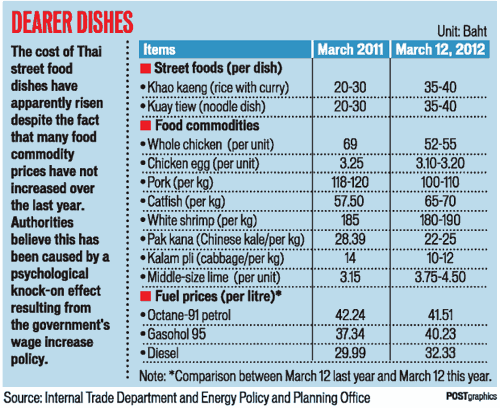
According to a story in today’s paper, the prices of commodities like meat and eggs has actually been falling over the last year, and fuel prices are now lower or slightly higher than they were this time last year.
But vendors, anticipating Thailand’s coming minimum wage increase, have been increasing their prices.
People across the country are being squeezed in the economic vice of rising inflation and stagnant incomes.
Just one year ago, a simple dish of khao kaeng (rice with one side dish) was 25 baht, but today some street vendors, shop-house stalls or food courts are selling it at 40 baht.
According to the latest Abac poll, almost 64% of people say they are more concerned with what to eat than with any political conflicts that might result from charter amendments.
My experience is that dishes in my neighborhood have not, in fact, been increasing in price drastically. However, I have noticed a slight decline in the quality and quantity of dishes.
(For the record: In the chart above, when you figure that $1 is about 30 Thai baht, we’re still talking about dishes that are, by Western standards, quite cheap.)
Twin brothers have confessed they assaulted a professor who leads a campaign to reform laws concerning Thailand’s monarchy, police said Thursday.
Police Lt. Gen. Winai Thongsong said Supot and Supat Silarat turned themselves in and admitted punching Worachet Pakeerut in a parking lot at Bangkok’s Thammasat University because of “differing views.”
Worachet and other members of a group called Nitirat, or Enlightened Jurists, have drawn criticism for seeking to reform Thailand’s lese majeste law. The law mandates prison terms of up to 15 years for insulting the monarchy.
Winai said the brothers acted on their own in Wednesday’s attack.
“I was not happy,” Supat said, as police discouraged him from speaking at a news conference. The brothers said they sell clothes and perfume for a living.
The Bangkok Posthas more, including a photo of the brothers.
A Thai protest leader whose movement helped topple three prime ministers was sentenced Tuesday to 20 years in prison for falsifying financial documents aimed at securing a $32 million government bank loan for his media empire.
Sondhi Limthongkul faces separate charges in connection with the aggressive protests of his People’s Alliance for Democracy, or Yellow Shirts, who in 2008 occupied the prime minister’s offices for three months and Bangkok’s two airports for a week. The group is still active, though less influential.
The 64-year-old Sondhi pleaded guilty to crimes involving documents he submitted for his Manager Media Group to secure a 1 billion baht loan in 1997 from the state Krung Thai Bank.
He was sentenced to five years each on 17 counts, but the 85-year term was halved because he pleaded guilty. The final sentence was capped at 20 years because it is the maximum allowable on the charge.
He was later released on 10 million baht ($328,000) bail pending appeal of his sentence.
A Thai man who helped lead anti- government protests was sentenced to seven and half years in jail for insulting the royal family.
Surachai Danwattananusorn, 68, had a 15-year prison term cut in half because he pleaded guilty to the charges, Bangkok’s Criminal Court said today. His legal team will seek a royal pardon, even as police investigate an additional complaint against Surachai, lawyer Karom Ponpornklang told reporters.
“Surachai has accused the monarchy of being behind protests and conflicts in the country,” the court said in its ruling. “This is not true as the monarchy’s activities are for the benefit of Thai people. His move is considered a severe offense and does not deserve a suspended punishment. He’s mature and he still does this.”
A Thai court has sentenced a member of the Red Shirt political movement to 7 1/2 years imprisonment for remarks judged to have insulted the country’s monarchy.
The court ruled Tuesday that 70-year-old Surachai Danwattananusorn made speeches against the monarchy three times in 2010.
Surachai was a communist insurgent in Thailand in the 1970s and was imprisoned in the 1980s. More recently he has led a faction of the Red Shirts, who that took to the streets and clashed with the military in 2010.