Categories
Tech

The Emails and Texts That Show How Badly Instagram Wants me Back


2018-03-15_instagram

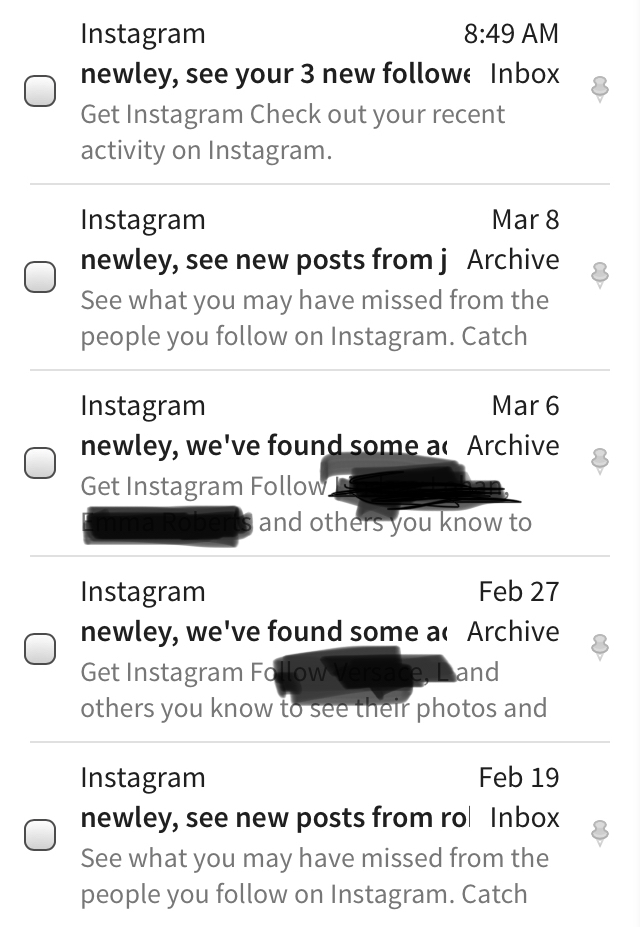
Around February 15 – about month ago – I decided I would delete the Facebook and Instagram apps from my iPhone.

I haven’t quit these services entirely, and at this point don’t immediately intend to (I can still view both via a browser).

But I wanted to take a break given all I’ve been reading lately about how social media apps are engineered to hijack our attention in order to keep serving us ads.  (What about Twitter? I have no plans to abandon the app for now, as its enormously helpful for following the news.)

I’d heard about people receiving plaintive emails and even text messages from these platforms attempting to get them to re-engage. So I figured I’d document my experience here.

While I’ve received some emails from Facebook, Instagram, especially, really seems to want me back. And I’m not even a power user, much less an “influencer.” I have several hundred followers, but less than a thousand.

Anyway, above are the five emails I’ve received from the service since I last opened the app. I also received two text messages, spaced just a few days apart, roughly two weeks into my hiatus:

IMG-5575IMG-5604

Stay tuned. I may update this post as I receive more messages. Assuming Instagram hasn’t given up on me yet…
Categories
Journalism Tech

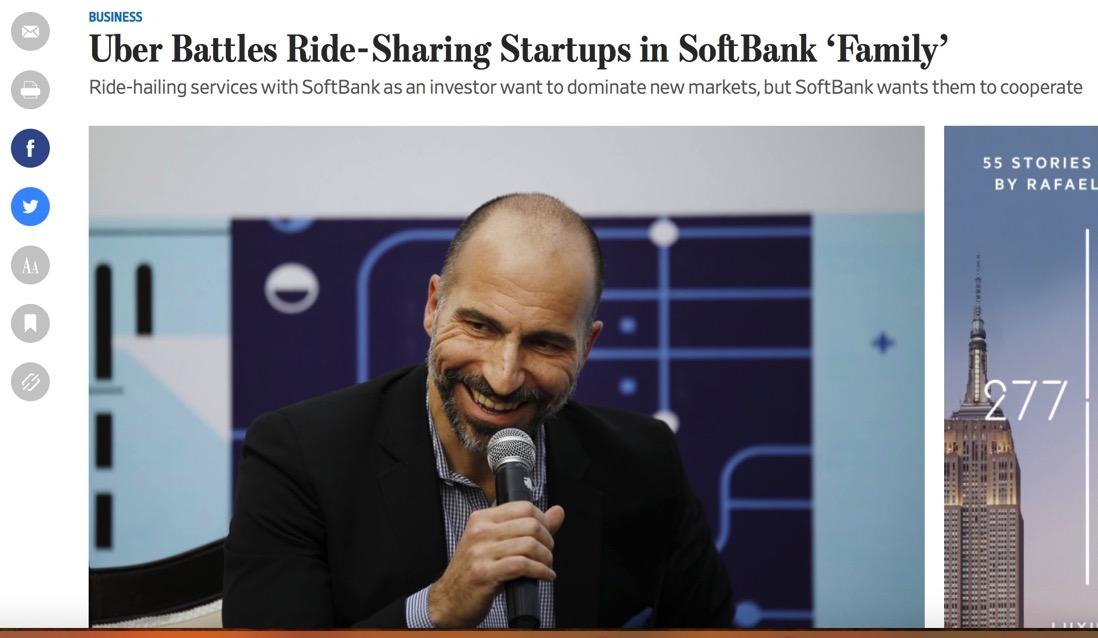
Uber Battles Ride-Sharing Startups in SoftBank ‘Family’

2018 03 04uber sb

That’s the headline of my newest story, which I wrote with my colleage Mayumi Negishi, out today. It begins:

SoftBank Group Corp., the world’s biggest technology investor, has poured some $20 billion into ride-sharing companies around the globe, including Uber Technologies Inc.

Now, those companies are spending at least some of SoftBank’s money to battle each other.

In Japan, Uber is gearing up to fight China’s Didi Chuxing Technology Co., which is planning to enter the market after an investment by SoftBank of around $10 billion.

In India, Uber is facing off with local champion ANI Technologies Inc.’s Ola, in which SoftBank has about a 30% stake and a board seat. SoftBank invested $7.7 billion in Uber for a 15% stake this year.

Uber and Ola are also grappling in Australia, where Ola started operations in February. Uber in Southeast Asia is trailing Singapore’s Grab Inc., whose president joined from SoftBank in 2016 following its $750 million investment in the company.

Click through to read the rest.

Categories
India Journalism Tech

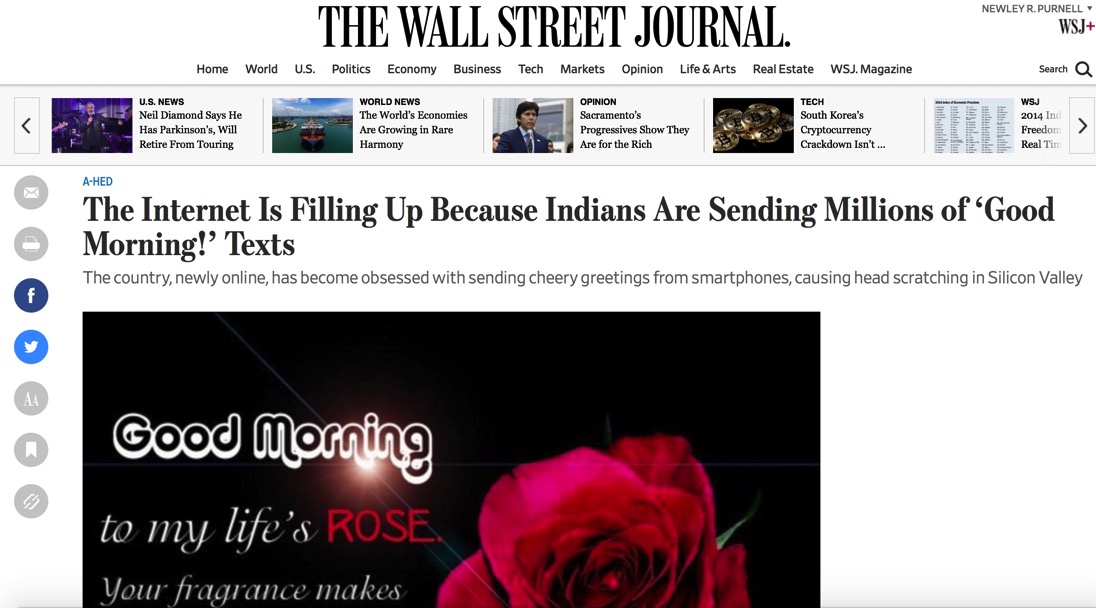
The Internet Is Filling Up Because Indians Are Sending Millions of ‘Good Morning!’ Texts

Goodmorning 2018 01 23

That’s the headline of my newest story, an A-hed out yesterday.

It begins:

Google researchers in Silicon Valley were trying to figure out why so many smartphones were freezing up half a world away. One in three smartphone users in India run out of space on their phones daily.

The answer? Two words. “Good Morning!”

The glitch, Google discovered, was an overabundance of sun-dappled flowers, adorable toddlers, birds and sunsets sent along with a cheery message.

Millions of Indians are getting online for the first time—and they are filling up the internet. Many like nothing better than to begin the day by sending greetings from their phones. Starting before sunrise and reaching a crescendo before 8 a.m., internet newbies post millions of good-morning images to friends, family and strangers.

All that good cheer is driving a 10-fold increase in the number of Google searches for “Good Morning images” over the past five years. Pinterest, the San Francisco visual-search platform, added a new section to display images with quotes. It saw a ninefold increase over the past year in the number of people in India downloading such pictures.

Facebook Inc.’s WhatsApp messaging service—which has 200 million monthly active users in India, making the country its biggest market—added a status message last year so users could say good morning to all of their contacts at once.

The story, which is on the front page of Tuesdays print WSJ, seems to have touched a nerve. It’s been widely shared online, and has been among the most popular stories on WSJ.com since it was published.

Categories
Tech

My Favorite Email Newsletters of 2017

email_newsletters

In an age of information overload, email newsletters remain an excellent way to keep abreast of topics you’re interested in without having to try to monitor the daily output of traditional media outlets, tweets from every corner of the world, various cable news shows, streaming content, Facebook posts, blogs and more.

After all, email simply comes to you, and you can benefit from experts’ curation of the most important, timely, informative, entertaining material.

Here are some of my faves:

General news and politics

  • Axios AM, by beltway insider Mike Allen. Ten things you need to know for the day. (It’s delivered in the mornings, U.S. time, so arrives in the early evening here, but is still great.)
  • Today’s Paper, from The Wall Street Journal. All the day’s most important stories, arranged by section. Yes, just like an actual newspaper!

  • Sunday New New York Times Digest, by Matt Thomas. A weekly rundown of highlights from the famously large edition.

  • The New Yorker Minute. A weekly scan of must-reads and okay-to-skips from the print magazine. Tagline: “Your secret weapon against the Three-Foot-Tall Stack Of Unread New Yorkers Sitting In Your Apartment.”

Media:

  • Reliable Sources. The day’s top media news, by CNN’s Brian Stelter. Especially helpful in these fraught times, when it can be hard to stay on top of things.

  • Morning Media. Politico’s daily “guide to the media circus.” A bit more inside baseball, with industry news like comings and goings of journalists from one outlet to another.

Tech

  • Briefing, from The Information. A daily, subscriber-only dispatch with commentary from the site’s journalists on the biggest tech news, as it happens. Highly informative.

  • Exponential View, by Azeem Azhar. A weekly, in-depth review of recent tech news, with an emphasis on artificial intelligence.

  • Asia Tech Review, by Tech Crunch’s Bangkok-based Jon Russell. A weekly round-up of what’s happening in this part of the world, broken down by country and region. If it’s big tech news in the region, you can trust Jon will be on it.

  • Login, another from Axios. This one’s penned by Ina Fried. The top tech news, every day, with a healthy sense of humor.

  • Recode Daily. Stories from the well-known tech site and other sources.

  • Mine! To get Newley’s Notes – my recent writings and five interesting tech-related stories every week – just click here and enter your address in the box.

Others

  • Longform. The week’s best deep dives.

  • Noticing. A newsletter just launched by Jason Kottke, whose blog I’ve been reading for more than 15 years. I’m confident it’s gonna be great.

Related post from 2013: Some of My Favorite Email Newsletters.

Categories
India Journalism Tech

A Browser You’ve Never Heard of Is Dethroning Google in Asia

Uc browser

That’s the headline of my newest story, out today. It begins:

JAKARTA, Indonesia—A mobile browser rarely used in the West has outflanked Google’s Chrome in some of Asia’s fastest-growing markets, giving owner Alibaba Group Holding Ltd. an advantage in the race among technology giants to capture the next generation of internet users.

Hundreds of millions of people in India, Indonesia and other emerging markets getting online for the first time are picking UC Browser, owned by Chinese e-commerce giant Alibaba, over ones made by U.S. rivals. Users say UC Browser works better in countries dominated by low-end smartphones and spotty mobile service.

“It’s faster, it takes up less memory, and it looks better” than Chrome, said Rizky Ari Prasetya, a 20-year-old Jakarta resident who recently ditched Chrome for UC Browser.

India and Indonesia are among the last, great untapped markets for internet users. Just 30% of India’s 1.3 billion people are online, and only 25% of Indonesia’s 260 million use the web, according to the International Telecommunication Union, a United Nations body.

Click through to read the rest.

Categories
Tech

4 Factors that Explain Bitcoin’s Rise

money1

More on Bitcoin, following my recent Newley’s Notes devoted to the digital currency:

Financial advisor and author Ben Carlson has a post at his (quite enjoyable) blog, A Wealth of Common Sense, on how to explain the rise of Bitcoin. He puts it down to the following factors:

  1. Storytelling — the narrative — which may be true — is that Bitcoin represents a new kind of paradigm and none of the old rules about other asset classes apply.
  2. Technology — the block chain represents a legitimate technological leap, hence there is legitimate excitement.
  3. Decentralization — the global financial crisis has weakened our faith in institutions like big banks, and Bitcoin is basically institution-free.
  4. Resilience — Bitcoin has crashed before, but continues to rise, he says.

He concludes:

Anyone who tells you they know where this thing is heading, how to value it, where it ends, etc. is nuts. No one has a clue. This is everything you’ve ever read about the markets all wrapped into one — FOMO, supply & demand, human nature, behavioral biases, volatility, booms, busts, uncertainty about the future, etc.

Seems about right to me.

Categories
India Journalism Tech

By Me Yesterday: Google, India, and the Future of the Web

india_traffic

The story begins:

NEW DELHI—An explosion of smartphone usage in India is changing the way Alphabet Inc.’s Google sees the future of the internet.

As a mobile price war in the South Asian nation has slashed data rates to less than $5 a month for unlimited high-speed access, hundreds of millions of people are getting online for the first time and bingeing, stretching their low-end smartphones to the limit.

The Mountain View, Calif., company rolled out several apps and functions Tuesday aimed directly at these net newbies and those like them in other emerging markets.

As online activity here has increased this year, the inexpensive smartphones used by many consumers have struggled to handle the surge. To help, Google has shrunk the file size of its mobile operating system and many popular apps. Users in India are frequently offline so Google has given them the ability to do more without an internet connection. Also, they are much more likely to get around on motorcycles than in cars so Google Maps has started offering suggested routes and travel-time estimates for two-wheelers.

Click through to read the rest.

For more on the products, here’s a blog post from Google containing additional details.

Categories
Journalism Tech

By Me Today: Uber Hits Roadblocks in Southeast Asia

2017-11-28ubergrab

The story begins:

SINGAPORE—When Uber Technologies Inc. retreated from China last year after conceding a costly battle with a local rival, the ride-hailing giant vowed to devote new resources to winning other lucrative markets in Asia.

Since then, Uber has suffered setbacks in Southeast Asia, a region of 600 million people, where it has been outflanked by another local player, Grab Inc., which is gobbling up market share. Grab has expanded more rapidly, been more nimble in meeting local preferences, analysts say, and has forged better relations with regulators.

Grab has more monthly active users than Uber across six Southeast Asian countries, according to app analytics firm App Annie, while a May report from consultancy Bain found users across the region prefer Grab to Uber.

Now Uber investors and analysts believe the region may be the next to be ceded by Uber, which withdrew from Russia in July.

Click through to read the rest.


Categories
India Journalism Tech

By Me Today: India’s Ola in Talks to Raise Up to $2 Billion

traffic-671399_640.jpg

The story begins:

NEW DELHI—Uber Technologies Inc.’s rival in India, Ola, is in talks to raise as much as $2 billion, a cash injection that would provide added fuel to fight the San Francisco ride-hailing giant in the world’s second-most-populous country.

ANI Technologies Pvt.’s Ola, based in Bangalore, is in discussions to receive the funds from Japan’s SoftBank Group Corp. and possibly one or more other backers, according to a person familiar with the matter.

Ola, which launched in 2011—two years before Uber’s arrival in India—is locked in a tight battle with the U.S. firm for control of the Indian market, which could prove lucrative as millions of people join the internet economy via inexpensive smartphones.

Click through to read the rest.

Categories
India Journalism Tech

By Me Today: Google Wants a Piece of Mobile Payments in India

2017-09-18rupee

The story begins:

Alphabet Inc.’s Google is aiming for a piece of India’s booming—but increasingly crowded—mobile-payments business.

The Mountain View, Calif., tech giant on Monday launched its first-ever smartphone app that lets users transfer money to individuals and businesses in the country without the use of a credit or a debit card, a crucial factor since many here lack plastic.

Click through to read the rest.

So, to re-cap the state of play as people leapfrog from cash (over credit cards) to payments via smartphones here:

  • Paytm — which we profiled back in June — is the market leader, with more than 225 million users. There are other popular services here, as well, like Mobikwik.
  • WhatsApp, with 200 million users in India, is exploring a payments feature.
  • Hike, India’s biggest home grown app, added a payments feature a few months ago.

Watch this space.