Categories
India Journalism Tech

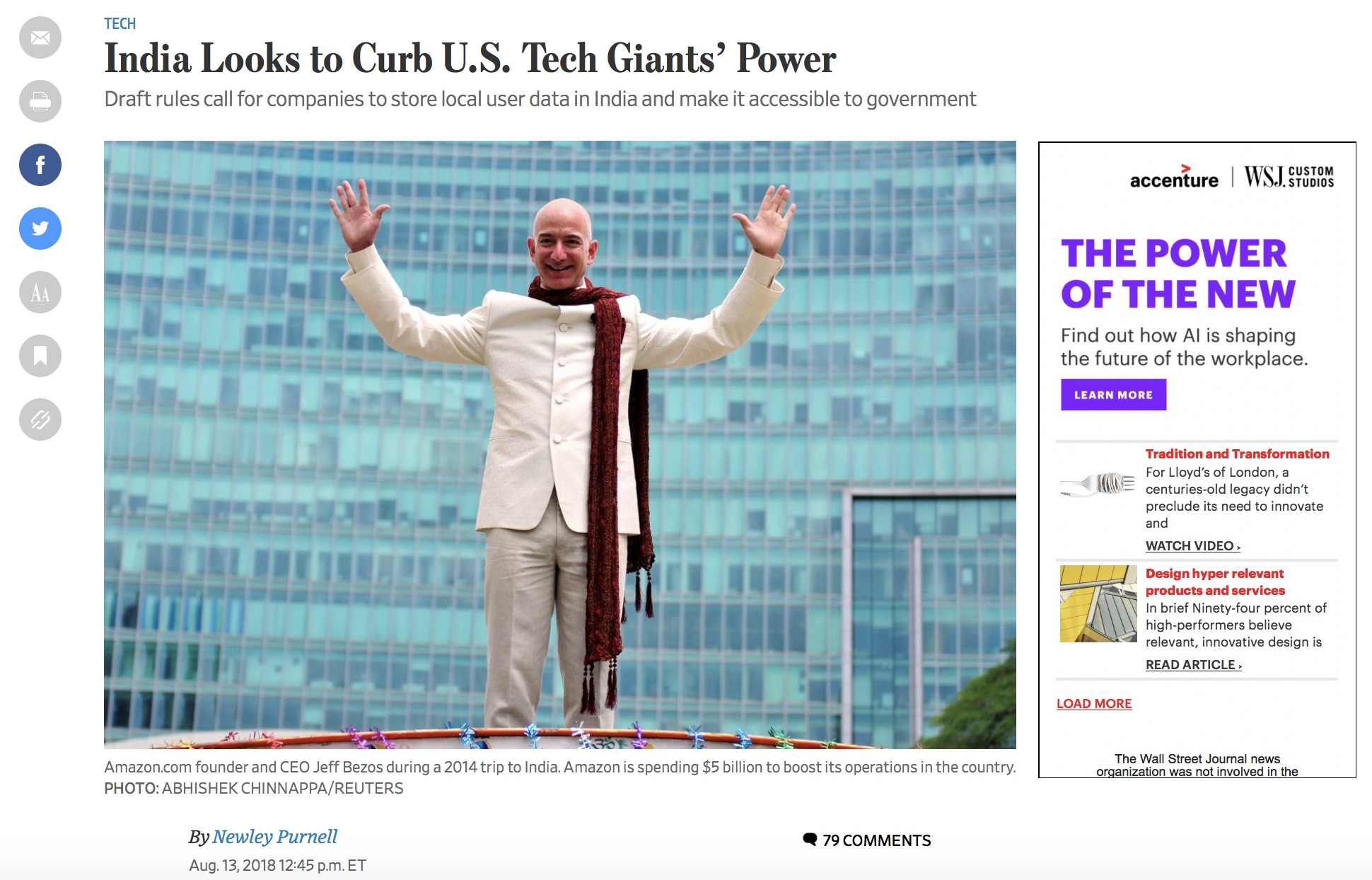
India Looks to Curb U.S. Tech Giants’ Power

That’s the headline of my most recent story, which came out Monday and was in Tuesday’s print Wall Street Journal. 

It begins:

Indian policy makers are looking for ways to tamp down American tech behemoths, a shift that could crimp growth potential in one of the biggest remaining open markets for their expansion.

India wants to slap new rules on Amazon.com Inc., Apple Inc., Alphabet Inc.’s Google, Facebook Inc. and other firms, using a page from China’s playbook to take control of its citizens’ data and shelter homegrown startups.

The proposed rules, which have emerged in recent weeks in a series of private, draft government policies, have U.S. tech companies concerned, according to   familiar with the matter. American firms are betting billions on the Indian market because, unlike China’s, it has been relatively open to foreign competitors. That might be about to change.

“It is unprecedented and it needs to be taken very seriously,” said Vinay Kesari, a Bangalore-based technology lawyer specializing in regulatory matters who has worked with U.S. tech firms. “It could have huge implications.”

Click through to read the rest.

Categories
Book Notes Tech

Book Notes: ‘The Master Switch,’ by Tim Wu

From time to time I share notes about the books I’ve been reading, or have revisited recently after many years.

These posts are meant to help me remember what I’ve learned, and to point out titles I think are worth consulting. They’re neither formal book reviews nor comprehensive book summaries, but simply my notes from reading these titles.

For previous postings, see my Book Notes category.

The Master Switch: The Rise and Fall of Information Empires

Published: 2010
ISBN-13: 978-0307269935
Amazon link

Brief Summary

All new communications media are at first open, but come to be dominated — closed — by corporations. “The cycle” is happening again with the internet.

My Notes

In this meticulously researched and prescient* 2010 book, Columbia University Law Professor Tim Wu, who famously coined the term “network neutrality,” shows how radio, film, television and cable all began as wide-open playgrounds for hobbyists. Then large corporations took over, exercised monopoly control, and have stifled innovation.

Wu says this represents “the cycle.” As he writes, “information empires” eternally “return to consolidated order however great the disruptive forces of creative destruction.”

What is “the master switch“? Wu takes the phrase from CBS executive Fred Friendly, who:

…thought that the shortage of TV stations had given exclusive custody of a ‘master switch’ over speech, creating ‘an autocracy’ where a very few citizens are more equal than all the others.’

  • It’s important to note that the book was published in 2010, the same year that the Arab Spring began. Eight years ago there was, in my mind, a much more utopian view of what the web could become: a place for free speech to blossom, where everyone can have a voice and speak truth to power.

That was, of course, long before the rising skepticism of how platforms like Facebook and Twitter wield their power, and long before “fake news” and Russian trolls. And it was, of course, before Obama’s 2015 net neutrality rules — and before FCC Chairman Ajit Pai rolled them back last year.

My notes on other tidbits from history that I enjoyed reading about:

  • RCA dominated radio, then suppressed the release of TV until they could control the medium, Wu writes.
  • In the 1940s AT&T killed through a series of lawsuits an inventor’s simple, useful contraption called the Hush-a-Phone; it was, Wu writes, an example of a corporation stifling innovation.
  • The breakup of the Hollywood monopolies, in which studios owned theaters and produced fairly bland content, gave rise to the “new Hollywood” and classic films of the 1970s, such as “The Godfather” and “Bonnie and Clyde.”
  • At Apple, Steve Wozniak wanted openness (i.e. Apple II, which could be tinkered with); Steve Jobs wanted things closed (i.e. the Mac, which was sealed). Wu says Wozniak told him “That was Steve. He wanted it that way. The Apple II was my machine, and the Mac was his.”
  • Google wants the web to remain open, even though it has enormous power. Wu writes:

    In fairness, it must be allowed that Google has remained more committed to openness than any information empire before it. What now seems possible, if unprecedented, is a well-defended Internet monopolist running a mostly open system.

  • Wu recounts an interesting Google anecdote:

    In the fall of 2010, I was on Google’s campus speaking of cycles, of open and closed, centralization and decentralization. A senior employee raised his hand. “You have a good point,” he said. “When you’re a new company, getting started, openness seems really great, because it offers a way in. But I have to admit, the bigger you get, the more appealing closed systems starts (sic) to look.”

  • Finally, Wu says the stakes are much higher when it comes to the web, compared to other media. That’s because “our future…is almost certain to become an intensification of our current reality: greater and greater information dependence in every matter of life and work, and all that needed information increasingly traveling a single network we call the internet…already there are signs that the good old days of a completely open network are ending.”
Categories
Journalism Tech

App Traps: How Cheap Smartphones Siphon User Data in Developing Countries

That’s the headline of a story out Thurs. and in Friday’s paper that I wrote with my colleagues Josh Chin, Myo Myo, and Kersten Zhang. It begins:

For millions of people buying inexpensive smartphones in developing countries where privacy protections are usually low, the convenience of on-the-go internet access could come with a hidden cost: preloaded apps that harvest users’ data without their knowledge.

One such app, included on thousands of Chinese-made Singtech P10 smartphones sold in Myanmar and Cambodia, sends the owner’s location and unique-device details to a mobile-advertising firm in Taiwan called General Mobile Corp., or GMobi. The app also has appeared on smartphones sold in Brazil and those made by manufacturers based in China and India, security researchers said.

Taipei-based GMobi, with a subsidiary in Shanghai, said it uses the data to show targeted ads on the devices. It also sometimes shares the data with device makers to help them learn more about their customers.

Smartphones have been billed as a transformative technology in developing markets, bringing low-cost internet access to hundreds of millions of people. But this growing population of novice consumers, most of them living in countries with lax or nonexistent privacy protections, is also a juicy target for data harvesters, according to security researchers.

Smartphone makers that allow GMobi to install its app on phones they sell are able to use the app to send software updates for their devices known as “firmware” at no cost to them, said GMobi Chief Executive Paul Wu. That benefit is an important consideration for device makers pushing low-cost phones across emerging markets.

“If end users want a free internet service, he or she needs to suffer a little for better targeting ads,” said a GMobi spokeswoman.

Click through to read the rest.

Categories
India Tech

Somehow I Missed this Bill Gates Quote

Bill Gates quote

Here’s a photo of a poster I recently spotted for sale by a sidewalk vendor here in New Delhi’s Connaught Place.

Yes, it has the billionaire Microsoft founder and now famed philanthropist Bill Gates saying:

“If you born poor it’s not your mistake, but if you die poor it’s your mistake.”

Hmm…

Categories
Journalism Tech

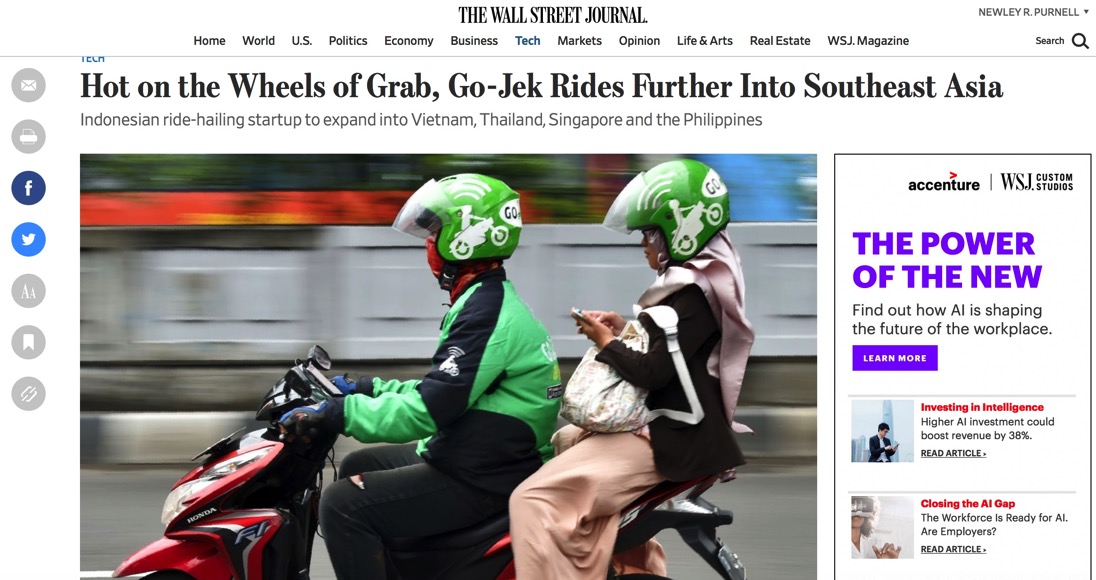
Hot on the Wheels of Grab, Go-Jek Rides Further Into Southeast Asia

gojek southeast asia

That’s the headline of a story out Thurs. that I wrote with my colleage P.R. Venkat. It begins:

Motorcycle-taxi service PT Go-Jek Indonesia will invest $500 million to expand its operations in Southeast Asia, revving up competition in a fast-growing consumer market just two months after Uber Technologies Inc. reached a landmark deal to exit from the region.

The Indonesian company said in a statement Thursday it plans to enter Vietnam, Thailand, Singapore and the Philippines in the next few months and is currently working with regulators and stakeholders across the region.

Go-Jek will initially offer motorcycle-hailing services in Vietnam, Thailand and the Philippines, and provide traditional taxi services in Singapore, where motorcycle taxis aren’t permitted, a company spokesman said. The move, in effect, puts Go-Jek in direct competition with regional market leader Grab Inc.

Click through to read the rest.

Categories
India Journalism Tech

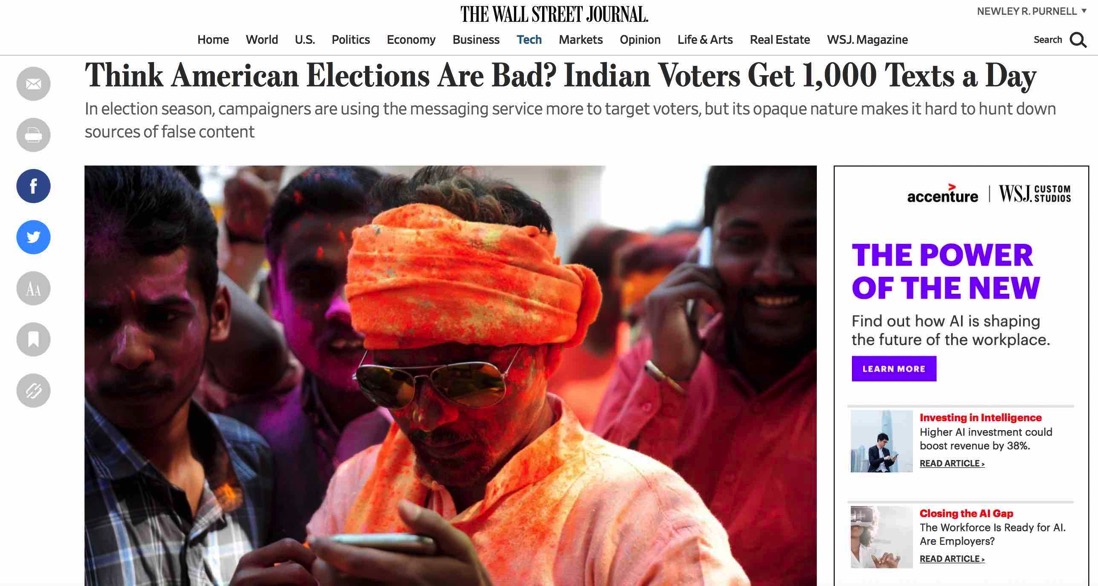
Think American Elections Are Bad? Indian Voters Get 1,000 Texts a Day

2018 05 16whatsapp

That’s the headline of my most recent story, out yesterday, which I wrote with a few colleagues. It begins:

For Gurupad Kolli, a 40-year-old lawyer who lives in a remote Indian village, the torrent of WhatsApp messages surging to his phone a few weeks ago meant one thing: election day was near.

They’re at turns strident, angry, buoyant, informative, misleading, gripping and confusing, he says. Some days he received as many as 1,000 of them through the popular messaging service. Pleased to no longer “depend on the mass media like newspapers,” the resident of Ramapur village in the southern state of Karnataka nonetheless also conceded “there’s so much false and fake news going around.”

He isn’t alone in his bewilderment. The rapidly falling cost of smartphones and mobile data in the world’s second-most-populous nation has turbocharged the spread of WhatsApp, where it is growing far faster than other social media and messaging platforms such as Twitter and Facebook.

India is home to more WhatsApp users than any other country, accounting for more than 200 million of the 1.5 billion monthly active global users. That rivals the popularity in India of Facebook Inc., which owns WhatsApp. Tens of millions of Indians of all ages have made the messaging service, which is simple to join and use, their entry point to the world of digital communication, especially in poor, remote areas where users are flocking to the internet for the first time.

Click through to read the rest.

Categories
Journalism Tech

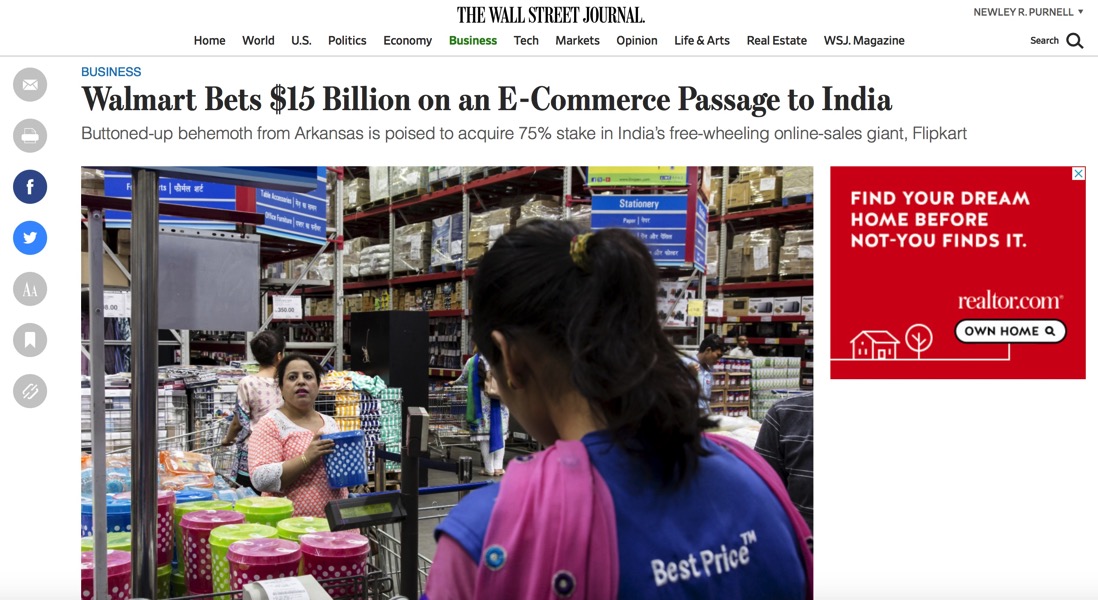
Walmart Bets $15 Billion on an E-Commerce Passage to India

Walmart filpkart

That’s the headline of a story just out today with my colleagues Eric Bellman and Corinne Abrams: It begins:

NEW DELHI—The famously frugal and focused Walmart Inc. is betting $15 billion on a much different kind of company: a sprawling Indian e-commerce startup that has burned through mountains of cash to try to conquer the country’s online shopping market.

The deal for a roughly 75% stake in Flipkart Group is set to be announced as early as this week.

If the union works, it could provide India’s leading online seller needed funds and traditional retailing expertise, while Walmart would be well-positioned for e-commerce in the world’s second-most-populous nation.

“I would not have bet on a deal converging between Walmart and Flipkart, primarily because of the culture difference,” said Kashyap Deorah, a veteran internet entrepreneur and author of “The Golden Tap,” a 2015 book detailing the history of Indian tech startups.

“Walmart is an extensively positive margin driven culture, and Flipkart has consistently been a gross margin negative business,” he said. The deal shows “Walmart considers India as a long-term strategic market,” he said.

Click through to read the rest.

Categories
India Journalism Tech

Walmart Looks to Scale Back in U.K. and Brazil, With an Eye on India

walmart

That’s the headline of a story just out with my colleagues Sarah Nassauer and Luciana Magalhães: It begins:

The world’s biggest retailer has concluded it can’t take on the whole world by itself.

Walmart Inc. is in discussions to give up control over hundreds of stores in the U.K. and Brazil, two big markets where it has struggled for years, according to people familiar with the talks. At the same time, it is preparing to pour billions of dollars into an Indian e-commerce startup to crack a promising market that has long eluded the U.S. giant.

After spending decades building stores around the globe and taking on local players, Walmart is forming joint ventures in competitive markets and focusing investments in areas executives think will provide growth to a company with $500 billion in annual sales. The strategy shift comes as Walmart works to fend off Amazon.com Inc. and a growing crop of discount grocers in the U.S. and abroad.

And more on India:

At the same time, Walmart in advanced discussions to buy a majority stake in Flipkart Group, a homegrown startup that has become India’s largest e-commerce company. The deal isn’t yet complete and could fall apart, said a person familiar with the Flipkart discussions. Flipkart said it was valued at $11.6 billion in a funding round last year.

Click through to read the rest.

Categories
Sports Tech

Cryptocurrency Mania Comes to the Premier League?

IMG 5850

File under: Life in 2018, cryptocurrency edition:

My favorite Premier League team, Arsenal, now shows ads at its grounds for Cashbet Coin, which bills itself as the club’s “official cryptocurrency partner.”

I did a little digging.

Apparently I missed this Reuters story from January:

English soccer team Arsenal is entering the cryptocurrency world by signing a deal to promote new digital tokens being sold by an American gaming software company.

California-based CashBet said on Wednesday that the Premier League club had agreed to become its “exclusive and official Blockchain Partner” ahead of the upcoming “initial coin offering” (ICO) of its new cryptocurrency, “CashBet Coin”.

The partnership makes Arsenal “the first major team in world football to officially partner with a cryptocurrency”, CashBet said in a statement.

Who knew?

Categories
Journalism Tech

Alibaba Bets Another $2 Billion on Southeast Asia

2018-03-21_alibaba_lazada

That’s the headline of a story I wrote with my colleague Liza Liz, which ran on Monday. It begins:

Alibaba Group Holding Ltd. Executive Chairman Jack Ma is doubling down on Southeast Asia, investing another $2 billion in e-commerce subsidiary Lazada Group and naming trusted confidante Lucy Peng as its chief executive.

The investment announced Monday comes on top of the $2 billion the Chinese e-commerce giant has poured into Lazada since buying a majority stake in 2016.

Singapore-based Lazada operates online marketplaces in six Southeast Asian countries including Indonesia, selling everything from lipstick and car wax to instant coffee and smartphones.

Click through to read the rest.