Categories
Misc.

Thaksin asset verdict: today’s front pages

Here’s quick look at the front pages of today’s Bangkok Post and the Nation:

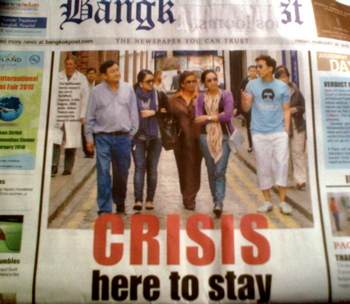
The Bangkok Post went with a photo of the Thaksin family and the headline “CRISIS here to stay.”

It’s below the fold in the (crappy cell phone) image here, but a pull-quote for the lead story ((Note that the Post‘s Web site looks different at the moment.)) reads, “Red shirts target not just the govt but also the elite, which the military will protect.”

thaksin_family_bkk_post.jpg

The Nation, meanwhile, has this: “Let JUSTICE Be Done,” says the headline. It may be too small to read in this image, but it continues with an ominous “though the heavens may fall…”

nation_let_justice_be_done.jpg

(Nation image via Nation editor @suthichai on Twitter.)

More soon…

(Update: Welcome, BP readers. For more posts about Thailand, be sure to subscribe to the Newley.com RSS feed and follow me on Twitter.)

Categories
Misc.

More on tomorrow’s Thaksin asset ruling: NYT and WSJ stories of note

thaksin.jpg

Two more stories I wanted to point out as we approach tomorrow’s verdict on ousted ex-Prime Minister Thaksin’s frozen assets.

  • First, the New York Times has this piece: “Thailand Bracing for Ruling on Thaksin’s Assets“:

    It begins:

    Friday is “judgment day” in Thailand, with a court set to decide whether to confiscate $2.3 billion in frozen assets belonging to the fugitive former prime minister Thaksin Shinawatra.

    The government is warning of potential violence by Mr. Thaksin’s supporters if the ruling goes against him. Soldiers and the police have been put on alert, checkpoints are in place, government buildings are under guard and judges have been offered safe houses.

    Some analysts call the warnings propaganda to discredit the opposition, which has said it will mobilize only a small crowd on Friday at the courthouse in Bangkok where the ruling is to be announced.

    Months of demonstrations by Mr. Thaksin’s supporters, continuing rumors of coups and small, symbolic acts of violence, like the firing of a grenade into the empty office of the army commander, have set the capital on edge.

    Newspapers have stoked the sense of urgency, with daily countdowns to “judgment day” and with headlines like one that appeared on Wednesday, in bold, red type, in The Nation: “Exclusive Interview: Absolutely No Coup.”

    And there’s this snippet about the red shirt movement:

    A telecommunications tycoon, Mr. Thaksin apparently retains enough wealth abroad to finance a nationwide political machine. A seizure of his assets frozen in Thailand should have no effect on this, said Thongchai Winijakul, a Thai historian at the University of Wisconsin-Madison.

    “It has been almost four years, and the movement is getting bigger, bigger, bigger, bigger without this frozen money,” he said.

    There’s also this quote at the end from Thongchai:

    “The best option for the reds to win is by election,” said Mr. Thongchai, the Thai historian. “No matter what, if they just wait, they have the vote. They are not stupid. They can wait.”

  • There’s also this opinion piece in the WSJ today from academic Thitinan Pongsudhirak: “Moving Beyond Thaksin.” (Note: I understand this story may be subscriber-only, but I’m able to access it fine, viewing it as a non-logged-in subscriber.)

    Thailand is dreading the Supreme Court’s verdict on former Prime Minister Thaksin Shinawatra’s frozen $2.3 billion in assets, scheduled for tomorrow. No matter how his wealth is disposed, given Thailand’s political polarization the only certainty is that no one will be satisfied. In fact, the conflict will likely intensify as pro- and anti-Thaksin protagonists hunker down for a long battle of attrition.

    Read the whole thing.

(All emphasis mine.)

I’ll be blogging here at Newley.com (and tweeting) about the verdict tomorrow, as well. So stay tuned…

Categories
Misc.

Anticipation of Friday’s court ruling on Thaksin’s assets

thaksin_asset_ruling.jpg

I’ll be writing more about this in future posts, but for the time being, I wanted to point out this WSJ story from today: “Thailand Braces for Thaksin Ruling.” It provides a good overview of the anticipation surrounding Friday’s supreme court ruling on Thaksin’s assets:

Thailand’s leaders are bracing themselves for possible unrest Friday, when a court is due to rule on whether to seize billions of dollars frozen in the bank accounts of ousted former Prime Minister Thaksin Shinawatra and his family.

The government has begun massing 20,000 police in the capital in the lead-up to the decision, which local media dub “Judgment Day.”

Political analysts say the verdict—which many expect to trigger the seizure of at least part of the $2.26 billion frozen in Mr. Thaksin’s family accounts—presents a dilemma for the country’s military-backed government.

For a sense of the local media’s treatment on the issue, as referenced in the story, see the Bangkok Post‘s special section, “Thaksin’s Judgment Day.”

Another story worth checking out is this Reuters piece, “Thai ex-PM Thaksin’s assets seizure case.”

Again, more on this in the coming days, I’m sure…

(Image source: WSJ.)

Categories
Misc.

See you next week

Quick note: I won’t be blogging here at Newley.com until Tues., Feb. 23. I may, however, be on Twitter over the coming days. So you can look for me there.

See you next week.

Categories
Misc.

Thai government: GT200 bomb detectors don’t work

gt200.jpg

AP: Thailand: British-made bomb detectors unreliable

Tests conducted by Thailand’s government have found that British-made bomb detectors it bought for a total of $21 million have an accuracy rate of only 20 percent, but they will continue to be used, officials said Tuesday.

Thailand has bought more than 700 of the GT200 devices since 2004 at an average price of 1 million baht ($30,000) each, and Prime Minister Abhisit Vejjajiva said no more would be purchased.

Despite the findings, the government will not ban the use of the GT200, which purportedly screens for explosives and narcotics.

(Emphasis mine.)

Elsewhere, here’s a good CNN TV package and text report on the subject.

And there’s this Bangkok Post opinion piece, about the GT200 and sniffer dogs: “Four-legged bomb detector is more reliable than GT200.”

For background on the device, see this Nov. 3, 2009 NYT story and this Jan. 22, 2010 BBC piece.

And BP has a number of posts on the device’s use in Thailand.

(Image source: The Nation.)

Categories
Misc.

Where to eat in Bangkok, by Austin Bush

np_khao_san_road.jpg

Visitors who are new to Thailand and have culinary questions about the Thai capital should check out “Where to eat in Bangkok 2010,” a new post by Austin Bush.

I can tell you from personal experience that Austin has a great deal of knowledge about Thai cuisine, and he has a good feel for what interests food-focused travelers. ((Readers may recall a recent eating expedition I undertook with Austin, in which we sampled Cameroonian food in Bangkok.))

Austin recommends that visitors first try Thai cuisine in shopping mall food courts (don’t knock ’em until you’ve tried ’em), then move on to an upscale Thai restaurant. Then he recommends visiting some Thai food neighborhoods before finally graduating to street food.

The post includes annotated Google Maps for more info on individual restaurants and neighborhoods.

(Image credit: a pic of yours truly, snapped by Austin himself.)

Categories
Misc.

Two WSJ stories: New ASEAN hoops league, and NK weapons crew

asean_basketball2.jpg

Two Thailand-related stories that I was too busy to post on Fri., but which I wanted to point out:

WSJ: “Long Shot: The New Asean Basketball League Tries to Win Over the Thais.”

Sports has always had its share of lovable long shots, plucky underdogs that fans pull for despite the odds, or even because of them. Now there’s the Thailand Tigers — one of six franchises of the Asean Basketball League, currently in the final weeks of its inaugural season. (The other five teams are the Philippine Patriots, the Singapore Slingers, the Satria Muda BritAma — from North Jakarta — the Kuala Lumpur Dragons and the opponent on this Sunday afternoon last month, the Brunei Barracudas.)

The league is backed by the big money and marketing savvy of founder Tony Fernandes, chief executive of budget carrier Air Asia, but it’s clear that the Tigers’ attempt to create a mass fan base is going to be no slam dunk.

“After all, this is the first entirely professional sports franchise in the history of Thailand,” proudly declares the Tigers’ 47-year-old owner, Wim Reijnen, adding that even the Thai soccer league has been semipro — that is, with rosters that mix pros and amateurs. He doesn’t care to divulge, though, just how much his players are paid.

A basketball aficionado since fellow Dutchman Rik Smits made it to the National Basketball Association in the U.S. in 1988, Mr. Reijnen says he’s long wanted to turn his performer-management experience to the realm of sports. In addition to picking the team name and colors and hiring and firing his first coach, he’s learned to cheer from the team bench “just like Mark Cuban” — the owner of the NBA Dallas Mavericks, who is known for his outrageous behavior and emotional outbursts.

(I love a good Rik Smits reference.)

I also enjoyed this:

It’s hard to find any basketball courts in the Thai countryside,” says American Ben Tamte, a hoops aficionado who teaches in Thailand.

And this:

“Still, Tigers’ owner Mr. Reijnen remains optimistic about the league and his underdog effort. “With more youth-development projects, basketball can only grow,” he says. “I think the nonstop action of an indoor sport where you sit in air-conditioning appeals to the people here. And now every young player in the country has a goal to shoot for” — in becoming a professional basketball player.

(Related satirical Onion story about Thai sports: “Just give me the damn sepak takraw ball.” Insert joke about Mae Hong Son Water Lillies here.)

In other news, the WSJ this story: “Thailand drops charges in weapons case“:

Thai officials dropped charges against the crew of a plane filled with illegal North Korean weapons detained in December at Bangkok’s international airport.

Prosecutors said they were responding to requests by the five crew members’ home countries, Belarus and Kazakhstan, to hand the cases over to potentially be tried in their own courts. Thai authorities said the men should be released soon, pending completion of procedural requirements, then deported.

Although rumored for days, the announcement surprised some weapons experts, who are puzzling over unanswered questions from the case and were hoping Thai authorities would hold the men longer, or at least until more details about the investigation were revealed. Thai officials have indicated the flight was headed for Iran, but it remains unclear who masterminded the arms purchase or where the arms were ultimately going to be used.

(My previous posts on the issue are here.)

(All emphasis mine.)

(Image source: WSJ.)

Categories
Misc.

The red shirt movement, the Thai government, and potential protests

red_shirts.jpg

As we approach the Feb. 26 court verdict in the Thaksin asset case, there has been much speculation — in the local media and from the Thai government — about upcoming Red Shirt protests. What form will the demonstrations take? When will they happen? Will they turn violent?

The Thai government has listed the steps it will take to control these potential gatherings. They will deploy, they say, tens of thousands of troops to keep order. There will be some 200 checkpoints throughout Bangkok. And there will be security forces in place in the north and northeast, Thaksin’s power base. The government says that there are elements of the Red Shirt camp that intend to use violence to bring Thaksin back to power.

The Red Shirts, for their part, have made references to assembling a million protesters in Bangkok. But no date for a potential demonstration has been announced publicly. The Red Shirts say that their movement is a peaceful one — despite the outburst of violence in April, 2009 — and that they merely plan to protest what they call double standards in Thailand. They say that in this country, influential people are able to break the law without repercussions. They chiefly point to the yellow-shirt (PAD) occupation of Bangkok’s airports in Nov., 2008, an act for which no one has been held accountable.

Here are a few stories I suggest consulting for more info.

Image source: Bangkok Post.

Categories
Misc.

Nine links to share

Some So many links to share. So little time. Herewith, several items that have caught my eye of late:

  1. Economist: “Laid-off lawyers, cast-off consultants.
  2. AFP: “Diehard Thaksin loyalist paints rural Thailand red.”
  3. GlobalPost: “Thailand: Amid coup buzz, Thai army chief heads to Pentagon.”
  4. WSJ: “Last Taboo in English Football: Playing Footsie With Mate’s Mate.”
  5. The Atlantic: “What Makes a Great Teacher?
  6. NY Magazine: “The Rise of Dog Identity Politics.”
  7. NY Times: “James Patterson Inc.
  8. GoodExperience.com: “Three lessons on what’s really important.”
  9. Economist: “Barack Obama’s first year: Reality bites.
Categories
Misc.

More on Matt Gross, the NYT, and multimedia travel journalism

In Jan., 2009, I wrote a post praising the work of the New York Times‘s Matt Gross, aka the Frugal Traveler.

For the last several years, Matt has been combining text, blog posts, and videos to create a unique brand of personality-driven travel journalism for the Times.

Matt has supplied readers — and viewers — with not just conventional, written travel stories. He has also provided advice on the best travel gadgets under $50, he has offered Q&As with fellow travelers, and he has even given us tips on traveling with a baby. Matt covers it all, from big picture stories about travel trends to narrowly-focused pieces on specific destinations and emerging technologies.

In terms of outreach, it’s interesting to note that Matt’s home on the Times site contains amble social media integration. There’s a Frugal Traveler Facebook page, and Matt is active on Twitter, interacting frequently with his more than 14,000 followers.

Matt’s latest story is a typical example of his multimedia storytelling. It appeared last Sunday, and it’s about a ramen noodle expedition he undertook in Tokyo. We get a lengthy (nearly 3000-word long) text story, “One Noodle at a Time in Tokyo,” as well as photographer Basil Childers‘s gallery of memorable images.

Matt also gives us a blog post with the back story about why the assignment was his dream trip, and readers can even find an annotated Google Map of the establishments he visited during the journey.

Moreover, the video that Matt (and, presumably, the NYT multimedia folks) has produced is useful, as well. And at four minutes long, it’s at least as long as a standard TV news/feature package. (You can find the video on the lower left side of the main story page.)

Another interesting tidbit: In the ramen story, Matt mentions that one of his guides was Brian MacDuckston, an American who lives in Tokyo and blogs at RamenAdventures.com. The NYT story links to Brian’s blog, naturally, and I noticed an interesting meta-twist: Brian has a blog post with images of one of the eating expeditions he took with Matt. ((One of Brian’s photos, in fact, is this one, which shows what I assume is photog Childers snapping a series of images of two women, one of whom has blonde hair, slurping noodles. One of the pics Basil snapped must be this shot, from the gallery. So here we have the digital contribution from the blogger/noodle enthusiast who guided Matt’s research — and some pics of the shooter in action.))

Is there a larger point here? I’m not sure.

But perhaps, in recounting all of this, the message is that in order to engage with audiences who are increasingly consuming their material online, travel journalists shouldn’t — can’t — think of themselves as simply writers anymore.

It helps if they’re insightful bloggers and understand the digital world. It also helps if they snap their own photos to accompany their stories — as Matt often does. And travel journalists have to be adept at producing videos and curating links to corresponding multimedia materials — blogs, bloggers, Google Maps, Facebook, Twitter — so that their audience can get the most out of their work.

It seems to be working for Matt and the Times.