Embedded above and online here is an interesting Wall Street Journal video segment on a proposed Asia-wide trade pact and the U.S.-backed Trans Pacific Partnership (TPP).
When President Obama lands in Yangon on Monday, he will be the first sitting American president to visit the country now known as Myanmar. But he will not be the first Obama to visit.
The president’s Kenyan grandfather, Hussein Onyango Obama, spent part of World War II in what was then called Burma as a cook for a British Army captain. Although details are sometimes debated, the elder Mr. Obama’s Asian experience proved formative just as his grandson’s time growing up in Indonesia did decades later.
“His roots go through Burma,” said Timothy Parsons, an African history professor at Washington University in St. Louis who wrote a book on the colonial East African military. “It is kind of an odd intersection of his life. It’s like the three corners of the triangle come together — America, East Africa and Southeast Asia.”
Defense Secretary Leon Panetta said Friday that the U.S. would participate in three Southeast Asian military exercises next year.
Panetta was in Cambodia for talks with his counterparts from 10 Southeast Asian nations in advance of President Barack Obama’s visit next week.
The defense chief said the exercises will be a humanitarian and disaster relief exercise hosted by Brunei; a counterterrorism exercise co-sponsored by the US and Indonesia; and a maritime security exercise led by Malaysia and Australia.
The United States on Friday reaffirmed its military ties with the authoritarian government of Prime Minister Hun Sen of Cambodia, a former Khmer Rouge commander, but Defense Secretary Leon E. Panetta also warned the country about its long record of human rights abuses.
An American Forces Press Service item is here. And a story from VOA is here.
Obama will be Thailand, Myanmar (Burma), and Cambodia from Saturday November 17 through Tuesday November 20.
The U.S. Embassy in Bangkok provides details on Obama’s itinerary:
In Thailand, he will meet with Prime Minister Yingluck to mark 180 years of diplomatic relations and reaffirm the strength of our alliance. In Burma, the President will meet with President Thein Sein and Aung San Suu Kyi and speak to civil society to encourage Burma’s ongoing democratic transition. In Cambodia, the President will attend the East Asia Summit and meet with the leaders of the Association of Southeast Asian Nations.
Despite the 12-hour time difference between Washington DC and Bangkok, US President Barack Obama will not even set foot in his hotel until after the day’s business here is finished.
The US president will arrive on Sunday afternoon at Don Mueang airport and travel directly to the Grand Palace where US Secretary of State Hillary Clinton will be waiting for him, a city police source said.
They will travel on to Siriraj Hospital where they will have an audience with His Majesty the King, the source added.
Mr Obama would then travel to Government House to have dinner with Prime Minister Yingluck Shinawatra, said the source, adding that after the dinner, he would have a meeting with about 600 US embassy staff at Chulalongkorn University’s sports complex.
At the end of the day, Mr Obama would check in at the Four Seasons Hotel on Ratchaprasong Road.
Obama will speak at Yangon University on Monday, according to the The New York Times.
The scars of military rule run deep at Yangon University — decrepit buildings, broken sidewalks and mold everywhere. But with plans for President Obama to visit on Monday, hundreds of workers have converged in an urgent effort to spruce up the campus. Mr. Obama’s trip to Myanmar will be the first by an American president, and the authorities are creating something of a Potemkin campus to greet him.
After meeting with an array of leaders in Myanmar, we believe that Thein Sein is committed to transitioning to democracy. But the jury is still out on whether the reform effort will succeed. This is not a revolution like we’ve seen in Middle East countries during the last two years. This is a calculated and contained process — a reform movement from within. On the one hand, it has to be slow and deliberate to allow for governing capacity to be built, as well as to prevent those who prefer the status quo from blocking change, and to keep oligarchs from seizing control and plundering Myanmar’s abundant natural resources. On the other hand, it does need to move quickly so that the population will feel the benefits of reform. Success will rely heavily on full engagement and investment from abroad.
And Lewis M. Simons writes in an op-ed about Obama’s “Asian-style diplomacy”:
As President Obama heads to Myanmar, Cambodia and Laos this week and next, intent on reversing China’s drive to tighten its grasp on Southeast Asia, he is exercising an uncannily Asian-style diplomacy.
By moving calmly into China’s backyard, without threats or in-your-face muscularity, he is proving himself adept at playing by Asian rules. How subtle of him. And smart.
On the subject of Cambodia and Hun Sen, Mark McDonald writes in the IHT:
President Barack Obama and Secretary of State Hillary Rodham Clinton will visit Southeast Asia this week, promoting American commercial interests in Singapore, reinforcing the U.S. military alliance with Thailand and putting the presidential imprimatur on democratic reforms in Myanmar.
But their stop in Cambodia for a regional summit meeting next week will be diplomatically stickier: Photo opportunities with Hun Sen, the authoritarian prime minister of Cambodia, will be hard to avoid.
Embedded above: Live coverage from The Weather Channel.
Here’s an update as of noon today (Tuesday):
Summary:
About six million people are without power throughout the northeast. An estimated 750,000 customers have lost electricity here in New York City.
NYC’s bridges, commuter rails, and subways are closed. (MTA updates here.)
Mayor Bloomberg said at a press conference about an hour ago that it could be three to four days until electricity is restored and the subways are running again. (Mayor’s office updates here.)
New York City airports are technically open, but airlines aren’t operating.
Millions of people along the U.S. East Coast remained without power Tuesday, as Superstorm Sandy brought powerful winds, rains, floods and snow to the mid-Atlantic states and Northeast.
The mega-storm’s center plowed through Pennsylvania early Tuesday after carving a harrowing path of destruction overnight, killing at least 17 people in seven states and cutting power to more than 6 million homes.
As Hurricane Sandy churned inland as a downgraded storm, residents up and down the battered mid-Atlantic region woke on Tuesday to lingering waters, darkened homes and the daunting task of cleaning up from once-in-a-generation storm surges and their devastating effects.
Power remained out for roughly six million people, including a large swath of Manhattan. Early risers stepped out into debris-littered streets that remained mostly deserted as dawn shed light on the extent of the damage. Bridges remained closed, and seven subway tunnels under the East River were flooded. Other mass transit service, including commuter rails, was also still suspended.
Hurricane Sandy grounded well over 10,000 flights across the Northeast and the globe, and it could be days before some passengers can get where they’re going.
According to the flight-tracking service FlightAware, more than 13,500 flights had been canceled for Monday and Tuesday, almost all related to the storm. By early Tuesday morning, more than 500 flights scheduled for Wednesday also were canceled.
Major carriers such as American Airlines, United and Delta cancelled all flights into and out of three area airports in New York, the nation’s busiest airspace. About one-quarter of all U.S. flights travel to or from New York airports each day. So cancellations here can dramatically impact travel in other cities.
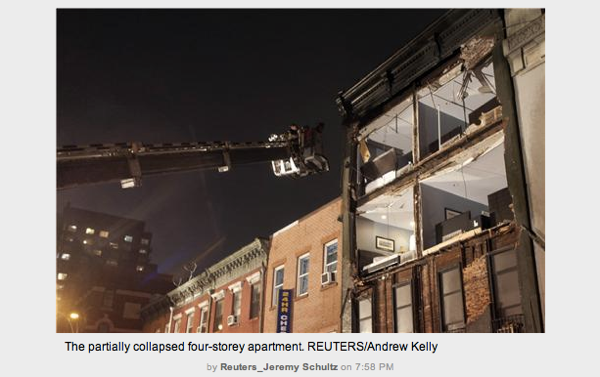
New York City officials began assessing damage after superstorm Sandy killed 10 people, sparked a fire that razed 80 homes in a Queens, flooded tunnels of the biggest U.S. transit system and left 750,000 customers without power, including the lower third of Manhattan.
And:
Sandy, which weakened as it passed over the coast, is among the worst storms in New York history, rivaling the blizzards of 1888 and 1947. It was the worst disaster in 108-year history of the subway system and exceeded transit officials’ worst-case scenario, said Joseph Lhota, chairman of the Metropolitan Transportation Authority.
Late last night, after the hurricane has passed, I took a walk around part of the Eastern portion of the Columbia University campus.
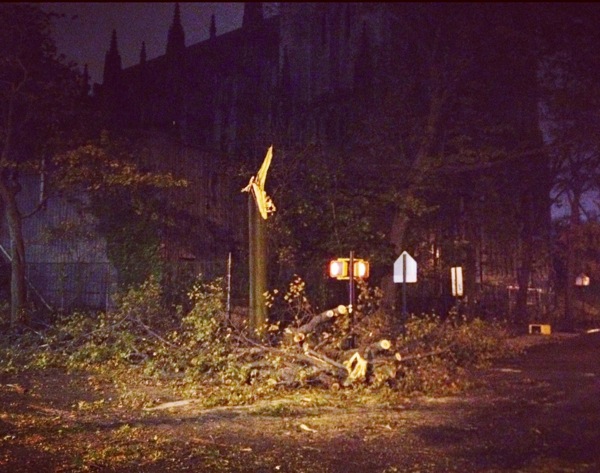
I saw some downed tree branches around Morningside Park, and above is a photo of a fallen tree I spotted near St. John’s Cathedral, on Amsterdam Avenue.
We have not experienced any disruptions in electricity or other services in this part of town, as far as I know.
For coverage of the Northern Manhattan area, see Northattan.org, a site run by J-School students.
Other Stuff
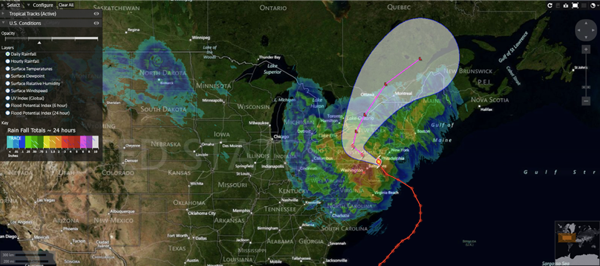
Above is a map of Sandy’s path (actual and projected), via Reuters.
Here’s the latest as of about 10:30 p.m. tonight (Monday):
Here in upper Manhattan near the Columbia University campus, we still have power, though the lights are flickering periodically. Many other parts of New York City, however, are in the dark.
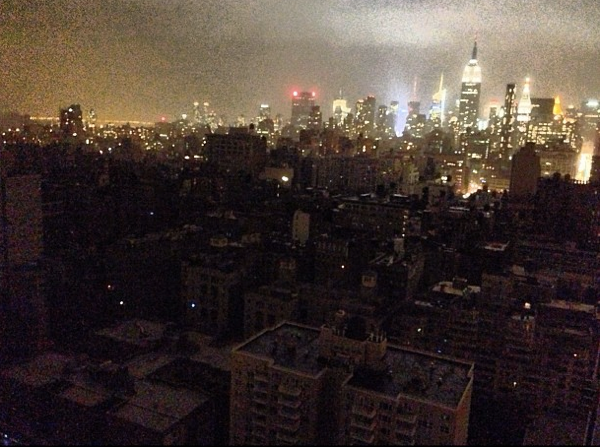
Hurricane Sandy battered the mid-Atlantic region on Monday, its powerful gusts and storm surges causing once-in-a-generation flooding in coastal communities, knocking down trees and power lines and leaving hundreds of thousands of people — including a large swath of Manhattan — in the rain-soaked dark.
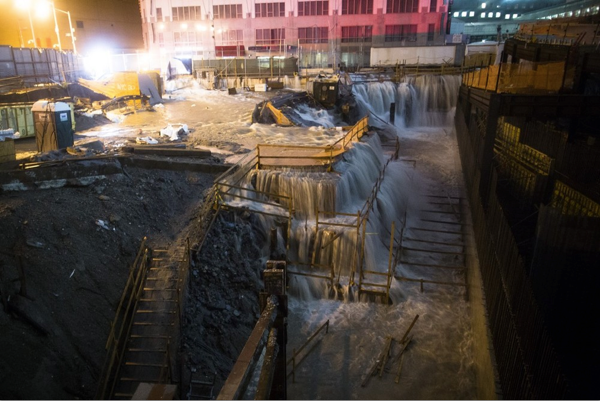
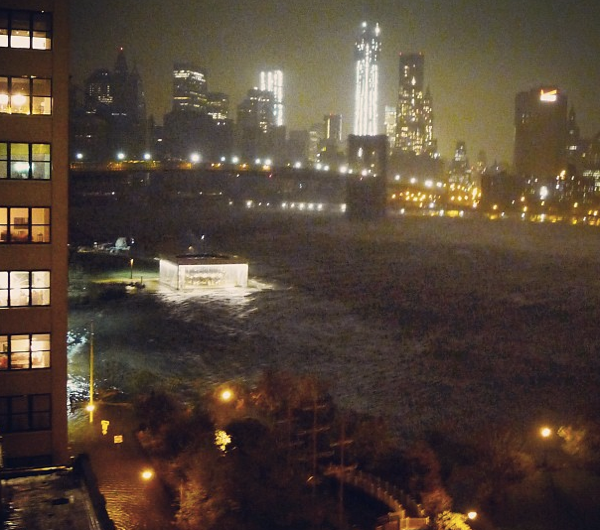
Much of New York was plunged into darkness Monday by a superstorm that overflowed the city’s historic waterfront, flooded the financial district and subway tunnels and cut power to nearly a million people.
The city had shut its mass transit system, schools, the stock exchange and Broadway and ordered hundreds of thousands of New Yorkers to leave home to get out of the way of the superstorm Sandy as it zeroed in on the nation’s largest city.
Above is a recent still photo from the NYT‘s Hurricane Sandy Webcam, located at the Times‘s building in midtown. You can see a portion of the city has lost power.
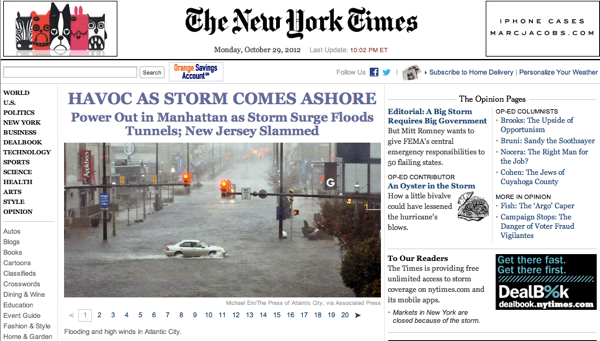
And above is a screen grab of Times‘s home page a few minutes ago (to give you a sense of the events’ significance).
Note: I’m not sure if power and Web access will continue to last here in upper Manhattan, but I’ll keep posting and Tweeting (@newley) as long as I can.
I can hear strong winds outside my building and the lights have been flickering.
Here’s the latest as of about 8:30 p.m. tonight (Monday):
Hurricane Sandy slammed into the New York region on Monday, its powerful gusts and storm surges causing once-in-a-generation flooding in coastal communities along the way, knocking down trees and power lines and leaving more than 100,000 people in the rain-soaked dark.
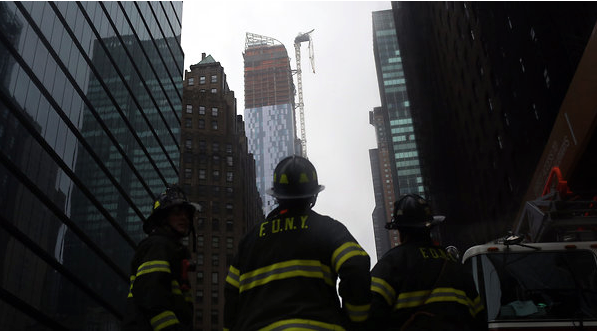
With one mighty gust of wind, the storm on Monday announced itself at 2:30 p.m. at one of Manhattan’s most prestigious addresses.
A crane at 157 West 57th Street swayed up and up and then snapped, leaving tons of metal dangling precariously over 1,000 feet above the ground, with no evident way to secure it with the storm bearing down.