Categories
Thai politics Thailand

Thailand Rubber Farmers’ Protests Continue

Reuters reports today:

Thailand faced pressure on Friday to end a two-week protest by rubber farmers after violent overnight clashes between riot police and a group of protesters who hurled rocks and bottles filled with an acidic liquid.

Police fired tear gas to disperse a group of protesters in Prachuap Khiri Khan province on a main road from Bangkok to the southern beach resort region of Phuket. At least 21 policemen were injured, authorities said.

“Acid and rocks were thrown at police, leaving one officer with a serious injury. Orders were issued to use teargas after a group of youths, who were not part of the protest, fired at police,” Deputy Prime Minister Pracha Promnok said on Friday.

For more, see stories from The AP, AFP, Al Jazeera, and The Bangkok Post.

And for an interesting look at Thailand’s rubber market, see this Bangkok Pundit post:

One thing that has surprised BP regarding the recent protests by rubber farmers is when analyzing the issue that little coverage is given to the actual rubber market. Successive governments have provided price support/subsidies for rice and rubber, but in slightly different forms. BP views there is a key reason for this and that is the markets for rice and rubber are quite different. This issue seems to be glossed over. One big difference is the existence of synthetic rubber.
Categories
Misc.

‘There are red lines even in a war as devoid of clarity as Syria’s’

A quote from a New Yorker piece on Syria by Steve Coll.

Categories
Thai politics Thailand

WSJ on Thai Reconciliation Talks

The Wall Street Journal reported yesterday:

Thailand’s government has been pushing for a top-level dialog for months to find a way out of its deep-seated conflicts, and grandees such as former British premier Tony Blair and Finland’s former leader Martti Ahtisaari converged in Bangkok Monday for an independently run talk-fest on how the country can move forward.

But there’s a problem.

So far, Thailand’s opposition parties have refused to participate in reconciliation talks, going as far as to accuse Prime Minister Yingluck Shinawatra’s government of paying Mr. Blair 20 million baht, or $640,000, for his appearance fee at Monday’s forum – an allegation that both the government and Mr. Blair denied.

There’s more today from the Bangkok Post.

Categories
Misc.

10 Links

  1. The Lasting Power of Dr. King’s Dream SpeechThe New York Times
  2. JustDelete.Me — “A directory of direct links to delete your account from web services.”
  3. Michael Pollan and Amy Harmon ‘talk’ it outColumbia Journalism Review
  4. The Danger of Strategic Distraction — Center for a New American Security’s Shawn Brimley on Syria
  5. WhichFamousEconomistAreYouMostSimilarTo.com — Which famous economist are you most similar to? (Via Fergus Pitt)
  6. How to Make Perfect CoffeeThe Atlantic
  7. As Clear As Mud: CrossFit, Tough Mudders, and the rise of social-physical challenges — Grantland
  8. HowManyPeopleAreInSpaceRightNow.com — How Many People Are In Space Right Now?
  9. In Thailand, Rubber Price Plunge Has Political CostThe New York Times
  10. Video embedded above and on YouTube here: “Martin Luther King – I Have A Dream Speech – August 28, 1963”

(Previous link round-ups are available via the links tag.)

Categories
Journalism

What I’ve Been up to This Summer

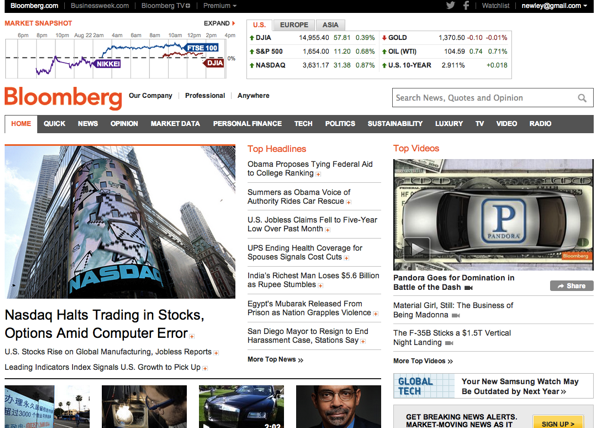
2013 08 22 bloombergdotcom

I’ve had quite a twelve months.

After completing an intensive nine-month master’s in business and economics journalism at Columbia in late May, I embarked on an equally memorable, though shorter, experience: a ten week internship at Bloomberg News‘s headquarters here in New York.

I finished at Bloomberg last Friday. It was a fantastic experience.

This recent BBC video provides a look the Bloomberg HQ as a workplace.

And embedded below — and online here — is an overview of Bloomberg’s operations.

I worked on the Emerging Markets team, assisting with coverage of everything from debt markets in Argentina to global currencies to equities in Mexico.

Here are links and snippets from just a few of the stories I worked on:

China Out of 10 Biggest Stocks as PetroChina Ousted:

Chinese companies have dropped out of the ranks of the world’s 10 biggest stocks by market value for the first time since 2006 amid a cash crunch, slower growth and the biggest U.S. stock rally in a decade.

Give Us Your Real Dollars for Our Fake Dollars: Argentina Credit:

President Cristina Fernandez de Kirchner’s wish of being able to print dollars is coming true as the central bank begins issuing dollar-denominated certificates today that trade in pesos.

Slim’s Frisco Surges as Gold Mine Strike Ends: Mexico City Mover:

Minera Frisco SAB, billionaire Carlos Slim’s gold and silver mining company, gained the most in two years after saying the government intervened to help end a strike at its biggest mine.

‘Fragile Five’ currencies unravel as developing economies suffer:

Emerging-market currencies are trailing their peers in advanced economies by the most since 2009 as a global recovery eludes countries from China to Brazil.

While helping out on stories like these was excellent training, perhaps my most instructive experiences came during the interactions I had in the newsroom with some truly top-notch reporters.

The timing of the internship worked well, too: This year at Columbia, I studied corporate finance; financial accounting; the history and future of journalism; computational journalism; and more.

And this summer at Bloomberg, I was able to put what I’d just learned to practical use in a fast-paced, competitive, collaborate environment where news moves the market in real time. In short, it was the perfect way to spend the summer.

So, looking ahead: What’s next for me over the coming twelve months?

Stay tuned.

Categories
Journalism Tech

Jim Stewart on the NYT’s Future Following the WaPo Sale

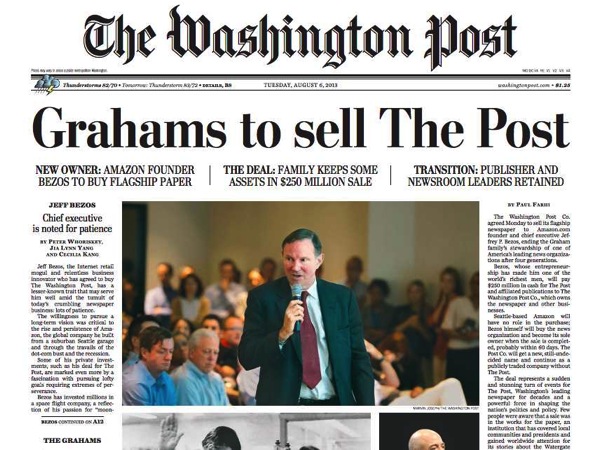
2013 08 11 wapo front page

I was lucky enough to study with Jim Stewart at Columbia this year, and I always look forward to reading his New York Times column, called “Common Sense.”

In his stories, Stewart often examines complex business and economics issues by focusing on facts and evidence and questioning conventional wisdom.

His latest column, which ran Friday, is especially intriguing, as it concerns the current profitability and long-term prospects of The New York Times, his very employer.

Following Jeff Bezos’s purchase of The Washington Post, Stewart asks: Would the Sulzbergers, the family that owns the Times, ever sell the paper?

The family says the NYT isn’t on the block, and Stewart highlights an important point — one which is often overlooked when people make assumptions about the newspaper industry: The Times, unlike the Post, is making money:

That The Times and its controlling family would be among the last survivors should come as no surprise, since it is the strongest of the great newspapers journalistically, and it is profitable. The Times has won 112 Pulitzer Prizes since 1918, including four this year, more than any other newspaper. A week ago, The Times reported quarterly operating earnings of $77.8 million, up 13 percent from a year earlier.

By contrast, The Washington Post’s newspaper division had losses of $53.7 million last year, with no end in sight.

With the Post owned by billionaire Jeff Bezos, “In stark financial terms, The Times is now a minnow in a sea of sharks” compared to companies like News Corporation, Facebook, Google, and others with huge market capitalizations, Stewart writes.

He continues:

Nearly everyone I spoke to this week praised The Times for what it has done with its resources. In contrast with Mr. Graham’s comment that he had no answers, The Times has articulated a strategy that addresses many of the pressing questions facing newspapers, and it seems to have been yielding results.

And:

Like The Post, The Times has tried to improve profitability by reducing costs, including the size of the newsroom. But that can go only so far before it begins to affect the quality of the news operation. It may be even more difficult if, as expected, Mr. Bezos invests in The Post’s national news operation. “The likelihood is that The Post and The New York Times will be competing head-to-head in a way they haven’t since the days of Abe Rosenthal and Ben Bradlee,” both legendary editors of The Post and The Times, Mr. Jones said.

The column is worth a read.

Meanwhile, for more on the WaPo sale and what it all means for the economics of journalism, see:

Categories
Thai politics Thailand

Thai Amnesty Bill Clears Lower House

A quick follow up on the protests in Thailand I mentioned a few days back:

The AP reports:

Thai lawmakers gave initial approval Thursday to a controversial bill to grant amnesty to people charged with political offenses during turmoil that began with a 2006 military coup.

The lower house of parliament voted 300 to 124 to accept the government-sponsored bill in principle after a two-day debate. Critics of former Prime Minister Thaksin Shinawatra fear it is an initial move toward allowing his return from overseas, where he fled to avoid jail after a conflict of interest conviction.

And:

Opposition from outside parliament was unexpectedly weak, and fears of major clashes involving street protests were not realized. The fate of Thaksin, who was ousted by the coup after being accused of corruption and disrespect for Thailand’s revered monarch, King Bhumibol Adulyadej, arouses fierce passions that sometimes have erupted into violence.

Meanwhile, The Guardian has a story on the protests, along with some analysis from Thitinan Pongsudhirak:

Thitinan Pongsudhirak, a political scientist at Bangkok’s Chulalongkorn University, said the protests demonstrated a disenchantment” with the government but it was highly unlikely that they would overthrow it.

“The protest really is designed to unseat the government. But the anti-Thaksin coalition is not united, there is unlikely to be any intervention by the military or the judiciary, and there is not enough traction, not enough numbers [from the protesters], for them to really succeed,” he said.

The BBC has a video report, including remarks from former prime minister Abhisit Vejjajiva.

And here’s a roundup of media coverage from Bangkok Pundit.

And finally, The Bangkok Post reports today that:

Authorities were confident they could easily handle the group of anti-government demonstrators still camping at Lumpini Park on Friday following the lifting of the Internal Security Act (ISA), saying they present no threat.

Categories
Journalism

Bezos Paid 17 Times Adjusted Profit for the Washington Post

Bloomberg reports today:

Jeff Bezos’s purchase of the Washington Post may look like a steal, yet it came at a rich valuation that newspapers such as the New York Times Co. (NYT) may only dream of obtaining.

The founder of Amazon.com Inc. (AMZN) plunked down $250 million for the Post newspaper division, about 17 times adjusted profit, according to data compiled by Bloomberg. That multiple implies a valuation for the New York Times of about $4 billion — more than double its current market value. Major metropolitan newspapers should fetch 3 or 4 times profit, said research firm Outsell Inc.

“Bezos paid a friendship premium of $200 million here,” Ken Doctor, a media analyst at Burlingame, California-based Outsell, said in a phone interview. “There are a handful of news brands in the world that will merit some kind of premium over the usual multiple, but the multiple over the multiple here seems really high.”

Categories
Thailand

Thailand Protests: More to Come This Week?

The AP reports:

Thailand’s capital braced Sunday for possible unrest in the week ahead, with street protests expected over moves in parliament that could eventually lead to a pardon for ousted Prime Minister Thaksin Shinawatra.

As many as 2,000 protesters calling themselves the People’s Army Against the Thaksin Regime turned up Sunday for a peaceful rally in a Bangkok park. But bigger and more militant protests are expected when parliament on Wednesday begins debating an amnesty bill that would cover people arrested for political activities since the 2006 military coup that ousted Thaksin for alleged corruption and disrespect to the monarchy.

There are also stories from the WSJ and the Bangkok Post.

For a comprehensive look at the amnesty bill’s political and economic implications, see this Bloomberg story from last week.

Categories
Thailand

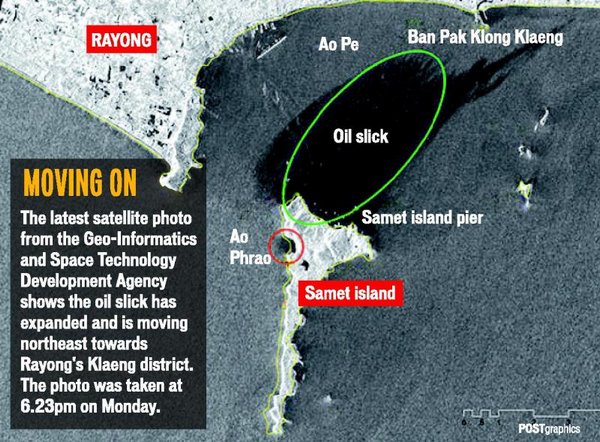
Koh Samet Oil Spill Seems to be Spreading

2013 07 30 koh samet oil spill

The WSJ‘s Southeast Asia Real Time reports:

The oil spill that hit Thailand’s popular Koh Samet island appears to be moving to coastal areas of the eastern province of Rayong, threatening to worsen the impact on the Southeast Asia country’s critical tourism industry.

“The crude oil spill in the middle of the sea has an extreme impact on Thailand’s tourism,” Tourism and Sports Minister Somsak Phurisrisak told reporters on Tuesday. He estimated that the damage from the oil spill to the tourism industry will be about 100 million baht or about $3.2 million.

A satellite image taken Monday evening showed a film of crude oil spill — which covers an area of about 15 kilometers, or 9.3 miles — was moving northeast of Koh Samet Island, which is about a mile away from coastal areas of Rayong province, according to data from the country’s Geo-Informatics and Space Technology Development Agency.

Click through for a map.

There’s more from the AP, and National Geographic has some images.

The Bangkok Post also has a story and a map of the affected area, seen above.

(Image: Bangkok Post.)