Categories
Newley's Notes

NN125: Uber-Grab Deal; Alexa Gets Creepy; ‘Sopranos’ Prequel

trees

Hi, friends. Welcome to the latest edition of Newley’s Notes, in which I share the best of what I write and the best of what I read.

If you like this newsletter, please forward it to a friend. If you received this from a pal, you can sign up here.

What I Wrote in The Wall Street Journal

🚘 — Uber Agrees in Principle to Exit Southeast Asia for Stake in Rival — The story, which I wrote with my colleagues Greg Bensinger and Julie Steinberg, begins:

Uber Technologies Inc. has reached an agreement in principle to sell most of its Southeast Asia operations to local rival Grab Inc., ending a costly fight for market share in the fast-growing region, according to people familiar with the matter.

In exchange for its operations in Southeast Asia, Uber would gain a roughly 30% stake in Grab, these people said. The two companies are still hashing out the final terms of the pact, the people said, cautioning any deal would be subject to regulatory scrutiny. One of the people said Uber’s stake in Grab could wind up being smaller.

5 Cool Tech-ish Reads This Week

🗞️ 1. “Get news. Not too quickly. Avoid social.” That’s New York Times tech columnist Fahad Manjoo’s Michael Pollan-esque advice. In a much-discussed piece, Manjoo says for two months he disconnected from online news and social media, relying instead on print editions of the Gray Lady, The WSJ, and The Economist. He writes:

It has been life changing. Turning off the buzzing breaking-news machine I carry in my pocket was like unshackling myself from a monster who had me on speed dial, always ready to break into my day with half-baked bulletins.

The gist: he felt plenty well informed about the world but avoided needless micro-updates, hot takes, fake news and social media toxicity.

(Postscript: Dan Mitchell, writing later at Columbia Journalism Review, quibbled with just how disconnected Manjoo really may have been during the period, given that he was still frequently using Twitter.

“I think it’s clear that I meant I ‘unplugged’ from Twitter as a source of news, not that I didn’t tweet at all,” Manjoo told Mitchell.)

🙄 2. Alexa: super creepy. Some owners of speakers powered by Amazon’s Alexa reported that the devices have been intermittently letting out weird giggles. “We’re aware of this and working to fix it,” Amazon told The Verge’s Shannon Liao. Here’s a video.

(It is no secret that I don’t like these listening devices — sorry, connected home gadgets — one bit.)

🌁 3. Depressing San Francisco story of the week: A shortage of affordable housing due to the tech industry boom means some middle class workers are paying up to $2,400 per month for what are essentially dorm rooms that lack kitchens or bathrooms.

The company building the units, called Starcity, “has already opened three properties with 36 units,” writes Nellie Bowles in the New York Times. “It has nine more in development and a wait list of 8,000 people.”

💬 4. Tool of the week: A great place for finding real quotes, at a time when many dubious ones are floating around online, is Quotenik.com, by writer/editor/researcher Sara Bader. Tagline: “A growing library of verified quotes.” You can search by author and by topic.

🕶️ 5. “The Big Lewbowski” is 20 years old. Charles Bramesco, writing in the New York Times, gives us “10 righteous heirs” to the Coen brothers’ masterpiece: Films released since 1998 that offer bits of Dude-esque stoner humor, film noir, and meta-strangeness.

🔫 Working Title of the Week

“The Many Saints of Newark.”

That’s the tentative title of a “Sopranos” prequel film — yes, you read that right — being produced by David Chase.

The official description, according to the NYT, says it will be “set in the era of the Newark riots in the ’60s, when the African-Americans and the Italians of Newark were at each other’s throats, and when among the gangsters of each group, it became especially lethal.”

There’s no release date yet, but I will certainly be watching this one.

🤡 1 Silly Thing

Bootleg_Daycare is the name of an Instagram account devoted to poorly done replicas of cartoon characters.

👊 Fist bump from New Delhi,

Newley

Categories
Journalism

Uber Agrees in Principle to Exit Southeast Asia for Stake in Rival

2018 03 10traffic

That’s the headline of my newest story, which I wrote with my colleagues Greg Bensinger and Julie Steinberg. It ran late Thursday, and begins:

Uber Technologies Inc. has reached an agreement in principle to sell most of its Southeast Asia operations to local rival Grab Inc., ending a costly fight for market share in the fast-growing region, according to people familiar with the matter.

In exchange for its operations in Southeast Asia, Uber would gain a roughly 30% stake in Grab, these people said. The two companies are still hashing out the final terms of the pact, the people said, cautioning any deal would be subject to regulatory scrutiny. One of the people said Uber’s stake in Grab could wind up being smaller.

Uber was spending some $200 million annually to take on Grab and another upstart in the region, GoJek, two of the people said. Go-Jek, a motorcycle-taxi service based in Indonesia, recently raised more than $1 billion in funding from KKR & Co. and Tencent Holdings Ltd., among others.

Click through to read the rest.

Categories
Newley's Notes

Newley’s Notes 124: Uber and SoftBank; How to Neuter your Smartphone; Mr. Rogers Breakdancing

2018 03 06 water

Edition 124 of my email newsletter went out on Sunday.

If you’d like NN delivered to your inbox, simply enter your email address here. It’s free, it’s fun, it’s brief, and few people unsubscribe.


Hi, friends. Welcome to the latest edition of Newley’s Notes: The best of what I write. The best of what I read.

If you like this newsletter, please forward it to a friend. If you received this from a pal, you can sign up here.

What I wrote in The Wall Street Journal

🚗 — Uber Battles Ride-Sharing Startups in SoftBank ‘Family.’ The story, which I wrote with my colleague Mayumi Negishi, went online a few hours ago. It begins:

SoftBank Group Corp., the world’s biggest technology investor, has poured some $20 billion into ride-sharing companies around the globe, including Uber Technologies Inc.

Now, those companies are spending at least some of SoftBank’s money to battle each other.

In Japan, Uber is gearing up to fight China’s Didi Chuxing Technology Co., which is planning to enter the market after an investment by SoftBank of around $10 billion.

In India, Uber is facing off with local champion ANI Technologies Inc.’s Ola, in which SoftBank has about a 30% stake and a board seat. SoftBank invested $7.7 billion in Uber for a 15% stake this year.

Uber and Ola are also grappling in Australia, where Ola started operations in February. Uber in Southeast Asia is trailing Singapore’s Grab Inc., whose president joined from SoftBank in 2016 following its $750 million investment in the company.

Click through to read the rest.

📲 5 Cool Tech-ish Reads This Week

1. Ding Dong, Amazon’s here. The Seattle titan bought video doorbell startup Ring, as our WSJ story said, in a deal valued at more than $1 billion. Following Amazon’s move into groceries — don’t forget about Whole Foods, after all — it now looks to be strengthening its smart homes business:

The latest deal plays to Amazon’s efforts to control the devices that power smart homes, an area in which it is becoming a dominant player. Certain Ring doorbells and cameras already connect with its virtual assistant, Alexa.

Package theft has become an increasing problem for e-commerce companies as consumers order more online. Amazon has responded with solutions including package lockers and apartment buildings’ package hubs. Late last year, it launched its Cloud Cam security camera combined with its “Amazon Key” product, which allows its delivery drivers to deposit packages into customers’ homes via a smart lock system.

2….And speaking of Amazon, is it being used for money laundering? Patrick Reames, an (actual) author, discovered that someone had apparently been using his name to launder cash, cybersecurity pro Brian Krebs reports:

Reames said he suspects someone has been buying the book using stolen credit and/or debit cards, and pocketing the 60 percent that Amazon gives to authors. At $555 a pop, it would only take approximately 70 sales over three months to rack up the earnings that Amazon said he made.

3. How to make your smartphone less addictive. In this Vox video, Tristan Harris, a former product pro at Google, provides tips for making our devices less like miniature slot machines.

(TLDR: eliminate automated alerts, make the screen less colorful, and only keep genuinely useful apps on your home screen.) For more, check out the essays on Harris’s website.

4. More than half of Americans favor regulating Big Tech. That’s according to new poll from Axios and SurveyMonkey showing the number of citizens who are “‘more concerned'” government will not go far enough to regulate tech” has risen from 40% in November. The big picture:

That’s a seismic shift in the public’s perception of Silicon Valley over a short period of time. It shows how worried Americans are about Russian meddling in the 2016 election, but it also reflects a growing anxiety about the potentially addictive nature of some of the tech companies’ products, as well as the relentless spread of fake news on their platforms.

5. Why speeding is so much more dangerous than you think. A fascinating video explanation, using a real world example and some equations, showing why driving at 100 miles per hour, say, is so much more perilous than 70 miles per hour.

🏀 Stat of the week

Over the past 30 days, House of Highlights has done more video views on Instagram (662 million) than the official ESPN (206 million) and SportsCenter (316 million) accounts combined, according to social media analytics company CrowdTangle.

That’s from a Recode story on the insanely popular House of Highlights, an Instagram account where 23-year-old Omar Raja posts NBA videos and commentary.

🕺 1 Silly/Awesome Thing

Mr Rogers breakdancing. In this video from 1985, a 12-year-old named Jermaine Vaughn guides Mr. Rogers. More on the episode is here.

👊 Fist bump from New Delhi,

Newley

Categories
Journalism Tech

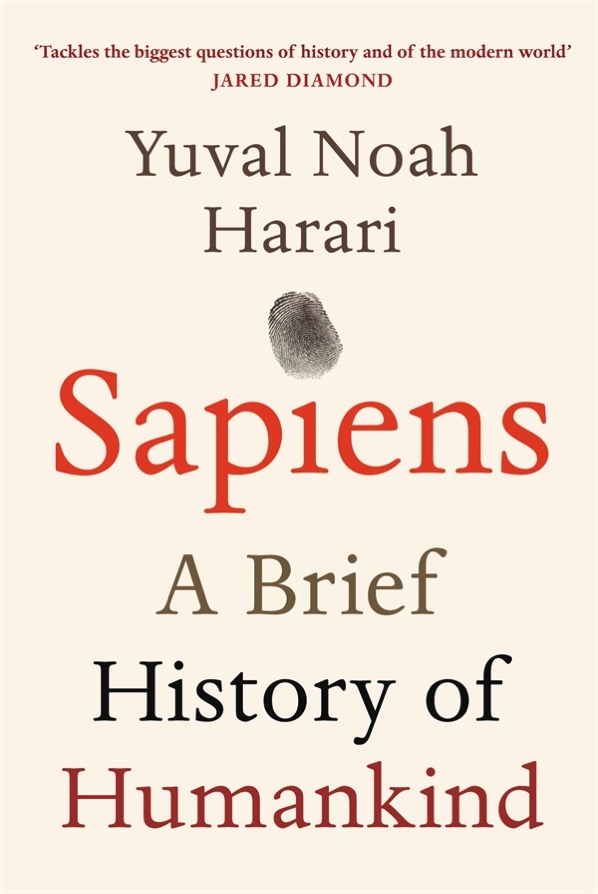
Uber Battles Ride-Sharing Startups in SoftBank ‘Family’

2018 03 04uber sb

That’s the headline of my newest story, which I wrote with my colleage Mayumi Negishi, out today. It begins:

SoftBank Group Corp., the world’s biggest technology investor, has poured some $20 billion into ride-sharing companies around the globe, including Uber Technologies Inc.

Now, those companies are spending at least some of SoftBank’s money to battle each other.

In Japan, Uber is gearing up to fight China’s Didi Chuxing Technology Co., which is planning to enter the market after an investment by SoftBank of around $10 billion.

In India, Uber is facing off with local champion ANI Technologies Inc.’s Ola, in which SoftBank has about a 30% stake and a board seat. SoftBank invested $7.7 billion in Uber for a 15% stake this year.

Uber and Ola are also grappling in Australia, where Ola started operations in February. Uber in Southeast Asia is trailing Singapore’s Grab Inc., whose president joined from SoftBank in 2016 following its $750 million investment in the company.

Click through to read the rest.

Categories
Newley's Notes

Newley’s Notes 123: iPhones vs. China Rivals; 15th Century Linguistic Riddle; Exploding Supernova

2018 02 27 trees

Edition 123 of my email newsletter went out on Sunday.

To join the list, simply enter your email address here. It’s free, it’s fun, it’s brief, and few people unsubscribe.


Hi, friends. Welcome to the latest edition of Newley’s Notes: The best of what I write. The best of what I read.

🙏 Reminder: If you like this newsletter, please forward it to a friend. If you received this from a pal, you can sign up here.

NN was on hiatus last week in part due to travel: We took a fantastic trip to the Southern Indian state of Kerala. It was my first visit to this part of India, and I really loved it: It’s much less crowded than many Northern Indian cities, and with its tropical climate it feels almost like Southeast Asia.

🛥️ We met some friends and did a houseboat tour through the Kerala backwaters, then took in the sights in the city of Kochi (aka Cochin), among them the Commonwealth’s oldest synagogue, built in the 16th century.

I’ll probably write more about this journey soon. Highly recommended.

On to this week’s NN:

✍️ What I wrote in The Wall Street Journal

— “Why the iPhone Is Losing Out to Chinese Devices in Asia.” The story begins:

NEW DELHI—The iPhone X has set a new benchmark for smartphone prices and bolstered Apple Inc.’s bottom line, but its steep price may be hobbling its future in Asia’s biggest markets and allowing Chinese challengers to grab market share.

Buyers from India to Indonesia are opting for models from Chinese smartphone makers like Xiaomi Corp. — sometimes called “the Apple of China” — along with BBK Electronics Corp.’s Oppo and Vivo.

Click through to hear from consumers in India and Indonesia on why they’re giving up their iPhones in favor of inexpensive models that nevertheless have some cool features.

Note: I am not entirely certain, but I think this passage…

Oppo’s “selfie expert” F3 offers options such as a front-facing camera for selfies with wide angle that lends itself to “wefies,” or group shots with several people crammed into the frame.

…may represent the first time the word “wefie” or “wefies” has ever appeared in The Wall Street Journal in print (vs. online)… 🤳

📲 5 Cool Tech-ish Reads This Week

1. Dropbox filed for an IPO. The popular cloud storage company’s public offering could be the biggest tech IPO since Snap’s in March 2017, according to our WSJ story. Here’s the wider context:

Dropbox’s offering will give public investors rare access to the class of richly valued tech startups. Most of the startups with the highest valuations have put off IPOs as they still have access to ample amounts of capital from giant investors including Japanese firm SoftBank Group Corp.

Uber Technologies Inc. and home-rental company Airbnb Inc. aren’t expected to debut until at least 2019, and with the exception of Spotify AB, which will go public without raising new capital in an atypical debut, few of the best-known private companies are expected to go public this year.

CNBC has a rundown of who stands to make the most cash from the deal:

Co-founder and CEO Drew Houston is Dropbox’s biggest shareholder, owning 25 percent of the shares before the offering. Arash Ferdowsi, the other co-founder and former chief technology officer, owns 10 percent.

Among institutional investors, Sequoia Capital, which led Dropbox’s seed round in 2007 and first venture round the following year, owns 23 percent, followed by Accel at 5 percent and T. Rowe Price at 3.5 percent.

2. Jason Kottke on how blogging has changed. I’ve read Kottke’s blog, Kottke.org, pretty much since it launched twenty years ago, in 1998. It’s one of the world’s longest running and best known independent blogs. I launched my blog — back when they were called “weblogs” — four years later, inspired in part by Kottke’s mission to essentially just share cool stuff online.

In this Q&A with Laura Hazard Ownen at Harvard’s NiemanLab, Kottke talks about content consumption trends: Fewer people are reading blogs following the rise of social media and the fall of RSS, but as advertising has diminished he’s launched a successful new membership model to help pay the bills.

3. A 15th century linguistic riddle, solved? University of Alberta scientists used algorithms to show the fabled Voynich manuscript may be written in a coded version of Hebrew. Not everyone’s buying the conclusions, as described by some media outlets, however.

For more, here’s a 2016 New Yorker piece with additional details on the mysterious manuscript.

4. “The Case Against Google.” File under: the burgeoning backlash against Big Tech. In this New York Times Magazine long-read doing the rounds this week, Charles Duhigg details antitrust complaints about the search giant. There are plenty of anecdotes here from execs who say Google has unfairly crushed their rival companies. The other side of the coin: Are customers actually being harmed by Google?

5. Hot new Q&A site: Molly. “Silicon Valley insiders have recently been answering questions about themselves via a new service called Molly,” writes Kia Kokalitcheva at Axios. “Ask personal questions,” the Molly tagline reads, “Molly gets answers.”

🌟 Quote of the week

“It’s like winning the cosmic lottery.”

That’s Alex Filippenko, an astronomer at UC Berkely, on fellow (amateur) astronomer Victor Buso’s impossibly lucky photograph — the first of its kind — showing a burst of light from a exploding supernova.

✈️ 1 Silly Thing

This is what happens when you activate an airplane’s emergency slide. A highly watchable gif.

👊 Fist bump from New Delhi,

Newley

Categories
Journalism

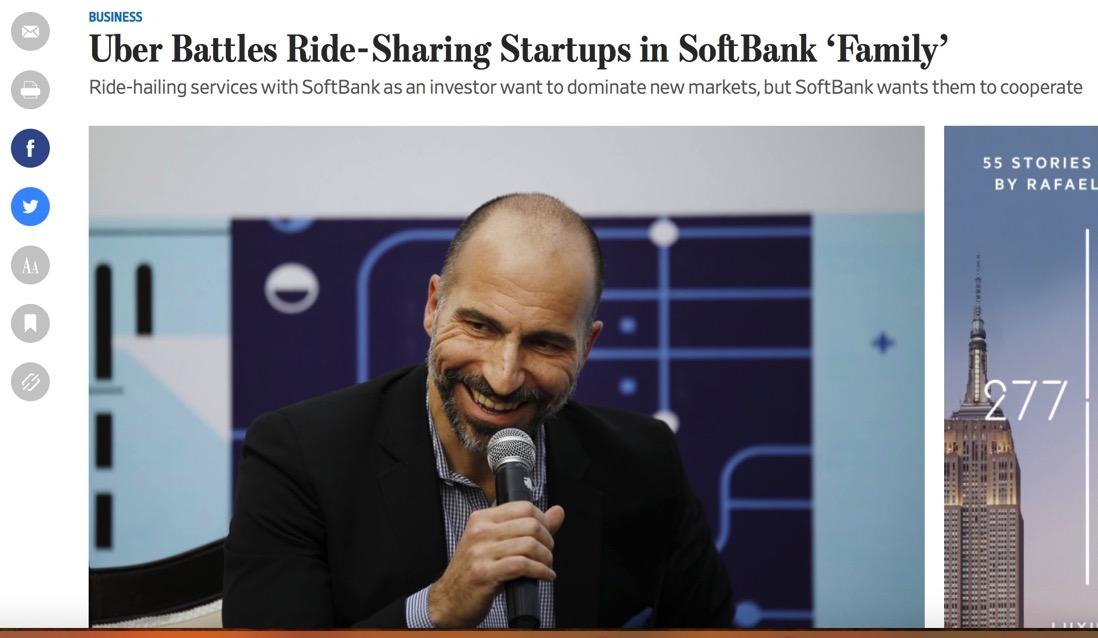
Why the iPhone Is Losing Out to Chinese Devices in Asia

2018 02 26 iphone asia

That’s the headline of my newest story, which ran last week.

It begins:

NEW DELHI—The iPhone X has set a new benchmark for smartphone prices and bolstered Apple Inc.’s bottom line, but its steep price may be hobbling its future in Asia’s biggest markets and allowing Chinese challengers to grab market share.

Buyers from India to Indonesia are opting for models from Chinese smartphone makers like Xiaomi Corp.—sometimes called “the Apple of China”—along with BBK Electronics Corp.’s Oppo and Vivo.

China’s manufacturers are increasingly churning out higher-priced devices that compete directly with Apple’s smartphones. They often have high-end features, but carry lower price tags than the iPhone X or even older iPhone models. They are targeting potential Apple customers by offering phones with robust hardware such as metal bodies, beefy batteries and unique features iPhones lack, including special cameras for taking better selfies.

Click through to read the rest.

Categories
Newley's Notes

Newley’s Notes 121: Notes from ‘Sapiens’; Tractor Hacking; ‘Donkey Kong’ Scandal?

2018 02 10galaxy

Edition 121 of my email newsletter went out on Monday.

To join the list, simply enter your email address here. It’s free, it’s fun, it’s brief, and few people unsubscribe.


Hi, friends. Welcome to the latest edition of Newley’s Notes: The best of what I write. The best of what I read.

What I wrote at Newley.com

Book Notes: ‘Sapiens: A Brief History of Humankind,’ by Yuval Noah Harari — You might have heard about this book. It’s been all the rage among Silicon Valley types for a few years. I loved it, so as I sometimes do, I shared my notes.

📲 5 Cool Tech-ish Reads This Week

1. Cryptocurrency utopians are flocking to Puerto Rico, where they want to build a blockchain-based community, Nellie Bowles reports in the New York Times. Among the reasons:

Puerto Rico offers an unparalleled tax incentive: no federal personal income taxes, no capital gains tax and favorable business taxes — all without having to renounce your American citizenship. For now, the local government seems receptive toward the crypto utopians; the governor will speak at their blockchain summit conference, called Puerto Crypto, in March.

2. Farmers in the Midwest are hacking John Deere software to fix their tractors themselves rather than using pricey dealerships. Interesting video report from Vice’s Motherboard.

3. Megan McArdle’s 12 Rules for Life. Not exactly tech related, but just plain smart and fun: From relationship tips to giving better compliments to dinner rolls, the always-excellent author and Bloomberg View columnist has got you covered.

4. Did “Donkey Kong” legend Billy Mitchell cheat? Venture Beat’s Jeff Grubb reports:

A Donkey Kong fansite has removed three high scores from arcade legend Billy Mitchell after an analysis revealed he likely misled the community about playing on real arcade hardware and that he instead submitted emulator gameplay.

Using an emulator rather than the real arcade game could make it easier and thus enable cheating, apparently. The lion-maned Mitchell stars in the excellent 2007 documentary “The King of Kong: A Fistful of Quarters.” (Trailer is here.)

5. “The Chrome Extensions We Can’t Live Without,” by Wired staff members. There are some gems in this list of add-ons to Google’s browser, such as the new-to-me Great Suspender (stops loading tabs you’re not using); HabitLab (a Stanford University tool for curbing your use of social media and other sites); and xTab (which sets a limit on how many tabs you can keep open).

🔬 Quote of the week

“I think this is one of the greatest advances in over 150 years of Maya archaeology.”

That’s from Stephen Houston, a Brown University archaeology and anthropology professor, on the huge network of previously undiscovered Maya ruins researchers have found in Guatemala.

💫 1 Silly Thing

“Mr. Bean Is A Master Of Physical Comedy.” An entertaining video from NerdWriter.

If you like this newsletter, please forward it to a friend. If you received this from a pal, you can sign up here.

Finally, a reminder that you can follow me on Facebook, like my Facebook page, and find me on Twitter.

Got any tips for improving Newley’s Notes? Hit reply! I love hearing from folks.

👊 Fist bump from New Delhi,

Newley
Categories
Newley's Notes

Newley’s Notes 120: Apple’s New HomePod; Exercise Data Dangers; Silent Music Videos

Colors

Edition 120 of my email newsletter went out on Wednesday.

To join the list, simply enter your email address here. It’s free, it’s fun, it’s brief, and few people unsubscribe.


Hi, friends. Welcome to the latest edition of Newley’s Notes.

If you like this newsletter, please invite others to sign up.

Administrative note: Anasuya suggested a tagline for Newley’s Notes:

The best of what I write. The best of what I read.

Do you like it? If not, hit me up and suggest a better one!

📲 5 Cool Tech-ish Reads This Week

1. Apple’s HomePod is coming. The $349 voice-activated speaker, which was supposed to launch before the holidays, will be in stores beginning Feb. 9, my WSJ colleague Tripp Mickle reports. It’ll have to play catchup to Amazon’s Echo and Google’s Home devices. At The Verge, Dieter Bohn writes:

The bet on the HomePod is the same as the bet on almost every new Apple product: that the spec list doesn’t add up to the whole experience. It’s a bet that there will be some special Apple design magic in the hardware and the software that just makes it feel better to use.

We’ll see.

2. Amazon’s cashierless convenience store opened to the public. Recode has a bunch of photos of the shop, located in Seattle. You scan an app when you walk in, and cameras in the ceiling match you to your account; you’re billed when you walk out. More in a separate Recode story here. With Amazon buying Whole Foods, it’s clear they’re moving into physical retail in a big way.

3. File under: Whoops. A reminder that our connected devices give off data exhaust: Fitness tracking app Strava released a map based on more than 3 trillion GPS data points around the world — such as where people exercise outside — showing the location of U.S. miliary personnel, Alex Hern writes in The Guardian:

In locations like Afghanistan, Djibouti and Syria, the users of Strava seem to be almost exclusively foreign military personnel, meaning that bases stand out brightly. In Helmand province, Afghanistan, for instance, the locations of forward operating bases can be clearly seen, glowing white against the black map.

And:

… a map of Homey Airport, Nevada – the US Air Force base commonly known as Area 51 – records a lone cyclist taking a ride from the base along the west edge of Groom Lake, marked on the heatmap by a thin red line.

The map in its entirety is available online here.

4. “The Follower Factory.” This in depth New York Times story illuminates the murky world of social media manipulation, focusing on a little-known U.S. company called Devumi, which “sells Twitter followers and retweets to celebrities, businesses and anyone who wants to appear more popular or exert influence online.”

5. TypesetInTheFuture.com is a blog (and soon to be book) about fonts in sci-fi movies. Nerd out on examinations of “2001: A Space Odyssey,“, “Alien,” and — my favorite, of course — “Bladerunner.”

🍔 Quote of the week

Whopper neutrality was repealed. They voted on it.

That’s from an entertaining video explainer/advertisement in which Burger King gives the world its take on net neutrality — using burgers.

💫 1 Silly Thing

“Silent Music Videos.” After the item in last week’s NN about Wookies dubbed to sound like Pee-Wee Herman, reader Lee LeFever writes in with a couple of gems.

People are now, it appears, creating new versions of music videos — and inserting non-musical audio. The result is quite bemusing.

Here’s David Bowie and Mick Jagger’s “Dancing in the Street,” and Miley Cyrus’s “Wrecking Ball.” Thanks, Lee!

👊 Fist bump from New Delhi,

Newley
Categories
Book Notes Books Life

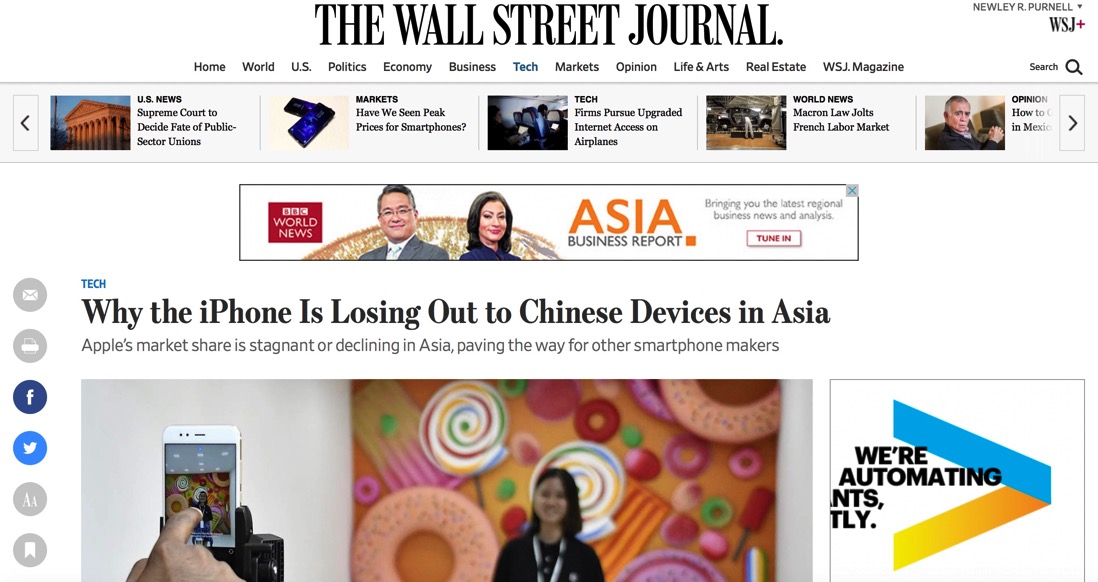
Book Notes: ‘Sapiens,’ by Yuval Noah Harari

Sapiens

From time to time I share notes about the books I’ve been reading, or have revisited recently after many years.

These posts are meant to help me remember what I’ve learned, and to point out titles I think are worth consulting.

For previous postings, see my Book Notes category.

Sapiens: A Brief History of Humankind

Published (in English): 2014
ISBN–10: 0062316095
Amazon link

Brief Summary

A deeply thought-provoking book about how homo sapiens came to dominate the world – and how our advancements have come at a significant cost.

My notes

I love big, sprawling books that tackle huge subjects and challenge you to change the way you conceive of the world.

This global bestseller, which has been all the rage among Silicon Valley technologists in recent years, in particular, is one of the best of that sort of title I’ve read.

It’s a kind of even-bigger-picture “Guns, Germs and Steel,” the hit 1997 book (which I also loved) in which Jared Diamond famously demonstrated the role the environment has played in shaping civilization and material development.

I think anyone who reads this fun, fast-paced, surprisingly easy-to-read book will be hard pressed not to come away with the sense that:

Human life is insignificant in the grand scheme of things;
– Our advancements as a species have been mind-bogglingly rapid, with humans and the planet paying a huge price;
– The way we have been living for the last 200 years is radically at odds with how humans have existed over the long term;
– The jury is out, according to Harari, as to whether humans will survive in the long term. He is not optimistic.

(Okay, all that may sound depressing, I know realize, but still…)

  • Harari, a historian, shows how homo sapiens evolved in East Africa 200,000 years ago, then 70,000 years ago spread out of Africa as the cognitive revolution took over, in which language emerge and allowed sapiens to either kill off or out-flourish other humans, like Neanderthals.
  • We all know that sapiens wiped out the world’s biggest animals, but Harari reinforces this point, recounting how we killed off megafauna from Australia to the Americas over time. Sapiens has historically destroyed everything in its path, and now that we have nuclear weapons, Harari is not bullish on our long term survival. But, of course, the universe doesn’t care about people. Cockroaches and rats are thriving today despite our having driven other creatures to extinction, and could in millions of years evolve into sophisticated creatures, thanking us for demolishing the planet and setting the stage for their rise.

  • The agricultural revolution, which happened about 12,000 years ago, was “history’s biggest fraud,” Harari writes, because it lead to widespread suffering for farmers and laborers producing food for elites, while life as hunter-gatherers may have largely been more conducive to human happiness despite shorter lives and higher rates of violence.

  • 2,500 hundred years ago coinage came into use. Money equals trust. Harari is big on “imagined orders” and the power of ideas to bind or separate us, such as democracy, capitalism, racism and the caste system.

  • The scientific revolution, about 500 years ago, lead to the industrial revolution some three hundred years later, and ultimately imperialism, with all its devastation for those subjugated.

    “The feedback loop between science, empire and capital has arguably been history’s chief engine for the past 500 years,” he writes. Capitalism + scientific inquiry = imperialism.

  • The industrial revolution – while providing us with undeniable material and medical benefits – has meant “family and community” have been replaced by “state and market.”

    “Millions of years of evolution have designed us to live and think as community members,” he writes. “Within a mere two centuries we have become alienated individuals.

  • Industrialized animal husbandry feeds the world, but “If we accept a mere tenth of what animal-rights activists are claiming, then modern industrial agriculture might well be the greatest crime in history.

  • I found the penultimate chapter, on human happiness, to be particularly thought-provoking.

    Money doesn’t ultimately bring lasting happiness due the luxury trap: there are diminishing returns to having fancy things, and someone always has even nicer stuff. That’s the case even for most billionaires.

    Community, family, positive marriages, and living according to one’s values – and with a sense of purpose – matter more. It could be that happiness most flourishes when we buy into belief systems or religious delusions, even if scientifically life has no meaning.

  • Harari seems to promote Buddhist philosophy and meditation as an antidote to alienation. “People are liberated from suffering not when they experience this or that fleeting pleasure, but rather when they understand the impermanent nature of all their feelings, and stop craving them,” he writes.

  • Ultimately, for all our advancements, human suffering is still rife in the world – whether it’s due to consumerism, ongoing oppression, or other factors. That puts all of our economic and scientific progress into perspective. Are humans actually happier today than tens of thousands of years ago? We are undoubtedly healthier and safer, but we may not be any happier.

Categories
Journalism

Mike Allen and Axios, Profiled in Buzzfeed

Washingtondc

Over at Buzzfeed, Steven Perlberg profiles Mike Allen and Axios, the news organization he co-founded just a year ago:

Axios has bigger ambitions than changing Washington’s news diet. Led by Allen’s fellow Politico alum Jim VandeHei, the company has a broad audience in mind: tens of millions of smart people who seek out quick news on a daily basis. Like Politico, Axios delivers news fast — but distilled down to a few sentences or bullet points. And like Playbook, Axios has created another language, framing the day’s stories under tags like: “Be smart,” “Why it matters,” “Go deeper,” and occasionally the highest praise, “Worthy of your time.” Allen calls these little framing phrases “Axioms,” and they litter Axios’s coverage of politics, media, business, and tech. Rival reporters call them primers for warmed-over conventional wisdom, but if you read Axios consistently enough, you can find yourself texting in Axiosese to friends.

Allen’s daily email newsletter, Axios AM, you’ll recall, was among my favorite email newsletters of 2017.

It’s timely, written in a personal voice by someone in the know, contains exclusive news, and – a big benefit in these crazy times – aggregates the top stories from a variety of different news outlets, so you always feel up to speed on what’s up in Washington.