Thailand’s capital braced Sunday for possible unrest in the week ahead, with street protests expected over moves in parliament that could eventually lead to a pardon for ousted Prime Minister Thaksin Shinawatra.
As many as 2,000 protesters calling themselves the People’s Army Against the Thaksin Regime turned up Sunday for a peaceful rally in a Bangkok park. But bigger and more militant protests are expected when parliament on Wednesday begins debating an amnesty bill that would cover people arrested for political activities since the 2006 military coup that ousted Thaksin for alleged corruption and disrespect to the monarchy.
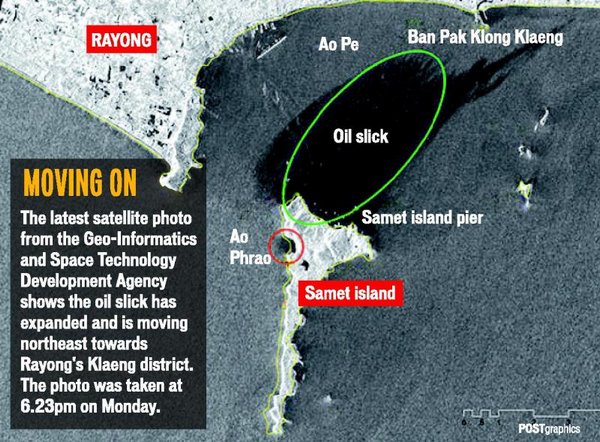
The oil spill that hit Thailand’s popular Koh Samet island appears to be moving to coastal areas of the eastern province of Rayong, threatening to worsen the impact on the Southeast Asia country’s critical tourism industry.
“The crude oil spill in the middle of the sea has an extreme impact on Thailand’s tourism,” Tourism and Sports Minister Somsak Phurisrisak told reporters on Tuesday. He estimated that the damage from the oil spill to the tourism industry will be about 100 million baht or about $3.2 million.
A satellite image taken Monday evening showed a film of crude oil spill — which covers an area of about 15 kilometers, or 9.3 miles — was moving northeast of Koh Samet Island, which is about a mile away from coastal areas of Rayong province, according to data from the country’s Geo-Informatics and Space Technology Development Agency.
Click through for a map.
There’s more from the AP, and National Geographic has some images.
The Bangkok Post also has a story and a map of the affected area, seen above.
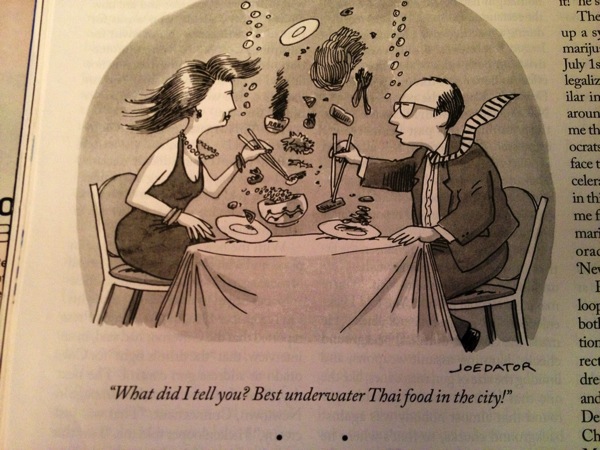
This week’s Mother’s Day themed New Yorker magazine cover, which you may have already seen, is remarkable.
But I also found another element of the issue to be notable — for a reason that should come as no surprise given my previous posts about stateside reminders of Thailand.
One thing, if you’ll forgive my pedantry: Even allowing for the cartoon’s cryptic nature, we all know that except for eating some soups, chopsticks aren’t typically used in Thailand. Forks and spoons are the norm.
But let’s not let that stand in the way of the joke…
A rush of cash into Thailand has sent the baht to its highest level in more than five years, making it Asia’s top currency in 2013, as investors clamor for deals in the fast-expanding Southeast Asian economy.
Fund managers also have been pouring money into shares, driving the benchmark SET Index to a 19-year high this week as fund flows have jumped to their highest levels in 44 weeks, according to data provider EPFR Global.
The roughly 5% rally in the emerging-market currency this year is especially surprising, and in contrast to neighboring currencies of Indonesia, Malaysia and Singapore that have been falling on renewed jitters over Europe’s banking system. That would normally prompt investors to also yank money out of Thailand.
And:
Late Wednesday in New York, the dollar bought 29.135 baht, down from 29.266 baht late Tuesday.
I often enjoy the The New York Times‘s “36 Hours in…” dispatches.
The travel pieces usually convey, in perhaps 1,500 words, both the destination’s atmosphere and practical tips for visiting.
So I was delighted to see today’s “36 Hours in Bangkok,” by veteran correspondent Thomas Fuller.
I especially like the lede, because it mirrors much of my affection for the Thai capital:
Bangkok has hit the sweet spot. It’s modern but far from antiseptic, filled with luxuries, pampering and great food — but still affordable. In the glare of the tropical sun it can be an ugly sprawl of tangled wires and broken pavement. Yet amid the chaos, visitors find charm and, above all, character. Somehow extremes coexist: skyscrapers and moldy tenements; high-end, cloth-napkin dining and tasty street food stalls; five-star hotels and fleabag guesthouses overflowing with backpackers; libidinous hedonism and Buddhist meditation. To travel across Bangkok is to see several worlds at once. Increasingly it is also convenient. The city of paralyzing traffic now has ample public transportation options ranging from boats to an expanding subway system. But if there is one reason visitors return again and again to Bangkok, it is the people. The anonymity and daily grind of urban life is slowly wearing away at the legendary Thai smile. Yet Bangkok remains one of the friendliest cities on the planet, still infused with the Thai village traditions of hospitality and graciousness.
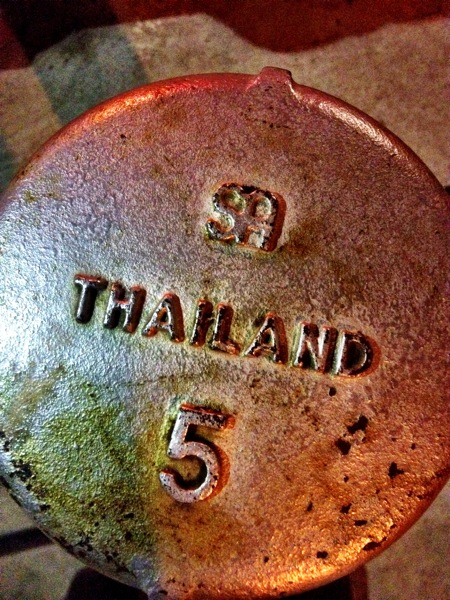
We have a definitive answer to the question I posed back in October: What’s with the New York City fire hydrant poles marked ‘Thailand’? Above is a photo I took back in the fall.
Michael De Stefano left a comment on the post Tuesday saying that:
Actually, it’s rather prosaic. By law, the Country of Origin must be on items purchased by the City of New York. In your travels, you’ll see manhole covers labeled “India”. The poles you’ve found are called ‘bollards’; they protect the hydrant from errant vehicles.
I followed up with Michael via email, and he explained that he knows about the issue because he’s a New York City civil servant who used to work in purchasing.
According to the law, the lowest bidder for producing such goods wins, Michael said. (The New York Times ran a memorable story in 2007 about manhole covers manufactured in India’s West Bengal state.)
So there you have it: Quite intuitively, the polesbollards are labeled “Thailand” because that’s where they’re made.
I remember thinking, earlier, that this most obvious of explanations was possible. (For further reading, here’s more from the Thai government on the country’s steel industry as of 2007.)
On a side note: One of the great pleasures I get from maintaining this blog is receiving thoughtful feedback from folks who happen upon my posts.
Thanks, Michael. And thanks to those who commented on the original item, both here and on Twitter. (In fact, Bangkok-based @KristoferA even speculated, originally, that the bollards were manufactured in Thailand.)
Philosophy is really homesickness; it is the urge to be at home everywhere. — Novalis
What does “home” mean, anyway?
The concept seems especially complicated to me these days, as an American studying here in New York City after living in Bangkok for six years.
Thailand, as you might imagine, is often on my mind.
And I occasionally encounter unexpected reminders of the country and its people here in New York — and not just in the form of the city’s many Thai restaurants.
There was the mysterious New York City fire hydrant marked “Thailand” that I mentioned back in October. (The conundrum remains unsolved, though I suspect I’ll uncover an explanation eventually.)*
There’s Absolute Bagels, a popular shop near Columbia University that is, improbably, run by Thais. (I sometimes stop by to chat with the staff. I’m sure they think I’m a lunatic.)
There was the large table of Thai patrons Anasuya and I bumped into downtown at the famous Katz’s Delicatessen one Saturday last November.
And — getting to the point of this post — just a few weeks ago, I registered my latest unexpected brush with Thailand, though it was fictional and not NYC-specific.
Take a look at the embedded video above, which is also on YouTube here.
The show, of course, is about a high school chemistry teacher (not Gale) in Albuquerque who becomes a crystal meth cook.”**
Visually, the series is pure Southwest U.S., with scene after scene of arid desert landscapes. I’m currently working my way through the show’s fourth season.
I was surprised and delighted when, in that season’s fourth episode, viewers were treated to a video of Gale crooning to Peter Schilling’s 1983 hit song “Major Tom (Coming Home).”
And the karaoke subtitles are in…Thai.
Just a few snippets of Gale’s wonderfully weird performance appeared in the episode, but entire performance is above.
In the scene, Gale is sporting a tan travel vest, a neckerchief, and a fanny pack. Is the video from a trip he took to Thailand? We don’t know. (At least not yet.)
What did “home” mean for Gale? Was he a New Mexico native? Or did he move to New Mexico from elsewhere? When did he travel to Thailand, and what did he make of the place?
The song Gale sings, as it happens, is about an astronaut who becomes marooned in space.
The closing lines are:
Earth below us
drifting, falling.
Floating weightless
coming home…
Earth below us
drifting, falling.
Floating weightless
coming, coming
home…
home…..
Keep on singing, Gale.
In case you’re curious, embedded above and on YouTube here is Schilling’s English-language video.
It is entertaining in its own way, as is the original German version. But I think I prefer Boetticher’s rendition.
*If you have any thoughts on the fire hydrant, please let me know.
**Thanks, Nick, for the recommendation.
(Image: Photo of Bangkok by Prachanart on Flickr.)
BANGKOK — Thai authorities have tightened security measures at the U.S. Consulate in the northern province of Chiang Mai following reports that it was a possible target of attack from al-Qaida and Salafist terrorist groups this month, officials said Tuesday.
Prime Minister Yingluck Shinawatra told reporters she had been informed about the reports and that she had ordered security agencies to add more forces to provide safety at the facility, 570 kilometers (350 miles) north of Bangkok.
“The U.S. Embassy in Thailand has not requested any extra measures but we have to monitor the situation attentively,” Yingluck said.
Deputy Prime Minister Chalerm Yubumrung refused to give details about the threats, but said the reinforced measures had been put in place since Feb. 6 and will continue until the end of multinational military exercises, called Cobra Gold, on Sunday.
A prominent Thai activist and magazine editor was sentenced to a decade in prison Wednesday for defaming Thailand’s monarchy, a verdict rights groups condemned as the latest affront to freedom of expression in the Southeast Asian country.
Somyot Pruksakasemsuk was convicted of publishing two articles in an anti-establishment magazine that made negative references to the crown.
A Thai court on Wednesday sentenced a labor activist and former magazine editor to 10 years in prison for insulting Thailand’s king, the latest in a string of convictions under the country’s strict lese majeste law.
The case of Somyot Pruksakasemsuk, 51, was different from previous lese majeste cases because Mr. Somyot directly challenged the law itself, saying it violated the right to free expression.
A court in Thailand sentenced a magazine editor to 10 years in prison Wednesday for publishing two articles that prosecutors said defamed the country’s revered monarchy, focusing fresh international attention on both the way Thailand’s strict lese majeste laws are applied and the extent of the country’s gaping political divides.
A former Thai magazine editor was jailed for 10 years on Wednesday for insulting the royal family under the country’s draconian lese-majeste law, a sentence that drew condemnation from international rights groups and the European Union.
Somyot Prueksakasemsuk was found guilty of publishing articles defaming King Bhumibol Adulyadej in 2010 when he was editor of a magazine devoted to self-exiled former Prime Minister Thaksin Shinawatra.