Categories
Misc.

AFP on political instability in Thailand

For a summary of the political situation here in Thailand, I suggest reading this AFP story from today: “Thailand braces for fresh political instability.”

The story includes some interesting quotes from analysts. Such as this, on Abhisit:

The 45-year-old premier came to power in late 2008 when the previous pro-Thaksin government collapsed after protests by the ultra-royalist “Yellow Shirts”, who are aligned with the traditional Thai elite.

He heads an increasingly shaky six-party coalition. But Paul Chambers, a Thailand specialist at Heidelberg University in Germany, said his downfall would lead to an early election that none of his allies can afford.

“The coalition is more likely to stay afloat rather than cave in,” he said. “The dangers to Abhisit currently exist more in terms of violent attacks on his person, rather than his forced removal from the prime ministerial chair.”

And this:

“Political life in Thailand is immature,” said one Western analyst, requesting anonymity, who downplayed rumours of an imminent putsch.

“I see nothing that would suggest that the Thai army is divided. It is an army that obeys,” he said. “There are Red Shirts in the military but in 2006 they participated in the coup because these were the orders.”

(Emphasis mine.)

Read the whole thing.

Categories
Misc.

Two quick links: Thailand political risks and arms from North Korea

Just quickly, I wanted to point out this Reuters item from yesterday: “FACTBOX-Five political risks to watch for Thailand.” Give it a read.

Also, to follow on the issue of the plane carrying arms from North Korea, Bloomberg had this story Jan. 29 that’s worth a look: “Iran Was Destination of North Korean Arms, Thailand Reports.”

Categories
Misc.

Map Ta Phut: the big picture

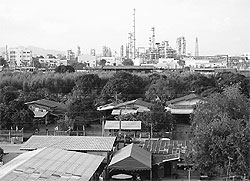
map_ta_phut.jpg

Many news stories about the Map Ta Phut industrial estate issue focus on the latest developments — court decisions, the number of suspended cases, latest appeals, etc.

An opinion piece in yesterday’s Bangkok Post is worth pointing out, however, because it provides some analysis and takes a big picture look at the situation.

The piece, written by two Political Science academics — one from the U.S.’s Northern Illinois University and one from Thailand’s Thammasat University — is called “Map Ta Phut spat hides a colossal failure.”

Here are a few relevant snippets, though I suggest reading the piece in full.

One lesson that emerges from this chronology of events is that Thais have long recognised the need for wider public participation in public policy making, in large part reflecting sensitivity to the environmental consequences of large energy, industrial and infrastructural projects.

Despite this understanding, however, Thais have to date not been successful in devising mechanisms to balance the voices of the diverse interests involved and to then (and this is crucial) reach an authoritative decision that will be accepted as at least procedurally legitimate and, contingently, the last word by most of those interests. This failure is now evident in the impasse that has been reached in Map Ta Phut.

And:

The difficulty involved in the Map Ta Phut conflicts goes well beyond a refusal to confront environmental issues. Several business voices have suggested, in fact, that they worry less about more stringent environmental regulations than about a lack of regulatory clarity. The absence of effective, inclusive deliberations that result in widely supported public policies that state officials implement authoritatively is evident in other areas of Thai public life as well. Indeed, the planning processes governing Thailand’s major public investment projects such as airports, mass transit, irrigation, and even the ports and industrial estates of the Eastern Seaboard projects (where Map Ta Phut is located) themselves often have been uncertain, slow and episodic. Or consider that after many years and studies, decisions and revisions, Thailand’s parliament has yet to relocate.

Making decisions about big, expensive and complex projects with environmental impacts is of course a challenge in any country and often leads to delays, challenges, and cost overruns. The problem, however, seems to be acute in Thailand.

Why is it so difficult to make big, consequential decisions in Thailand? In part, the answer relates to Thailand’s political pluralism that impedes the sort of streamlined and technocratic decision procedures we might find in China or Singapore. Even under Thailand’s authoritarian regimes of the past 30 years, political power typically has not been concentrated enough to make it easy to reach big decisions and make them stick. (The Thai Rak Thai Party’s political dominance from 2001 to 2006 and then prime minister Thaksin Shinawatra’s decisive personality marked a major exception to these patterns.)

And:

Weak political institution

Still other factors that may make it difficult to reach big decisions in Thailand relate to the feebleness of the country’s political institutions. While in many countries it seems natural to accord major influence over key public policies to formal representative institutions – legislatures and political parties – in Thailand many people are dubious of the representative character of those institutions. As a result, Thais are as apt to view decisions reached in parliament as fixes bargained among an oligopoly of special interests as they are to see it as a reasoned compromise growing out of relatively disinterested and sober deliberations.

(Emphasis mine.)

Again, I suggest reading the piece in full.

As a reminder, here is my Jan. 15 post with PM Abhisit’s remarks on Map Ta Phut.

I’m also establishing a Map Ta Phut tag for future posts on the issue.

Image source: Bangkok Post.
Categories
Misc.

Suggested weekend reading

Some links that have caught my eye of late:

See you next week.

Categories
Misc.

Update: Crew of N. Korean arms plane to be held until Feb. 11, Bangkok Post says

An update to my previous post: The Bangkok Post is now saying this:

The prosecution on Friday deferred until Feb 11 a decision on whether to indict the five crew members of a plane which landed at Don Mueang airport with an undeclared cargo of weapons from North Korea.

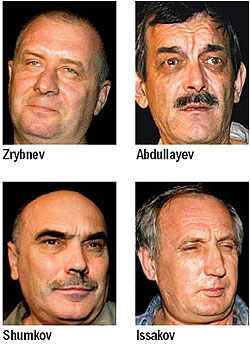
It was earlier reported that the prosecutors might drop charges against pilot Mikhail Petukhou, 54, from Belarus, and Alexandr Zrybnev, 53, Ciktor Abdullayev, 58, Vitaliy Shumkov, 54, and Ilyas Issakov, 53, from Kazakhstan for illegal arms possession, carrying weapons without permission, illegally bringing them into Thailand and failing to inform authorities of the items.

Kayasit Pissawanprakan, chief of the Criminal Litigation Office, said the prosecution could not yet decide whether they should be arraigned. There were still a large number of documents to be examined.

The prosecution, therefore, deferred the decision until Feb 11 and sought court permission to detain the five suspects for another 12 days at the Bangkok Remand Prison, he said.

(Emphasis mine.)

Categories
Misc.

Bangkok Post: Crew of North Korean arms plane to be released today?

n_korea_arms_plane_crew.jpg

Today’s Bangkok Post, citing an anonymous source, has this story: “Korea arms plane crew ‘to go free.’

The first two graphs:

Prosecutors have decided to drop charges against five suspects found last month with 35 tonnes of weapons on a plane from North Korea, a source close to the case has revealed.

The source did not elaborate yesterday on the reasons leading to the prosecutors’ decision, which will be announced today.

Previous posts on this topic are here.

(Photo at right: four of the rive crew. Image source: Bangkok Post)

Categories
Misc.

Reuters: “Are cracks appearing in Thailand’s military?”

Given my recent posts on the subject, I wanted to point out a story that Reuters ran yesterday. It’s called “Are cracks appearing in Thailand’s military?

Here are the first few graphs.

A grenade attack on the office of Thailand’s army chief this month is stoking fears of a worst-case scenario in Thailand’s political crisis — a possible fissure in the military along fault lines that have divided the country.

Analysts, diplomats and military sources say it is premature to talk of a split in Thailand’s powerful and politicised army but that festering ideological differences show signs of broadening in one of the most charged climates in decades.

A divide in an institution central to Thailand’s power structure would deepen uncertainty over the outlook for Thailand’s export-dependent $260 billion economy, Southeast Asia’s second-largest, and raise the prospect of instability in a country seen as a gateway to the region for foreign companies.

Large numbers of soldiers of lower ranks and some senior officers, analysts say, are sympathisers of Thailand’s rural, grassroots anti-government, red-shirted protest movement.

In contrast, many of the military’s top brass are at the other end of the political spectrum, allied with royalists, business elites and the urban middle classes, who wear yellow at protests and largely support the present government.

The red-yellow divide is growing increasingly intractable.

(Emphasis mine.)

Worth a read.

Categories
Misc.

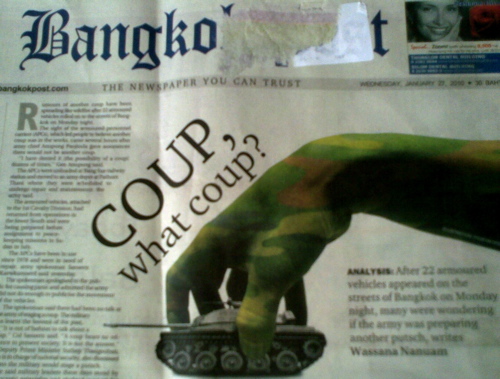
Front page of today’s Bangkok Post: “Coup, What Coup?”

bkk_post_coup_rumors.jpg

I mentioned yesterday the Jan. 15 grenade attack on the office of Thai General Anupong, and how the incident underscores tensions within the Thai Army.

So I wanted to follow up, just quickly, with a cell phone pic of the front page of today’s Bangkok Post. The story, as you can see, is called “Coup, What Coup?

Here are the first few graphs:

ANALYSIS: After 22 armoured vehicles appeared on the streets of Bangkok on Monday night, many were wondering if the army was preparing another putsch

Rumours of another coup have been spreading like wildfire after 22 armoured vehicles rolled on to the streets of Bangkok on Monday night.

The sight of the armoured personnel carriers (APCs), which led people to believe another coup was in the works, came several hours after army chief Anupong Paojinda gave assurances there would not be another coup.

“I have denied it [the possibility of a coup] dozens of times,” Gen Anupong said.

(Emphasis mine.)

Worth a read.

I have no viewpoint to add on the issue, but I’m sharing the image because Thailand watchers might like to see how prominent the story is in today’s edition of the print paper.

Categories
Misc.

Spotted by Austin in Northern Thailand: bespoke chicken carrier

chicken_holder.jpg

Image credit: Austin Bush.

Excellent post from Austin Bush about running into a guy carrying a bespoke bamboo chicken container in Northern Thailand, near Mae Hong Son.

Check out the full post for the details and another pic.

As Austin says:

I came across the guy above just outside Ban Mae Lana, possibly the most attractive rural village anywhere in the country. He made for a nice portrait, but initially I was drawn to his ‘luggage’: a chicken container carved out of a length of bamboo, complete with a window and airholes! He explained that he takes the rooster into the woods, ties it to something and encourages it to call. This apparently attracts any ‘wild chickens’ (kai paa), which he then shoots. Unfortunately this particular chicken wasn’t yet ready. “He’s still scared of the forest,” explained the man, “He needs to be trained.”

(Emphasis mine.)

If carrying single chickens for hunting purposes were more commonplace, I reckon that this ingenious device would be right at home on Cool Tools or Street Use.

Categories
Misc.

Grenade attack on Thai Army general’s office

A brief post about a story that has received little international coverage, but which is worth pointing out to Thailand-watchers…

Local media has reported that on Jan. 15, a grenade was fired into the sixth-floor office of General Anupong Paojinda, in the Thai Army headquarters. The attack happened at night, and no one was hurt.

Still, the incident — and the government has now confirmed it happened, though it was initially dismissed as a rumor — highlights tensions within the Thai army.

The government suspects that army specialist Khattiya Sawasdipol, known for being sympathetic to Thaksin and the red shirts, is behind the attack.

For more, you can find some (inside baseball) stories from the Bangkok Post here (Jan. 26) and here (Jan. 25), as well as analysis pieces here (Jan. 23) and here.

And here’s a Jan. 22 AFP story, as well as a Jan. 23 The Star column from Philip Golingai.

As Golingai points out, here are a couple of graphs from the last Post story I linked to above, by Veera Prateepchaikul:

For the time being, the army chief appears safe, with a tight security cordon around him. But the big question remains in the minds of the general public: how can ordinary people feel safe and secure if the army chief’s life is threatened and he needs extra protection?

This outrageous incident is a direct challenge to the authority of Gen Anupong in his capacity as the army commander-in-chief – not mention a huge slap in the face.

(Emphasis mine.)

Food for thought.