To follow up on my last two posts:
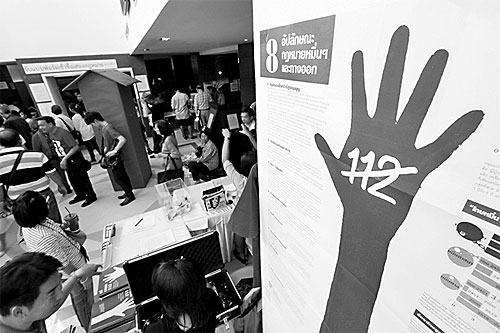
The Thammasat Univ. lèse-majesté/free expression issue continues to make headlines here in Thailand and abroad.
Today’s Bangkok Post reports:
Students, alumni members and lecturers at Thammasat University remain divided over the use of its main campus as a venue for the Nitirat group to engineer a campaign to amend the controversial lese majeste law.
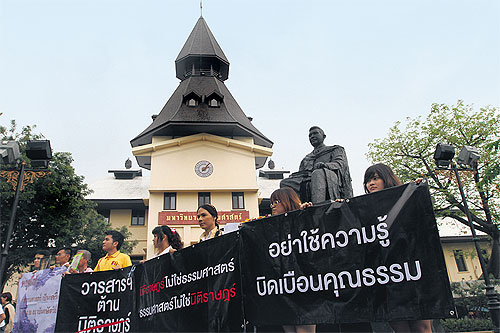
More than 200 current and former student members of the Journalism and Mass Communication Faculty staged a rally against Nitirat at the Tha Phrachan campus. Students and lecturers from other faculties and supporters joined in the demonstration.
They were countered by a group of students who gathered at Thammasat’s Rangsit campus in Pathum Thani who oppose the ban on Nitirat. The group will hold a rally at Tha Phrachan campus on Sunday.
More on the protesting journalism students, some of whom are pictured above: the Post said yesterday:
A group of former and present students of the faculty of journalism and mass communication at Thammasat University on Thursday submitted a letter to the university rector to investigate and take legal and disciplinary action against the lecturers comprising the Nitirat group.
They called during a rally for members of the Thammsat community to oppose Nitirat’s proposal for the amendment of Section 112 of the Criminal Code, for the university to launch a legal and disciplinary investigation of the seven law lecturers, for the mass media to exercise discretion in presenting information on the proposed amendment, and for people in all walks of life to oppose any move deemed insulting to the monarchy.
Elsewhere in the Post today, scholar Thitinan Pongsudhirak looks at Thai identity and puts the Nitirat campaign in historical context:
The Nitirat campaign to amend Article 112 of the Criminal Code, commonly known as the lese majeste law, has generated a political tempest.
It has struck a consonant chord as much as it has riled apprehensive nerves of reformers and conservatives on both sides of the political fault line centring on the monarchy’s role in Thai democracy.
Read the whole thing.
Meanwhile, Reuters reported yesterday that:
American linguist Noam Chomsky, Princeton University professor Cornell West and 221 other foreign scholars have urged Thailand’s prime minister to revise laws that shield the country’s monarchy from criticism, lending their voice to a controversial campaign.
In a letter seen on Thursday and sent to Yingluck Shinawatra a day earlier, the mostly U.S. and European academics backed the campaign by seven Thai university lecturers to amend the world’s toughest lese-majeste laws, which they said had become “a powerful tool to silence political dissent”.
(All emphasis mine.)
(Image: Bangkok Post.)