Categories
Misc.

More on Matt Gross, the NYT, and multimedia travel journalism

In Jan., 2009, I wrote a post praising the work of the New York Times‘s Matt Gross, aka the Frugal Traveler.

For the last several years, Matt has been combining text, blog posts, and videos to create a unique brand of personality-driven travel journalism for the Times.

Matt has supplied readers — and viewers — with not just conventional, written travel stories. He has also provided advice on the best travel gadgets under $50, he has offered Q&As with fellow travelers, and he has even given us tips on traveling with a baby. Matt covers it all, from big picture stories about travel trends to narrowly-focused pieces on specific destinations and emerging technologies.

In terms of outreach, it’s interesting to note that Matt’s home on the Times site contains amble social media integration. There’s a Frugal Traveler Facebook page, and Matt is active on Twitter, interacting frequently with his more than 14,000 followers.

Matt’s latest story is a typical example of his multimedia storytelling. It appeared last Sunday, and it’s about a ramen noodle expedition he undertook in Tokyo. We get a lengthy (nearly 3000-word long) text story, “One Noodle at a Time in Tokyo,” as well as photographer Basil Childers‘s gallery of memorable images.

Matt also gives us a blog post with the back story about why the assignment was his dream trip, and readers can even find an annotated Google Map of the establishments he visited during the journey.

Moreover, the video that Matt (and, presumably, the NYT multimedia folks) has produced is useful, as well. And at four minutes long, it’s at least as long as a standard TV news/feature package. (You can find the video on the lower left side of the main story page.)

Another interesting tidbit: In the ramen story, Matt mentions that one of his guides was Brian MacDuckston, an American who lives in Tokyo and blogs at RamenAdventures.com. The NYT story links to Brian’s blog, naturally, and I noticed an interesting meta-twist: Brian has a blog post with images of one of the eating expeditions he took with Matt. ((One of Brian’s photos, in fact, is this one, which shows what I assume is photog Childers snapping a series of images of two women, one of whom has blonde hair, slurping noodles. One of the pics Basil snapped must be this shot, from the gallery. So here we have the digital contribution from the blogger/noodle enthusiast who guided Matt’s research — and some pics of the shooter in action.))

Is there a larger point here? I’m not sure.

But perhaps, in recounting all of this, the message is that in order to engage with audiences who are increasingly consuming their material online, travel journalists shouldn’t — can’t — think of themselves as simply writers anymore.

It helps if they’re insightful bloggers and understand the digital world. It also helps if they snap their own photos to accompany their stories — as Matt often does. And travel journalists have to be adept at producing videos and curating links to corresponding multimedia materials — blogs, bloggers, Google Maps, Facebook, Twitter — so that their audience can get the most out of their work.

It seems to be working for Matt and the Times.
Categories
Misc.

AFP on political instability in Thailand

For a summary of the political situation here in Thailand, I suggest reading this AFP story from today: “Thailand braces for fresh political instability.”

The story includes some interesting quotes from analysts. Such as this, on Abhisit:

The 45-year-old premier came to power in late 2008 when the previous pro-Thaksin government collapsed after protests by the ultra-royalist “Yellow Shirts”, who are aligned with the traditional Thai elite.

He heads an increasingly shaky six-party coalition. But Paul Chambers, a Thailand specialist at Heidelberg University in Germany, said his downfall would lead to an early election that none of his allies can afford.

“The coalition is more likely to stay afloat rather than cave in,” he said. “The dangers to Abhisit currently exist more in terms of violent attacks on his person, rather than his forced removal from the prime ministerial chair.”

And this:

“Political life in Thailand is immature,” said one Western analyst, requesting anonymity, who downplayed rumours of an imminent putsch.

“I see nothing that would suggest that the Thai army is divided. It is an army that obeys,” he said. “There are Red Shirts in the military but in 2006 they participated in the coup because these were the orders.”

(Emphasis mine.)

Read the whole thing.

Categories
Misc.

Two quick links: Thailand political risks and arms from North Korea

Just quickly, I wanted to point out this Reuters item from yesterday: “FACTBOX-Five political risks to watch for Thailand.” Give it a read.

Also, to follow on the issue of the plane carrying arms from North Korea, Bloomberg had this story Jan. 29 that’s worth a look: “Iran Was Destination of North Korean Arms, Thailand Reports.”

Categories
Misc.

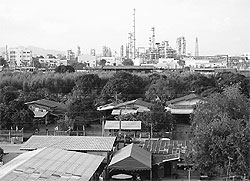
Map Ta Phut: the big picture

map_ta_phut.jpg

Many news stories about the Map Ta Phut industrial estate issue focus on the latest developments — court decisions, the number of suspended cases, latest appeals, etc.

An opinion piece in yesterday’s Bangkok Post is worth pointing out, however, because it provides some analysis and takes a big picture look at the situation.

The piece, written by two Political Science academics — one from the U.S.’s Northern Illinois University and one from Thailand’s Thammasat University — is called “Map Ta Phut spat hides a colossal failure.”

Here are a few relevant snippets, though I suggest reading the piece in full.

One lesson that emerges from this chronology of events is that Thais have long recognised the need for wider public participation in public policy making, in large part reflecting sensitivity to the environmental consequences of large energy, industrial and infrastructural projects.

Despite this understanding, however, Thais have to date not been successful in devising mechanisms to balance the voices of the diverse interests involved and to then (and this is crucial) reach an authoritative decision that will be accepted as at least procedurally legitimate and, contingently, the last word by most of those interests. This failure is now evident in the impasse that has been reached in Map Ta Phut.

And:

The difficulty involved in the Map Ta Phut conflicts goes well beyond a refusal to confront environmental issues. Several business voices have suggested, in fact, that they worry less about more stringent environmental regulations than about a lack of regulatory clarity. The absence of effective, inclusive deliberations that result in widely supported public policies that state officials implement authoritatively is evident in other areas of Thai public life as well. Indeed, the planning processes governing Thailand’s major public investment projects such as airports, mass transit, irrigation, and even the ports and industrial estates of the Eastern Seaboard projects (where Map Ta Phut is located) themselves often have been uncertain, slow and episodic. Or consider that after many years and studies, decisions and revisions, Thailand’s parliament has yet to relocate.

Making decisions about big, expensive and complex projects with environmental impacts is of course a challenge in any country and often leads to delays, challenges, and cost overruns. The problem, however, seems to be acute in Thailand.

Why is it so difficult to make big, consequential decisions in Thailand? In part, the answer relates to Thailand’s political pluralism that impedes the sort of streamlined and technocratic decision procedures we might find in China or Singapore. Even under Thailand’s authoritarian regimes of the past 30 years, political power typically has not been concentrated enough to make it easy to reach big decisions and make them stick. (The Thai Rak Thai Party’s political dominance from 2001 to 2006 and then prime minister Thaksin Shinawatra’s decisive personality marked a major exception to these patterns.)

And:

Weak political institution

Still other factors that may make it difficult to reach big decisions in Thailand relate to the feebleness of the country’s political institutions. While in many countries it seems natural to accord major influence over key public policies to formal representative institutions – legislatures and political parties – in Thailand many people are dubious of the representative character of those institutions. As a result, Thais are as apt to view decisions reached in parliament as fixes bargained among an oligopoly of special interests as they are to see it as a reasoned compromise growing out of relatively disinterested and sober deliberations.

(Emphasis mine.)

Again, I suggest reading the piece in full.

As a reminder, here is my Jan. 15 post with PM Abhisit’s remarks on Map Ta Phut.

I’m also establishing a Map Ta Phut tag for future posts on the issue.

Image source: Bangkok Post.