Categories
Misc.

H1N1 spreads in Thailand

H1N1 infections in Thailand have increased markedly over the past few days. Confirmed cases are now at 310, up from just 16 last week.

Here are three recent stories:

  • Nation: “Confirmed Type-A (H1N1) flu cases rise to 310

    The confirmed case of Type-A (H1N1) influenza cases in Thailand has risen to 310, Deputy Public Health Minister Manit Nopamornbodi announced Tuesday.

    He said the Public Health Ministry will Tuesday hold a meeting of doctors nationwide to make preparations to cope with the more outbreaks.

    Despite the increase of the cases, Manit pleaded the public not to panic.

  • Bangkok Post: “109 new flu cases

    The number of A(H1N1) influenza cases in Thailand had risen to 310 after 109 new cases were reported on Tuesday, Public Health permanent secretary Prat Boonyavongvirot said.

    Dr Prat said the Ministry of Public Health will now hold a press conference on the H1N1 outbreak everday at around 11am to prevent any misleading information.

    He said the number of H1N1 flu cases would likely increase, but it was not unusual since other countries also encountered the same problem.

  • And earlier today, there was this story in the Bangkok Post: “Officials muzzled on H1N1

    The Public Health Ministry is asking provincial health and hospital chiefs not to speak to the media about influenza A (H1N1) cases in an effort to calm disquiet over the extent of the spread of the virus.

    Ministry spokesman Suphan Sithamma said a letter was being sent to senior health figures warning them not to say anything about the number of flu cases and details about the patients. All information was to be filtered through health authorities in Bangkok.

    The ministry’s hush-hush order came as the number of flu cases passed the 200 mark and experts expected it to rise further.

Categories
Misc.

David Carradine’s death — a few thoughts on media coverage

A few thoughts about David Carradine’s death and the subsequent media coverage:

  • The image supposedly showing Carradine’s body in his hotel room
    As theories about the cause of Carradine’s death evolved from suicide to auto-erotic asphyxiation, a key element in the public’s perception of the case, it seems, was the surfacing of a photo that supposedly shows Carradine’s body in his hotel room. In the image, which is digitally altered to obscure the face and much of the body, a man is shown hanging in a closet, with his hands bound above his head.

    Thai tabloid newspaper Thai Rath published the image two days after Carradine was found dead, and many assume the photo is authentic. (I will not link to it here.) Others, however, aren’t so sure about the image’s provenance. As Andrew at the Thai media blog Bangkok Bugle points out:

    The upmarket Nai Lert Park hotel where Carradine’s body was found is refusing to confirm or deny if the image depicts one of their suites. Thai Rath remains equally silent about its sources, as does the Royal Thai Police about whether this image is genuine.

    Thailand’s most popular newspaper has been branded “sick” and “sensationalist” for its decision to publish the pictures on Saturday, however to those in Thailand their coverage is nothing out of the ordinary. Yesterday’s front page, for example, showed blood-spattered bodies from the latest terror attack in the south of the Kingdom.

    Regardless of this particular photo’s authenticity, there’s a bigger issue here: Thai Rath and other newspapers in Thailand are known for their graphic coverage. As Patrick Winn noted last month in GlobalPost:

    Each morning, Thailand’s newspaper racks offer a gallery of gore.

    Few days pass without a corpse, face-down and blood-soaked, appearing on Thai newspapers’ front pages. Equally common are accident scenes, with unlucky drivers spilling lifelessly from their totaled cars.

  • Backlash in the Thai English language media
    There’s been some backlash in the Thai English-language papers. On Wednesday, the Nation ran this opinion piece, called “Sorry, David, if we are denying you peace.” The author explains the paper’s approach to covering the story. And yesterday’s Bangkok Post has this item, “Shocking pix need a call for moral outrage.”
  • International coverage
    News of Carradine’s death has made headlines the world over, not just in Thailand, of course. Al Tompkins has a post at the journalism site PoynterOnline called “Why You Shouldn’t Publish Alleged Carradine Death Photos.” An excerpt:

    Thai Rath, a newspaper in Thailand, has published a front-page photo of what it says is David Carradine’s body hanging by ropes in a hotel closet. The actor was found dead in a Bangkok hotel last week.

    No doubt, the grisly photo, as well as an autopsy photo that’s been surfacing across the Web, will generate lots of traffic.

    But they’re not news.

    It’s right to wonder whether they’re authentic, but even if they are, I can’t imagine a legitimate reason to publish them.

  • New details and the ongoing investigation
    Meanwhile, details about Carradine’s death are still emerging: A forensics expert hired by the actor’s family has now examined Carradine’s body in the US. As the AP recently reported, the expert says Carradine’s death was not a suicide, though he cautioned that a final cause of death can’t be determined at this point. The results of ongoing Thai forensics tests should be known in a matter of weeks.
Categories
Misc.

David Carradine: update from Bangkok

Here’s the latest on “Kung Fu” and “Kill Bill” star David Carradine’s death here in Bangkok:

  • Thai newspaper Thai Rath has published an image that allegedly shows Carradine dead in his hotel room. The photo supposedly shows Carradine naked, hung in a closet with his hands bound above his head. (Interest in the image spiked last weekend: a search for “David Carradine death photo” debuted on the Google Trends list of most-searched-for phrases on Saturday.)
  • Carradine’s family is upset about the publication of the image, and they’ve said they may pursue legal action if other outlets run the photo. Carradine’s family has also said they want the FBI to investigate the case. Thai police say the FBI can “observe” the investigation.
  • Regarding the publication of the image, the Bangkok Post has this story: “Carradine family upset by Thailand

    The family of the late actor David Carradine have launched strong anti-Thailand criticism touched off by the death of the TV and movie star.

    They are “profoundly disturbed” by publication of a forensics photo in a Bangkok newspaper, claim that the Thai pathologist is incompetent, want to go around the Thai police with FBI investigators – and threaten to sue any Thai media printing additional photos of Carradine after his death.

Categories
Misc.

More on Carradine’s death in Bangkok

AP: “Thai police: Carradine death may be accidental

BANGKOK (AP) — The body of American actor David Carradine, best known for the 1970s TV series “Kung Fu,” was found in a hotel room closet with a rope tied to his neck and genitals, and his death may have been accidental suffocation, Thai police said Friday.

The 72-year-old actor’s body was discovered Thursday in his luxury suite at Bangkok’s Swissotel Nai Lert Park Hotel. Police initially said they suspected suicide, though Carradine’s associates had questioned that theory.

Categories
Misc.

David Carradine dies in Bangkok

Actor David Carradine, best known for his role on the 1970’s TV series “Kung Fu,” was found dead here in Bangkok today. Police have said that he was found hung in his hotel room.

In addition to starring in “Kung Fu” and in many Hollywood movies, Carradine had a notable part as “Bill” in Quentin Tarantino’s “Kill Bill” volumes 1 and 2. The 72-year-old was in Bangkok shooting a new film.

Here’re some news stories:

AP/NPR: “Actor David Carradine Found Dead In Bangkok

BBC: “Kung Fu star Carradine found dead

EW.com: “David Carradine: RIP

Nation: “David Carradine found dead in Bangkok

Categories
Misc.

The iPod-ification of Khao San Road

I was in downtown Bangkok’s Banglamphoo district yesterday afternoon, and I figured I’d drop by Khao San Road to see how it’s looking these days. You may remember that I penned a New York Times travel story in 2007 about how Khao San Road, long a gathering spot for backpackers, has become increasingly upscale.

I hadn’t visited the area in about six months, and at first, everything seemed normal: There were vendors selling offbeat T-shirts, various travelers were drinking beer at outdoor cafes, and a young woman was sitting on a curb, getting her hair braided.

But then I saw this, which I must admit took me by surprise:

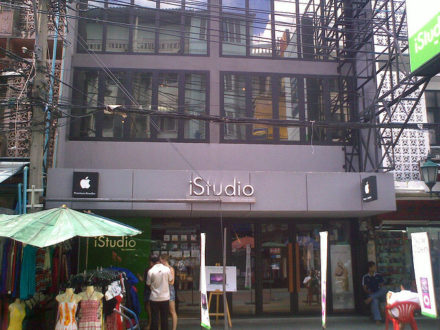
Yes, that’s a recently-opened iStudio shop — a Mac re-seller — on Khao San Road. I went inside, and can report that the shop sells the full range of Apple gear: routers, desktops, laptops, iPods, and even the iPhone. Here’s another pic:

I also noticed, further down the street, that in addition to pirated music CDs, which have been available on Khaosan Road for many years, there’s now at least one vendor selling bootlegged computer software.

And then there’s this:

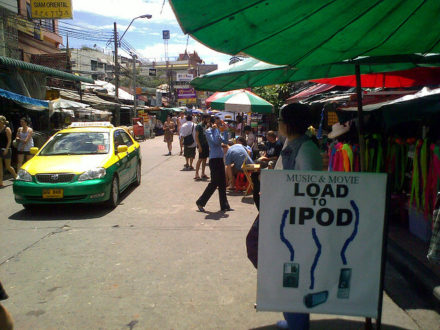
There were at least two stalls where vendors were selling movies and music that could be downloaded directly to iPods, mobile phones, or computers. You can see, here, that the sign says “Music & Movie — Load to iPod.” (For the record, this practice may not be particularly new. And it may not be unique to Bangkok: A friend in the know tells me that this downloading service has been available in Phnom Penh for some time.)

So these new, digital offerings — the iPod-ifcation of Khaosan Road, if you will — means that if you’re a backpacker and you want to upgrade your aging iPod, let’s say, or even purchase a new iPhone, you can do so at one end of the street. Then you can wander a few hundred meters down the road and load the device up with pirated flicks and tunes. And there you go: You’re set for the rest of your journey.

Depending on your perspective, I imagine this is either scary, surprising (or not), or totally cool. Maybe it’s some combination of all of those.

Categories
Misc.

Adioso: new site for budget airlines in Southeast Asia

Adioso is a promising new site that tracks budget airline fares in Southeast Asia and Australia. The site is still in beta, but some features include:

  • A spare design and an easy-to-use search bar at the top of the site.
  • Once you select your location within the region, you can search for cheapest domestic and international fares, regardless of carrier.
  • A “price feed” with updates on new bargains.
  • While it’s not exactly remarkable these days, the site’s blog and integration with Twitter add some personality and timeliness to the site. (Sample tweet from an hour ago: “AirAsia to launch flights to Sri Lanka tomorrow. The result: Australia to Colombo from AUD$234 (via KL). Current best price: $1042!”)

(Via @travelfish)

Categories
Misc.

NYT podcast on Myanmar and Aung San Suu Kyi

In this week’s New York Times podcast ((Here’s a list of my favorite podcasts.)) about international news, correspondent Seth Mydans discusses Aung San Suu Kyi and Myanmar. If you’re looking for some general context and historical perspective, it’s worth a listen.

Click here and scroll down to World View Podcast. You can stream the 6 min., 30 sec. mp3 or subscribe for future episodes.

Categories
Misc.

Nokia E71 review: notes after five months of use

Let’s talk smartphones — mobile phones that have advanced Web browsing and multimedia capabilities.

Nokia E71

First things first: I like Apple products, but I’m holding off on the iPhone ((I’m still deciding what to make of the issue of iPhones in Thailand. The devices are available here, but they’re usually more expensive than in the US, and the 3G versions typically come tethered to contracts. More on this, perhaps, in a later post.)), at least for now. ((Another note about the iPhone in general: I’ve played with examined a few models up close, and my feeling is that the touch screen interface is simply superior to an interface that uses buttons. For more on this, see this column from tech usability expert Jacob Nielsen. Key quote: “History is now repeating itself. Just as Apple popularized the GUI on the desktop through the Mac, it’s popularizing the GUI on mobile devices through the iPhone.”))

Back in December, I purchased a Nokia E71 (sample unit pictured above) here in Bangkok.

My one sentence review: The Nokia E71 is a great all-around smartphone, but think twice if you have fat fingers. (More on the issue of pudgy digits and small keys below…)

Pros

  • Call quality: I upgraded from my candybar form factor Nokia ((I’m a loyal Nokia consumer. Their phones are typically very tough, they have good battery life, and they have a logical user interface.)) to take advantage of the E71’s bigger screen for Web browsing, as well as enhanced video and camera, among other features. So it was a pleasant surprise, then, to find out that perhaps the most notable attribute of the device is its phenomenal voice call quality.
  • The video quality is decent. Here’s a 20-second video I shot at a bar here in Bangkok while watching President Obama’s inauguration. (Note that the quality of the mp4 video is slightly better than what you see in this Youtube version.)

    And so you can get a sense of what videos in bright light look like, here’s a short video I shot on a ferry coming back to Bangkok from Koh Samet:

  • Web access: Gmail for mobile devices works very well, and Web browsing with the Opera mini browser — which you’ll need to download separately — is fantastic. Seriously, do yourself a favor and download Opera mini. It works a lot better than the built-in Nokia browser.

Cons

  • The QWERTY keyboard is simply too small for me.
  • It pains me to say this, since Nokia typically creates highly user-friendly phones. But there’s very little space between the keys, and some of the keys in the middle of the pad are cluttered and hard to read at a glance. The keys have Thai letters, the Roman alphabet, and numbers all crammed together.

    A major downnfall: The keys that are most important — the ones with numbers, as it’s a phone, after all — can be difficult to spot quickly. The slim, sleek E71 replaced the older — and comparatively chunkier —E61, but I actually prefer the larger keys on the older model. You can see the difference between the two models in the image below:

    Nokia E71 vs. E61
    The older E61 (left) and the newer E71 (right)

    Yes, the E61 looks somewhat like a calculator. But the keys are much easier to use.

  • This may well be my own fault, but I haven’t taken to the QWERTY keyboard. The built-in predictive text feature is decent, and it does a good job of guessing and then remembering the words you type. But I have to say I miss T9. ((Confession: I recently used my old, trusty, Nokia 3110 classic — truly a no-frills phone — while traveling, and I loved using T9 again.)) The E71 takes two hands to use; you only need one for T9-equipped devices.

On the fence

  • GPS: I’m on the fence about the built-in GPS function. One annoyance is that the built-in functionality takes a long time to load and update, so it’s not ideal for navigating by car. However, the Google Maps mobile integration is excellent. It takes what would otherwise be a cumbersome feature and makes it speedy and useful. ((Thanks to SN for the Google Maps tip!))
  • Radio: apparently the phone has a built-in radio, but I’ve yet to use it.

The bottom line: the Nokia E71 is a solid smartphone. Web browsing works well, and the call quality is exceptional. But unless you have very small fingers, you might find the QWERTY keypad hard to use.

Other Nokia E71 reviews:

Categories
Misc.

WSJ on yellow shirts as a political party

WSJ: “Thai Protest Group Votes to Form a Political Party

PATHUM THANI, Thailand — Members of Thailand’s yellow-shirt protest movement voted to form a political party, creating a potentially influential force as the country struggles to pull itself out of recession.

Tens of thousands of members of the People’s Alliance for Democracy — a movement instrumental in bringing down two governments — converged on a sports stadium in this town near Bangkok on Monday and voted to transform the grass-roots campaign against corruption into a formal political party.

The apparently overwhelming assent — almost the entire stadium stood up to vote for the change — points to an expanded political role for the group’s leaders after it gained global notoriety for shutting down Bangkok’s international airports for a week last year.

The new party, which the PAD hasn’t yet named, could further elevate publisher and broadcaster Sondhi Limthongkul, the 61-year-old driving force behind the movement.

The PAD’s vote comes as Thailand grapples with its worst economic slump in more than a decade. The state economic planning agency said GDP contracted 7.1% in the first three months of 2009 from a year earlier, the worst performance since the 1997-98 Asian financial crisis.

Also in today’s WSJ: “Thai Economy Enters Recession, but Recovery Is in Sight.”

Thailand’s economy plunged into recession in the first quarter as the global downturn hammered exports and tourism slumped due to political unrest. But the government and economists say the economy is probably at or near the bottom.

Seasonally adjusted gross domestic product shrank 1.9% in the three months ended March from the prior quarter, said the head of the National Economic & Social Development Board, Ampon Kittiampon. The state economic planning agency said GDP contracted 7.1% in the first three months from a year earlier, the worst performance since the 1997-98 Asian financial crisis.