Categories
India Journalism Tech

India’s Top Court Rules Massive Biometric Identity Database Legal—With Restrictions

That’s the headline of my most recent story, written with a colleague, out yesterday.

It begins:

India’s highest court ruled that the world’s largest biometric identification database doesn’t infringe on citizens’ privacy rights—but needs some new limitations.

The country’s controversial Aadhaar program uses photos, finger and eye scans and has already signed up more than 1 billion people. It has sparked an intense global debate over how far a democracy should be able to go in collecting the personal data of its citizens and how that data can be used, shared and protected.

Wednesday’s Supreme Court ruling was a response to multiple challenges to the system.

A five-judge panel ruled in a 4-1 decision that the program is constitutional and helps the poor by streamlining disbursement of welfare benefits. Being in the database, however, shouldn’t be required for using mobile phones, opening bank accounts or for school admissions, according to the 1,448-page document outlining the court’s decision. It had been unclear for some time whether such organizations could compel people to supply Aadhaar numbers.

“It’s a historic judgment,” Finance Minister Arun Jaitley said. “Everyone must realize, including critics of Aadhaar, that you can’t defy technology or ignore it.”

Click through to read the rest.

Categories
India Journalism Tech

SoftBank Leads $1 Billion Investment in Indian Hotel-Booking Startup

That’s the headline on my latest story, out yesterday. It begins:

SoftBank Group Corp. is doubling down on one of its biggest bets in India by leading a $1 billion investment in hotel-booking startup OYO Hotels.

The company, based in Gurgaon, India, has received $800 million in a round led by SoftBank’s Vision Fund, which SoftBank Chief Executive Masayoshi Son is using to back cutting-edge technologies, OYO said Tuesday. U.S. venture-capital firms Sequoia Capital and Lightspeed Venture Partners also contributed to the round, and existing investors have pledged a further $200 million.

“We plan to rapidly scale our business,” with a focus on continuing OYO’s expansion into China, said 24-year-old company founder Ritesh Agarwal in a written statement. OYO also operates in Malaysia, Nepal and the U.K.

The new round of funding values the company at $5 billion, including the new funds, according to a person familiar with the matter. That is up from a post-money valuation of roughly $850 million when OYO received $250 million last year in a round led by SoftBank.

Click through to read the rest.

Categories
India Journalism Tech

Two Years Ago, India Lacked Fast, Cheap Internet—One Billionaire Changed All That

That’s the headline on my latest story, a page one piece out yesterday and online here. It begins:

MUMBAI—India’s richest man is catapulting hundreds of millions of poor people straight into the mobile internet age.

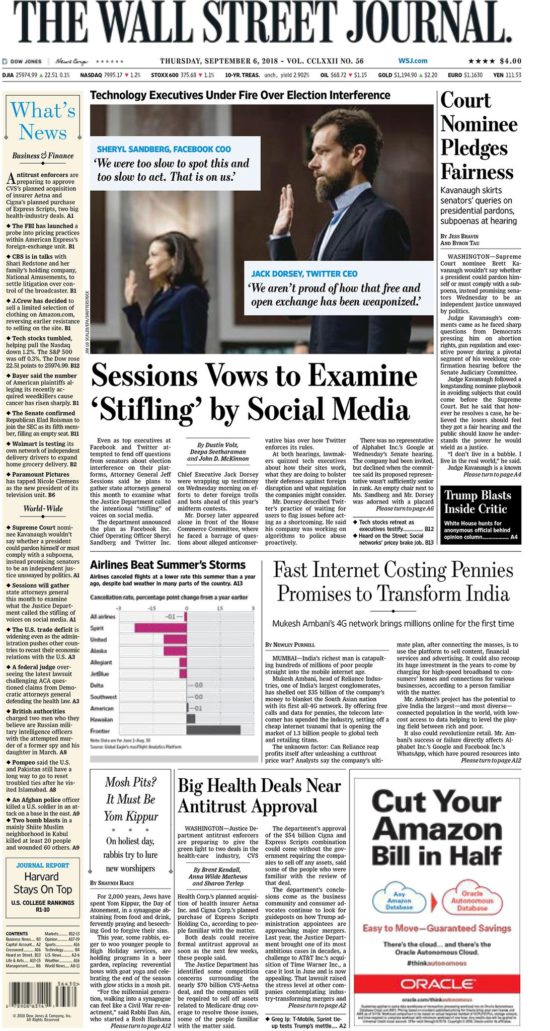
Mukesh Ambani, head of Reliance Industries, one of India’s largest conglomerates, has shelled out $35 billion of the company’s money to blanket the South Asian nation with its first all-4G network. By offering free calls and data for pennies, the telecom latecomer has upended the industry, setting off a cheap internet tsunami that is opening the market of 1.3 billion people to global tech and retailing titans.

The unknown factor: Can Reliance reap profits itself after unleashing a cutthroat price war? Analysts say the company’s ultimate plan, after connecting the masses, is to use the platform to sell content, financial services and advertising. It could also recoup its massive investment in the years to come by charging for high-speed broadband to consumers’ homes and connections for various businesses, according to a person familiar with the matter.

Click through to read the rest.

Categories
India Journalism

Mobile Money Heats Up in India as Google Doubles Down

That’s the headline of my most recent story, which came out yesterday. It begins:

NEW DELHI–Alphabet Inc.’s Google is raising its mobile-payments game in India with new functions and services as global players race to woo the nation’s legions of consumers who are skipping credit cards and transacting on smartphones instead.

A day after Warren Buffett’s Berkshire Hathaway Inc. said it had invested in the parent company of India’s largest digital-payments firm, called Paytm, Google said it is expanding its mobile money service in the South Asian nation. It is partnering with several local banks to offer consumer loans from within its app in the coming weeks, aiming to assist users seeking cash to cover expenses such as school fees.

Google is also expanding its tie-ups to more online merchants as well as to physical retail shops such as India’s ubiquitous mom and pop stores.

Click through to read the rest.

Categories
India Journalism

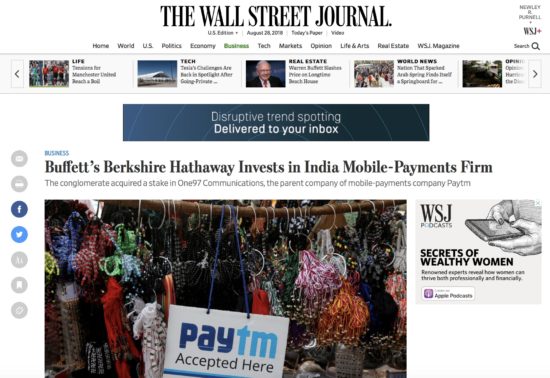
Buffett’s Berkshire Hathaway Invests in India Mobile-Payments Firm

That’s the headline of my most recent story, which came out yesterday. It begins:

NEW DELHI—-Warren Buffett’s Berkshire Hathaway Inc. is getting into the mobile-payments business.

The Omaha, Neb., conglomerate said Monday it invested in One97 Communications Ltd., the parent company of Paytm. The Noida, India-based company is India’s largest mobile-payments firm. It makes a popular smartphone app that can be used to pay for everything from movie tickets to auto-rickshaw rides.

Mr. Buffett’s assistant Debbie Bosanek said that Mr. Buffett wasn’t involved in the deal. She didn’t immediately confirm the size of the investment. Berkshire was in talks to invest 20 billion to 25 billion rupees ($285 million to $357 million), according to a person familiar with the matter.

Paytm, which says it has more than 300 million users, saw its usage skyrocket in 2016 when India’s government nullified its largest-denomination notes, a bid to root out tax evasion and corruption that triggered a cash shortage.

Click through to read the rest.

Categories
India Journalism Tech

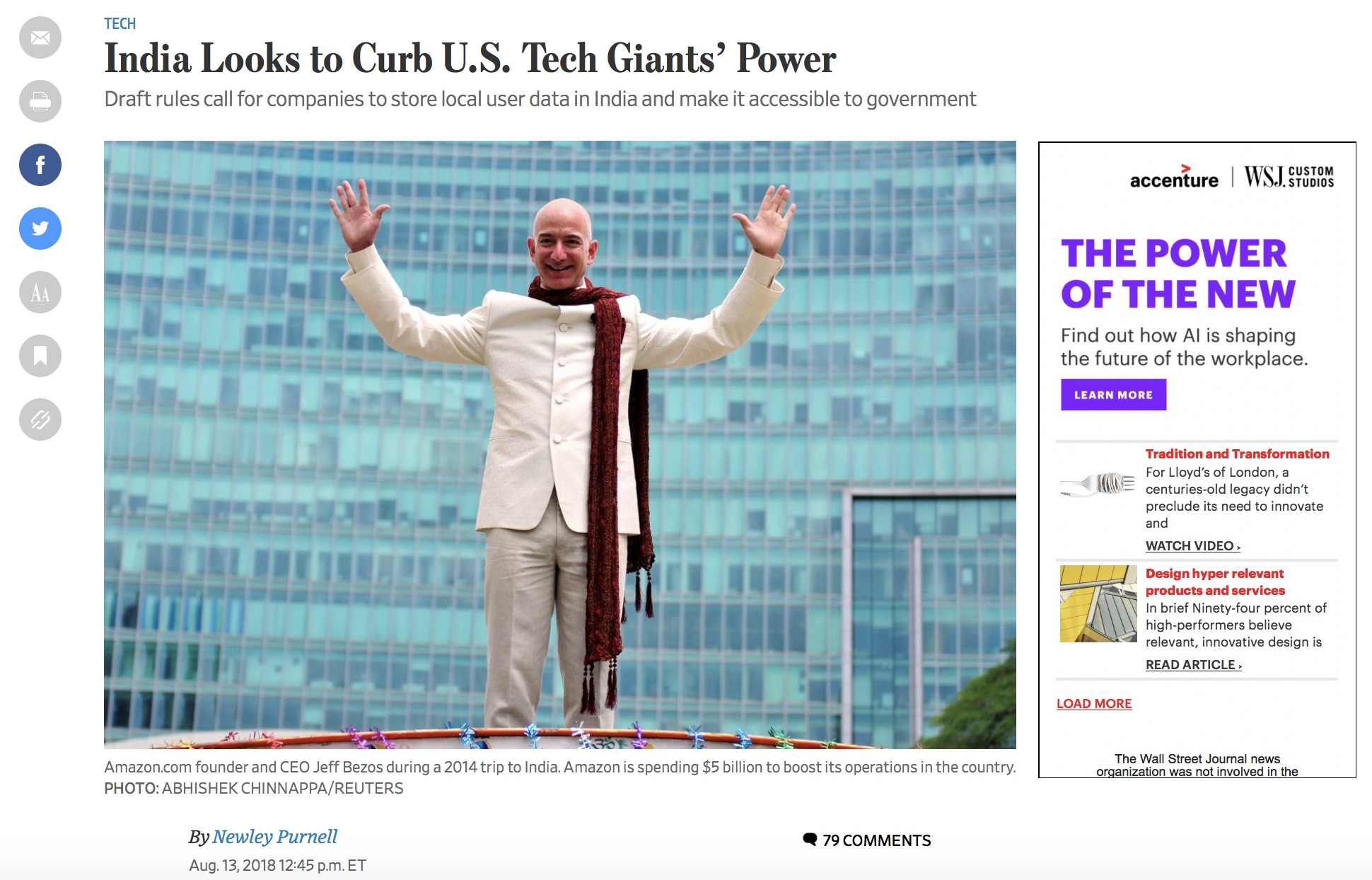
India Looks to Curb U.S. Tech Giants’ Power

That’s the headline of my most recent story, which came out Monday and was in Tuesday’s print Wall Street Journal. 

It begins:

Indian policy makers are looking for ways to tamp down American tech behemoths, a shift that could crimp growth potential in one of the biggest remaining open markets for their expansion.

India wants to slap new rules on Amazon.com Inc., Apple Inc., Alphabet Inc.’s Google, Facebook Inc. and other firms, using a page from China’s playbook to take control of its citizens’ data and shelter homegrown startups.

The proposed rules, which have emerged in recent weeks in a series of private, draft government policies, have U.S. tech companies concerned, according to   familiar with the matter. American firms are betting billions on the Indian market because, unlike China’s, it has been relatively open to foreign competitors. That might be about to change.

“It is unprecedented and it needs to be taken very seriously,” said Vinay Kesari, a Bangalore-based technology lawyer specializing in regulatory matters who has worked with U.S. tech firms. “It could have huge implications.”

Click through to read the rest.

Categories
Journalism Tech

App Traps: How Cheap Smartphones Siphon User Data in Developing Countries

That’s the headline of a story out Thurs. and in Friday’s paper that I wrote with my colleagues Josh Chin, Myo Myo, and Kersten Zhang. It begins:

For millions of people buying inexpensive smartphones in developing countries where privacy protections are usually low, the convenience of on-the-go internet access could come with a hidden cost: preloaded apps that harvest users’ data without their knowledge.

One such app, included on thousands of Chinese-made Singtech P10 smartphones sold in Myanmar and Cambodia, sends the owner’s location and unique-device details to a mobile-advertising firm in Taiwan called General Mobile Corp., or GMobi. The app also has appeared on smartphones sold in Brazil and those made by manufacturers based in China and India, security researchers said.

Taipei-based GMobi, with a subsidiary in Shanghai, said it uses the data to show targeted ads on the devices. It also sometimes shares the data with device makers to help them learn more about their customers.

Smartphones have been billed as a transformative technology in developing markets, bringing low-cost internet access to hundreds of millions of people. But this growing population of novice consumers, most of them living in countries with lax or nonexistent privacy protections, is also a juicy target for data harvesters, according to security researchers.

Smartphone makers that allow GMobi to install its app on phones they sell are able to use the app to send software updates for their devices known as “firmware” at no cost to them, said GMobi Chief Executive Paul Wu. That benefit is an important consideration for device makers pushing low-cost phones across emerging markets.

“If end users want a free internet service, he or she needs to suffer a little for better targeting ads,” said a GMobi spokeswoman.

Click through to read the rest.
Categories
Journalism Tech

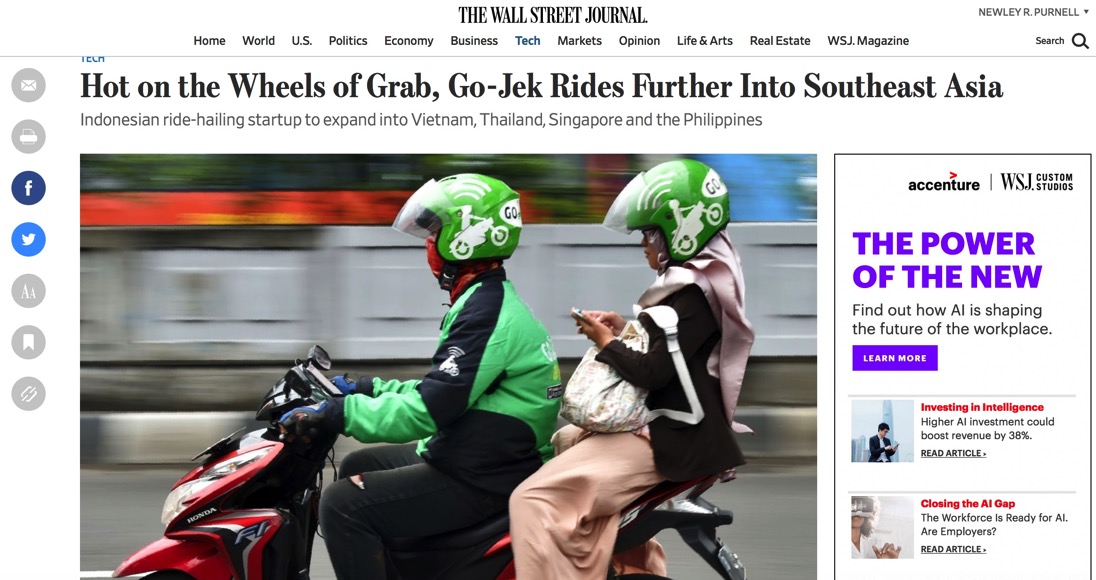
Hot on the Wheels of Grab, Go-Jek Rides Further Into Southeast Asia

gojek southeast asia

That’s the headline of a story out Thurs. that I wrote with my colleage P.R. Venkat. It begins:

Motorcycle-taxi service PT Go-Jek Indonesia will invest $500 million to expand its operations in Southeast Asia, revving up competition in a fast-growing consumer market just two months after Uber Technologies Inc. reached a landmark deal to exit from the region.

The Indonesian company said in a statement Thursday it plans to enter Vietnam, Thailand, Singapore and the Philippines in the next few months and is currently working with regulators and stakeholders across the region.

Go-Jek will initially offer motorcycle-hailing services in Vietnam, Thailand and the Philippines, and provide traditional taxi services in Singapore, where motorcycle taxis aren’t permitted, a company spokesman said. The move, in effect, puts Go-Jek in direct competition with regional market leader Grab Inc.

Click through to read the rest.
Categories
India Journalism Tech

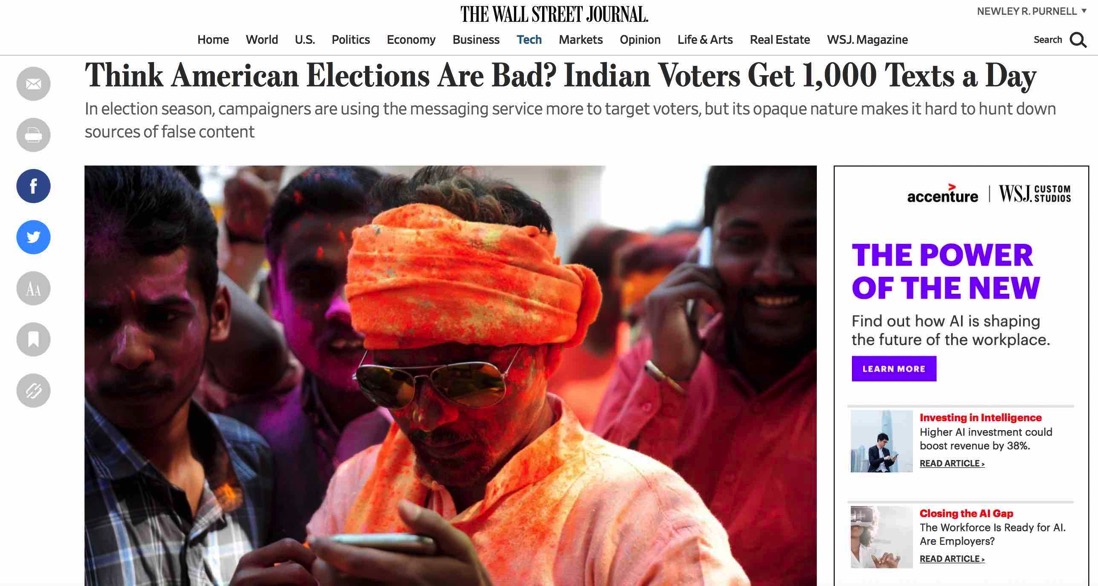
Think American Elections Are Bad? Indian Voters Get 1,000 Texts a Day

2018 05 16whatsapp

That’s the headline of my most recent story, out yesterday, which I wrote with a few colleagues. It begins:

For Gurupad Kolli, a 40-year-old lawyer who lives in a remote Indian village, the torrent of WhatsApp messages surging to his phone a few weeks ago meant one thing: election day was near.

They’re at turns strident, angry, buoyant, informative, misleading, gripping and confusing, he says. Some days he received as many as 1,000 of them through the popular messaging service. Pleased to no longer “depend on the mass media like newspapers,” the resident of Ramapur village in the southern state of Karnataka nonetheless also conceded “there’s so much false and fake news going around.”

He isn’t alone in his bewilderment. The rapidly falling cost of smartphones and mobile data in the world’s second-most-populous nation has turbocharged the spread of WhatsApp, where it is growing far faster than other social media and messaging platforms such as Twitter and Facebook.

India is home to more WhatsApp users than any other country, accounting for more than 200 million of the 1.5 billion monthly active global users. That rivals the popularity in India of Facebook Inc., which owns WhatsApp. Tens of millions of Indians of all ages have made the messaging service, which is simple to join and use, their entry point to the world of digital communication, especially in poor, remote areas where users are flocking to the internet for the first time.

Click through to read the rest.

Categories
Journalism Tech

Walmart Bets $15 Billion on an E-Commerce Passage to India

Walmart filpkart

That’s the headline of a story just out today with my colleagues Eric Bellman and Corinne Abrams: It begins:

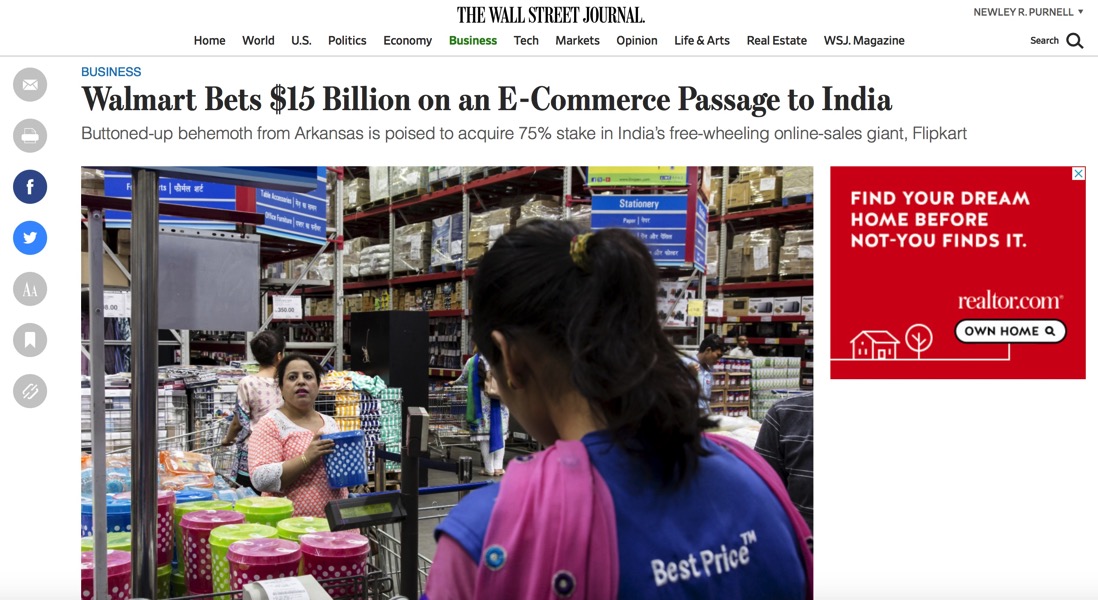
NEW DELHI—The famously frugal and focused Walmart Inc. is betting $15 billion on a much different kind of company: a sprawling Indian e-commerce startup that has burned through mountains of cash to try to conquer the country’s online shopping market.

The deal for a roughly 75% stake in Flipkart Group is set to be announced as early as this week.

If the union works, it could provide India’s leading online seller needed funds and traditional retailing expertise, while Walmart would be well-positioned for e-commerce in the world’s second-most-populous nation.

“I would not have bet on a deal converging between Walmart and Flipkart, primarily because of the culture difference,” said Kashyap Deorah, a veteran internet entrepreneur and author of “The Golden Tap,” a 2015 book detailing the history of Indian tech startups.

“Walmart is an extensively positive margin driven culture, and Flipkart has consistently been a gross margin negative business,” he said. The deal shows “Walmart considers India as a long-term strategic market,” he said.

Click through to read the rest.